Poka-Yoke is a Japanese term that means “fail-safing” or “mistake-proofing”. Poka-Yoke is any mechanism in a Lean manufacturing process that helps an equipment operator avoid (yokeru) mistakes (poka). Its purpose is to eliminate product defects by preventing, correcting, or drawing attention to human errors as they occur. The concept was formalized, and the term adopted, by Shigeo Shingo as part of the Toyota Production System. However, even after more than 5 decades of its evolution, the concept has still very limited application in the apparel and textile industry. Chandrark Karekatti, a certified Lean Sigma Practitioner with over nine years of expertise in apparel manufacturing and consulting services both in India and Bangladesh, discusses in detail on how the concept can be brought into the industry for ‘error-proofing’ apparel manufacturing operations.
Based on Author’s own experience in implementing these tools in apparel industry, an attempt is made to document their utility in needle industry.

Poka-Yoke, a Japanese process improvement tool that has found wide applications in manufacturing industries like automobiles, shows limited presence in apparel industry. Many people presume Poka-Yoke as limit switches, optical inspection systems, guide pins or automatic shutoffs that should be implemented by the engineering department. This is a very narrow view of Poka-Yoke. In practice Poka-Yoke mechanisms can be electrical, mechanical, procedural, visual, human, or any other form that prevents incorrect execution of a process step. It gives machines and operators the ability to detect when an abnormal condition has occurred and immediately generates an alert or stop work instruction. This enables operations to build-in quality at each process stage and also enables men and machines for more efficient work.


Poka-Yoke helps in developing a process or a system that enables quality to be built during the manufacturing process, while also authorizing operators to stop the line in case the product does not conform to the specifications. Ultimately, it prevents defective pieces from moving to next work station. The term ‘stopping’ is often wrongly interpreted as halting the production line. However, without literally halting the production line, the tool can be selectively used, depending on severity of the defect, for generating alert, so that the error is highlighted (detection) and preventive action planned to avoid repetition of similar error. Exhibit 1 shows Poka-Yoke philosophy dissipating errors as the root cause of defects.
Implementation in Apparel Industry
Based on working methodologies, Poka-Yoke tool can be classified into following two types:
- Prevention based
- Detection based
Prevention-based Poka-Yoke
Prevention-based mechanisms sense an abnormality that is about to happen, and then signals the occurrence or halts the process, depending on the severity, frequency or downstream consequences. There are two approaches for prevention-based Poka-yoke.
- Control Method &
- Warning Method
 Control Method: This method senses a problem and stops a line or process, so that corrective action can take place immediately, thus avoiding serial defect generation. Following are few examples demonstrating use of control method for error detection as used in apparel industry:
- Barcode/RFID scanning to ensure that the production progress on subsequent operation/process cannot be made unless the preceding operations/processes are complete. Thus ensuring that no production steps/operations are skipped/ incomplete, before moving garments/panels to next process step. (refer Exhibit 2).
- ERP systems can be configured to block ware house receipt until production progress quality audits/inspections are complete. (refer Exhibit 3).
- ERP systems can be configured with controls such that incomplete sales order cannot be released for production until a true manufacturable configuration is posted.
- Modern automatic cutting machines (CAM) can be programmed to disable cutting when preventive maintenance schedules have lapsed. This can help in controlling errors resulting from poor machine conditions.

Exhibit 9: Motion Step Method – Colour Coding in Finishing Section 
Exhibit 8: Detection type Poka-Yoke – Fixed Value Type 
Exhibit 10: Motion Step Method – Fully Automatic Robotics Systems Fusing machines that discontinue operation if the set process parameters are not attainable can be used to ensure conformance to set process parameters. These machines have ‘Diagnostic system’ for heating elements, compressed air supply and belt tracking that ensure that the actual working parameters conform to set process parameters.
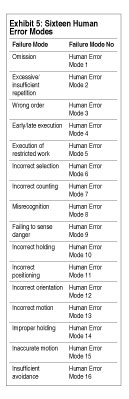
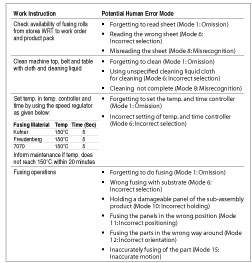
- Another important element in control method is identification and elimination of Human Work Error Mode. Various Human Error Modes are classified in 16 categories as shown in Exhibit 5. Standards operating procedure for continuous fusing operation (Exhibit 6) is demonstrated as example for developing these controls. For each of the process steps as indicated in SOP, the potential Human Work Error Mode is identified (refer Exhibit 7). The last step encompasses developing controls for preventing occurrence of identified Human Error Mode. Typically these controls are like checklists, flip boards, etc.
Warning Method: The warning method of implementing Poka-Yoke, signals the occurrence of a deviation or trend of deviations through an escalating series of buzzers, lights or other warning devices. However, unlike the control method, the warning method does not shut down the process on every occurrence. This method is used when a bandwidth of acceptance exists, for a process. For example drop in steam pressure in ducts, drop in suction pressure, DHU level at sewing section, etc. Exhibit 4 demonstrates the traffic light system indicating the current DHU level. Traffic light indicates the DHU level with red, yellow and green colours. Occurrence of red light calls for halting the production line until the situation is addressed.
Detection-based Poka-Yoke
Shop floor experiences have shown that detection- based Poka-Yoke can be implemented in three ways in apparel industry:
Contact Method: This method detects any deviation in shape, dimensional characteristics through mechanisms that are kept in direct contact with the part. A subset of this category is the non-contact method, which performs the same function through devices such as photoelectric cells. A contact type helps by physically guiding the manufactured produce with little or no human intervention to produce goods that conforms the requirements. Attachments and work aids in sewing machine are good example of this.

Fixed Value Method: This method is used in operations, in which a set of steps is sequentially performed. The fixed value method employs automatic counters or optical devices and controls the number of moves, rate and length of movement as well as other critical operating parameters. Typically these are programmable systems which work as per values punched in microprocessors.
Shopfloor trials have demonstrated improvement in product quality through use of machines working on similar principles. Examples are programmable profile stitching machines that eliminate human intervention in sewing operation (refer Exhibit 8).
Motion Step Method: This method ensures that a process or the operator does not mistakenly perform a step that is not part of the normal process. Simple example of this is colour coding of storage bins, oil containers, components, etc. to prevent using mixed or incorrect component. Colour coding of bins holding hang tags, labels in finishing section or at stores can help in improving visual controls (refer Exhibit 9).
Other examples of Motion Step type are fully automatic robotics systems that work as complete work stations. These work stations carry out material handling, sewing, and disposal functions thereby eliminating any chances of human errors resulting from handling, placement, fatigue etc. (refer Exhibit 10).