The fair featured a few veterans who have uncompromisingly pursued opportunities for innovation and improvement. StitchWorld takes a look at what these companies had new to offer…
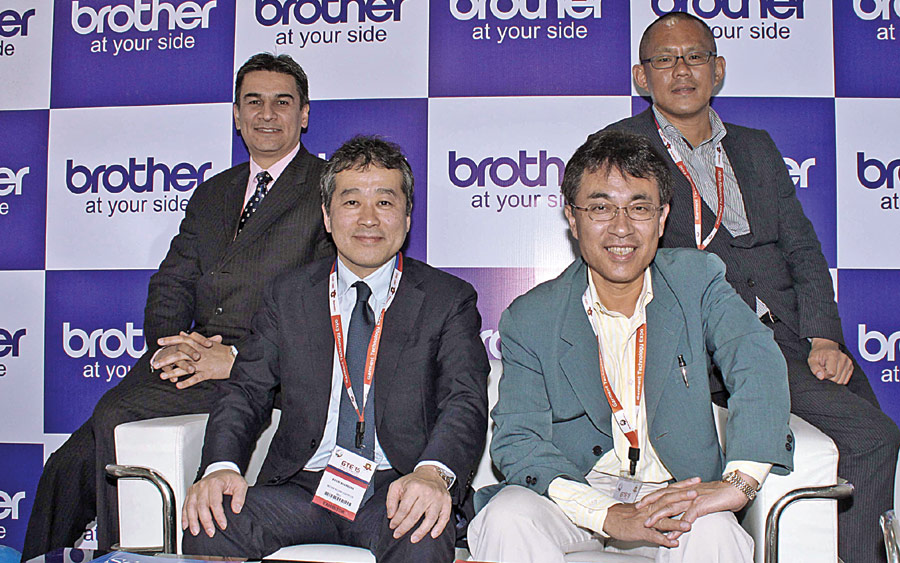
In this tough competitive environment, when most of the manufacturers are coming up with similar technologies, companies need to constantly update their product portfolios to stay in the business. Staying ahead of the curve Brother, a Japanese sewing technology provider, executed the same strategy and launched its single needle lockstitch machine with electronic digital feeding system at the fair.
At GTE 2015, where the machine was showcased for the first time in India, the special features of S-7300A – a single needle direct-drive lockstitch machine – were revealed. “The technology used in this machine is first of its kind. Most of the companies provide mechanical feed systems; for the first time an electronic digital feeding system has been used for a single needle machine. This means the feeding will be more accurate and easy to control. Multiple feed principles are possible in this machine, which is a very new concept. Besides this, the thread left-over is also reduced to 3 mm from 6 to 7 mm, which is offered by other machineries,” informs Akshay Sharma, CEO, Magnum Resources. “Owing to such short remaining thread lengths, this machine presents an opportunity to dispense thread trimming operators on the finishing floor and save Rs. 125,000 (US $ 2008) for every 100 sewing machines annually,” elaborates Randeep Sahani, General Manager, Brother International India. Further, with this machine one can get stitch variations within the same burst. For instance, for 50 stitches the stitch length could be 4 mm, and then for the next 10 stitches it could be 3 mm because of digital programming. So the final product which comes out is a niche product with exquisite technical construction and detailing.
Brother has put a pulse motor in addition to a servo motor in the machine, all in-built. There is an LCD colour panel within the machine, which is completely programmable like any smart phone. There is also a USB port to download and feed any new data, as and when required. Impressed by the features of the machine, one of the leading exporters of India booked 250 machines at the GTE fair itself. “Visiting buyers and buying houses staff also appreciated the consistent seam quality by this model, which they say has always been a bottleneck,” shares Randeep. Now to take the machine to the next level, Brother will be offering the machines to the top players of the industry on a trial basis, after which they would record the feedback received from the industry giants and use it to reach out to the other market players.
1) Morgan Tecnica gearing up for stickering automation
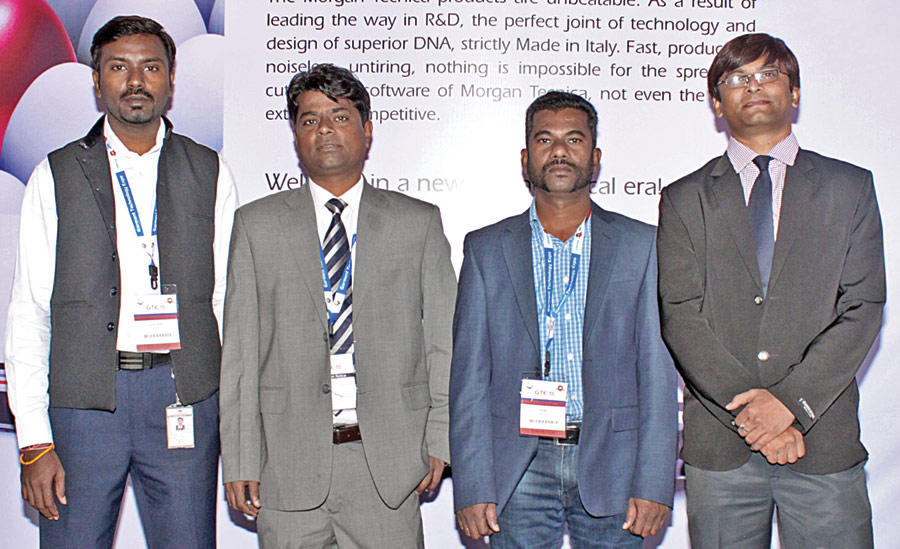
Known for providing pragmatic cutting room solutions, Morgan Tecnica, an Italian automated cutting room solutions provider, has successfully made inroads to the Indian apparel manufacturing sector with 170 spreader installations and 47 cutter installations across the country. Representing the company at the fair, Prakhar, Country Manager, India and Bangladesh, GA Morgan Dynamics, is optimistic of continuing the success run. “Our solutions are present at factories throughout the spectrum of the industry, be it small scale or large volume manufacturers.” Morgan’s clientele in India includes names like Page Industries, Kittex, Raymond, Bombay Rayon, Shahi Exports, Madame and Sportking.
Prakhar explains that the industry is adeptly recognizing the savings that an automated cutting room presents in the form of labour cost and fabric cost. “Our one automated cutter can feed three spreaders, and our solutions have proven results both in knits as well as woven fabrics, irrespective of the scale of the factory,” he adds.
Exhibited at the fair were live demonstrations on Cad MD 900, the company’s CAD solution and COP (Cut Order Plan). Also exhibited at the booth was 100-200 Leonardo, an ultra-wide ink jet plotter. The company is also gearing up for the release of a pathbreaking automated cutting machine, called Stampy, by mid-2015. Stampy is capable of stickering each cut panel after a lay has been cut. The company is looking at registering 15 per cent growth.
2) Bullmer showcases Procut D 8002 automatic cutter (Agent: Mehala )
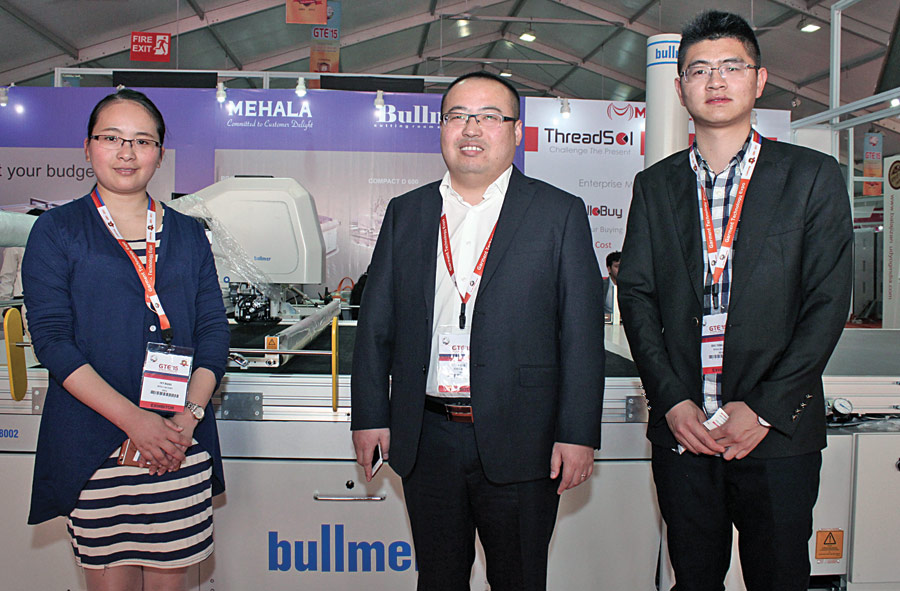
With its origins dating back to 1933, bullmer has successfully managed to maintain its niche in cutting room solutions for the apparel, automobile, aerospace, composite materials and leather segments. At the fair, the German cutting room specialist displayed Procut D 8002 automatic cutter. The high-ply cutter from bullmer is suitable for apparels, automotive upholstery, toys and luggage cutting applications. The maximum cutting height of the high-ply cutter is 80 mm and the cutting head has a maximum speed of 7200 RPM, while the maximum cutting speed realized by the cutter is of 100 metres per minute. The patented lubrication system is another advantage of the cutter, which not only reduces the need of lubricating the cutting head daily, but also extends the service life of the machine. The cutter comes with a cutting window length of approximately 1800/2500 mm and a sorting conveyor with clearing zone of approximately 1850/2300 mm. In the long version, the cutting beam is equipped with two-sided guidance-roll and spur gearing via angular toothed racks to guarantee an axis-conformed alignment during operation.
3) Krishna Lamicoat showcases innovative paper solutions
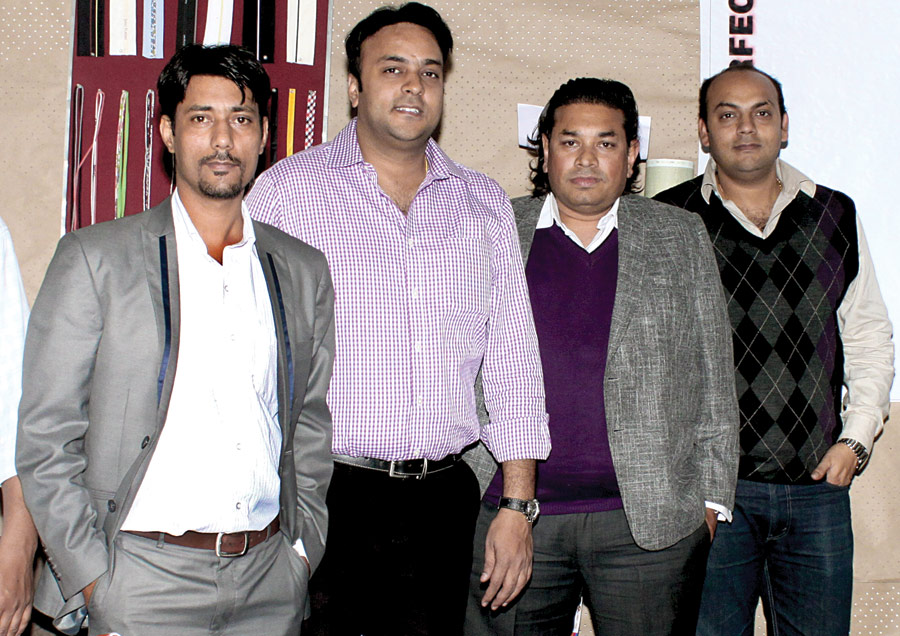
Reinventing is the mantra for Krishna Lamicoat, an indigenous specialty papers and films manufacturer. “Our focus on innovation has ensured that our products actually reduce the operating costs of factories,” says Ashok Chhajer, Director, Krishna Lamicoat. Recently, the company successfully wrestled erroneous pricing mechanisms of companies selling similar products with intensive training and communication sessions on the cutting floor with its customers. Exporting to 15 countries, the company has been at the forefront of providing to the paper needs of the cutting room with novel solutions like the heat-sealed paper and low GSM high-strength paper. “We are the second company in the world to be developing and manufacturing heat-sealed papers,” Ashok claims.
Heat-sealed papers allow the manufacturers to fix the marker at the top layer of the lay by simply ironing it. The paper can be peeled off once the pieces have been cut without the risk of adhesive marks being left behind. The company is aiming for a 15% growth in Indian market and is projecting 30% growth for the international market.
4) Cheran exhibits roll to roll sublimation transfer machines

Cheran Machines, an ISO 9001:2000 certified company, is a manufacturer and exporter of high performance textile and garment printing machines. Founded in 1996, this Coimbatore based manufacturer caters to the industry needs of Sri Lanka, Egypt, Vietnam, Bangladesh, Indonesia, Thailand, Madagascar, Dubai, Nepal and the Gulf regions.
“People still prefer to print on fabrics than garments; also polyester fabrics are very much in demand these days and sublimation prints cost the least on polyester fabrics. Moreover, the feel of sublimation prints is the best on these fabrics, so sublimation prints are more in demand as compared to the other prints,” explains JN Arora from Cheran. Sublimation prints are mostly applicable on sportswear, which are in great demand in both export and domestic market. These sportswear garments were earlier made from cotton, but now are only prepared from breathable sweat absorbing single-jersey polyester fabrics, thus increasing the demand for sublimation prints further.
Exhibiting the roll to roll sublimation transfer machine at GTE, Cheran claims full fabric utilization and minimal wastage with these machines and colour uniformity on all pieces printed. The maximum speed at which these machines operate is 2.5 metres per minute but to get good transfers, operating even at one metre per minute also serves useful. In the current year, there are possibilities that the existing buyers would expand further bringing in more business for both, Cheran Machines as well as the rapidly growing sublimation printing.
5) K P Exim highlights its effective Cixing and Steiger technologies
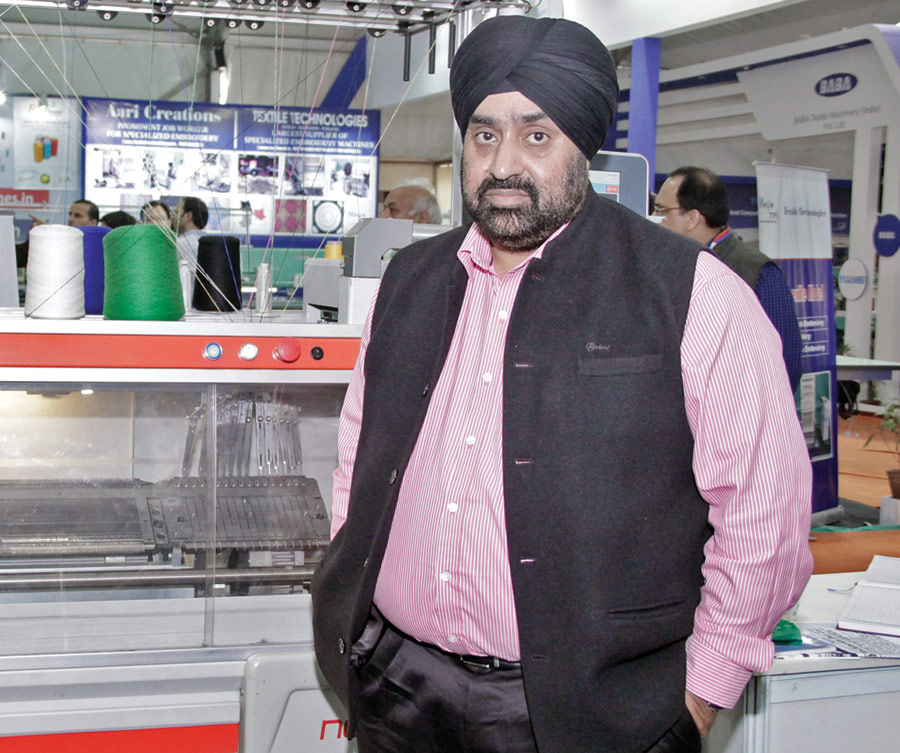
When Chinese technology providers entered the Indian market a few years ago, offering ‘cheaper options’, most of the users were unable to identify the goods those from the ordinary ones, giving booming business to all of them. However, within 3-4 years of installation of these machines, companies have been able to identify the most effective solution providers. One out of them is the Chinese knitting technology provider Cixing. Introduced in India by K P Exim, a Ludhiana based importer and supplier of garment technology, Cixing’s success in the domestic market can be gauged by both quality of its products and its business strategies. After 4 years of business in India, Cixing took over the Swiss knitting technology provider Steiger and later another Italian technology provider, which specializes in robotics. Cixing has now incorporated this robotic segment into the garment industry as well, for complete automation of the hosiery industry.
At the GTE fair recently, GP Singh from KP Exim shared insights on their effective knitting technologies. “Steiger technology is very different and can’t be compared to any other German or Japanese brand in the market. With Steiger, numerous designs can be created and the age-old problem of open Intarsia can also be removed,” informs Singh. Steiger’s feeders are independent of the carriage; each feeder has its own motor which is controlled by a controller which helps all the feeders move automatically. In addition to sweaters and cardigans, K P Exim also offers a whole range of flat knitting machines for home furnishing and car seat covers. It also provides efficient after-sales service with its 28 local technicians in Ludhiana and two technical engineers in Delhi. Its clientele includes Boutique International from Gurgaon and Vinay Knits P. Ltd., K L J and Sportsking from Ludhiana.
With the demand for sweaters increasing in the domestic and export market, the company is planning to set up an office in Surat as Gujarat has huge demand for tubular knitting machines for manufacturing leggings.
6) Lectra highlights the need for integrated solutions approach
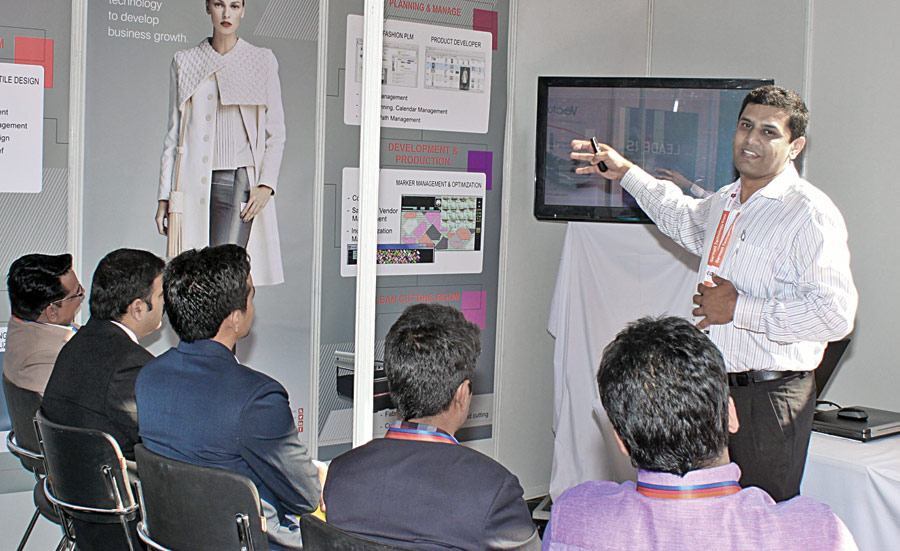
Recently Lectra bolstered its premium positioning, increased market presence and leadership positioning in India as the company’s strategy is not to simply sell software and cutters but to see how the company can effectively cater to their customer’s business needs. “Lectra’s approach is solutions and service-oriented as companies don’t ask for spreaders or cutters alone, but ways to save more fabric, produce more, optimize operational expenses and increasing equipment efficiency. For that, we show our clients the outcome of all processes supported by real time data which helps customers judge their decision before investing in our technology solutions,” informs Nagesh BT, Director, Lectra India.
Like other developing countries, while Indian companies are upgrading software and hardware technologies, the technical know-how to deploy these solutions effectively and reap full benefit of their investment remains rare. To cater to this need, Lectra offers continuous trainings and consultative approach to customers and has also kept educational initiatives as one of the key thrust areas for skill development to train future professionals. Carrying the same thought forward, Lectra organized an event at its booth to apprise the industry and education institutions of the company’s vision of ‘Technology Education 2015 and Beyond’.
Lectra has increased its portfolio to include a complete solution and consultative approach. “This growth has been possible not only because of exceptional services and continuous support but also because of demonstrating that the business needs of our customers have been met or exceeded. We have strengthened our core group of people who bring value to our customers and positioned our field professionals, ably supported by the customer care centre team, close to our customer base in Bangalore,” concludes Nagesh.