Fabric never lies. Long before silhouettes change or retail trends become visible on shelves, shifts in fabric sourcing often reveal where the apparel industry is actually heading.
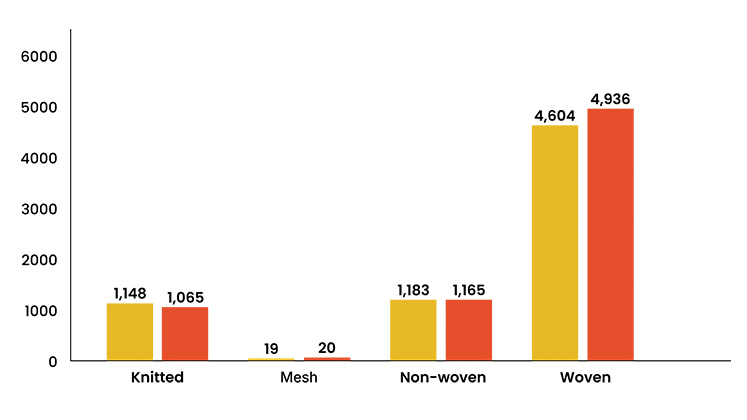
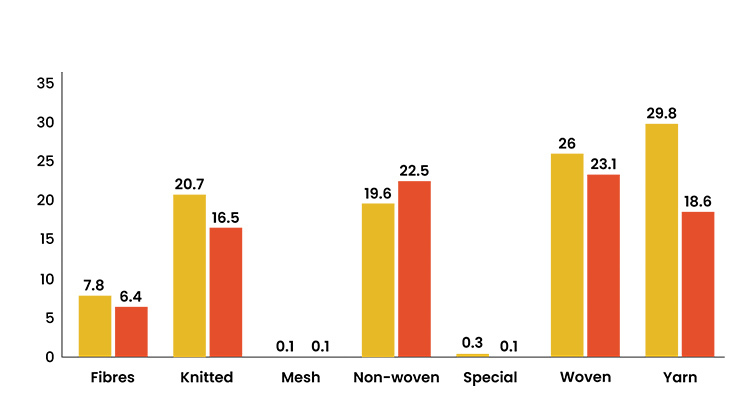
At a time when India’s textile exports declined from around US $14.40 billion in FY24 to US $13.71 billion in FY25 amid softer global demand and cautious sourcing sentiment, woven fabric exports grew around 7% year-on-year (See Graph 1), rising from US $4.60 billion to nearly US $4.93 billion.
INDIA’S TEXTILE EXPORTS: SELECT CATEGORY-WISE BREAKDOWN
Much of this growth is being driven by innovation in fabric development. Faced with volatile raw material prices, shorter fashion cycles and demand for more value-added products, mills are moving beyond conventional cotton fabrics and investing in lightweight constructions, fibre blends, performance finishes and sustainable materials. Buyers are also prioritising versatility, with fabrics traditionally associated with women’s wear now finding applications across both men’s and women’s apparel categories.
Moisture management, wrinkle resistance, softness, stretch recovery, and breathable constructions are increasingly becoming standard expectations rather than niche value additions.
New Demand Trends in Woven Fabric Categories
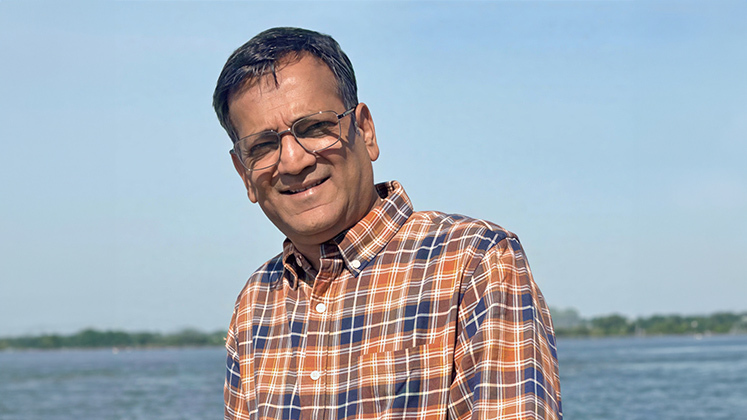
According to Dhaval Desai, MD, Desai Textiles, steep yarn prices have accelerated the industry’s shift towards lighter constructions and more efficient fabric engineering.
“With yarn prices at elevated levels, high-GSM fabrics have become commercially challenging in the current environment. The market is clearly moving towards lighter constructions that deliver value without compromising on performance. Blends incorporating Lyocell (Excel/Tencel) are gaining acceptance, as they strike the right balance between cost, comfort, and premium appeal,” said Desai.
Based in Ichalkaranji, one of India’s largest cotton greige fabric clusters, Desai Textiles manufactures a wide range of fabrics for shirting, bottoms, denim, workwear, athleisure and fashionwear. “In woven fabrics, we produce everything from basic weaves such as plain, twill and satin to value-added constructions like dobbies and jacquards,” said Desai, adding that “the growing adoption of shuttleless weaving technology has strengthened its position in woven apparel fabrics, particularly shirting.”
Similarly, Arknine Technologies, a B2B platform for fancy imported fabrics, is seeing growing demand across several woven fabric categories, particularly shirting fabrics made from cotton, polycotton and linen blends, bottom weights such as twills, gabardines and stretch chinos, lightweight comfort-stretch denim, durable poly-cotton workwear fabrics, and fashion fabrics developed using viscose, modal blends and textured weaves.

“Buyers are increasingly moving from pure cotton to cotton-polyester and cotton-viscose blends, while the use of elastane is rising as comfort becomes a key purchase driver. Customers are also becoming more price-sensitive, particularly in the mid-market segment,” said Gaurav Babel, Marketing and Business Development Head, Arknine Technologies Ltd.
He added that lighter GSM fabrics are also gaining preference as brands look to reduce costs, alongside a shift towards reactive-dyed and piece-dyed fabrics, which offer faster turnaround times than traditional yarn-dyed constructions.
The shift towards lighter and more comfort-driven fabrics is also visible across the ethnicwear and fashion fabric segment.

“We’re seeing strong movement in lightweight cottons and cotton blends, especially breathable, easy-to-wear fabrics that work well for kurta, kurti, and summer-driven categories. Viscose blends and soft-flowy constructions are also performing well in tops and fashion fabrics. On the construction side, structured yet lightweight weaves like fine dobby, subtle textures, and mediumweight plains are working because they balance design with wearability,” said Rishabh Jain, Creative Director, Monica Fab Creation, Ahmedabad, specialising in premium cotton, rayon, and fashion fabrics.
Sustainability Gains Momentum in Woven Fabrics

Beyond fabric construction, mills are also rethinking yarn choices. Jayesh Patel, Director, Omax Cotspin, highlighted, “We are focusing on new developments using recycled yarns and finer-count OE yarns to help reduce costs, although adoption depends on customer approvals.”
Based in Rajsitapur, Gujarat, Omax Cotspin manufactures hosiery and weaving yarns ranging from 16s to 50s counts. In the woven fabric segment, the company primarily serves the bottomweight, denim and workwear markets, and is currently developing lightweight cotton fabrics, heavy twills and blended constructions.
In the synthetic segment, Ashish Borda, COO, Borda Fabrics, a Surat-based manufacturer of synthetic and blended woven fabrics, highlighted that some of the strongest demand is coming from recycled polyester crepes and georgettes, reflecting brands’ growing focus on sustainable fashion materials.
“Recycled polyester crepes and georgettes remain among our strongestperforming categories as brands increasingly seek sustainable fabrics that can be sourced domestically and at scale. Poly-viscose crepes are also witnessing healthy demand in women’s wear, as they offer the right balance of affordability, wrinkle resistance, breathability and fluid drape. At the same time, highdensity nylon ripstop fabrics continue to find favour in workwear and other performance-driven applications, where durability, lightweight construction and technical performance are critical requirements,” explained Borda.
Echoing similar trends, Sudeep Galundia, MD, Galundia Textiles, a manufacturer and exporter of polyester, viscose and wool-blended fabrics and garments, said, “We are increasing the use of recycled polyester blends. This shift is driven by both the need to manage raw material costs and the growing demand for sustainable product lines from retailers. Heavy twills and stretch-based performance blends for workwear are also performing well.”

Natural-fibre blends are also witnessing growing interest. Hardik Jain, Director, Foralo Apparels, said the company is seeing demand across woven shirting and bottomweight fabrics developed using cotton-linen, lyocell-linen, viscoselinen, bamboo-linen and other blended constructions.
“We have seen increasing demand from domestic brands, driven in part by the popularity of linen collections offered by brands such as Zara, H&M and Uniqlo. We are increasing our focus on sustainable fibres such as Micromodal, Tencel, Linen and Hemp,” said Jain.
The Bhilwara-based company is currently focusing on woven fabric constructions such as 100% cotton slubs, cotton-linen blends, lyocell fabrics, lyocell-linen blends, viscose-linen blends and bamboo-linen blends. Linen content typically ranges from 10% to 50%, while fabric weights span between 135 GSM and 300 GSM, catering to both shirting and bottomweight applications.

Likewise, Anupam D Arya, Director, Fabriclore, a Jaipur-based B2B and B2C digital platform specialising in curated and sustainable textile, mentioned, “We are seeing increased adoption of linen–cotton, linen–viscose, filament blends, as well as branded fibers such as Liva, Lenzing, and Bemberg, often combined with cotton or viscose bases.”
He added, “One clear trend, however, is pricing evolution. Fabrics in the sub- ₹150 per metre range are seeing strong demand, up from ₹70-100 just a couple of years ago. This indicates a steady, if gradual, premiumisation of the market.”
According to Sagar Baheti, Partner, Acc Clothing LLP, Bengaluru, “The market is responding strongly to finercount fabrics, classics such as oxfords, chambrays and twills, natural and seminatural fibres like linen and lyocell, and multi-blend fabrics that offer a balance of aesthetics, performance and cost. One key shift we are observing is that Indian consumers are becoming increasingly aware of GSM and fabric hand feel. The demand is for fabrics that are neither too heavy nor too light, while still offering a premium feel,” said Baheti.
ACC Clothing’s core strength in woven fabrics lies in shirting and fashion fabrics. Recently, they have also expanded into bottom weight fabrics.
At the same time, several traditional woven categories are clearly losing momentum.
Heavy twills, coarse-count fabrics, rigid non-stretch constructions, heavy 100% cotton fabrics, stiff georgettes, plain commodity polyester fabrics, and highGSM bottomweights are witnessing slower movement. Manufacturers say commodity categories without differentiation in finish, texture, sustainability, or performance are facing relentless pricing pressure and shrinking margins.
“We have intentionally scaled back production of low-margin, plain polyester taffeta. We are ceding that ground to cheaper importers and focusing our looms on textured, recycled, or high-tenacity constructions,” said Borda.
Likewise, Baheti pointed out that, “Coarser count fabrics have seen fluctuating demand cycles, moving rapidly between high demand and near obsolescence. As a result, our sourcing strategy has evolved to focus less on chasing short-term trends and more on building a stable, long-term product mix.”
Managing Lead Times and Smaller MOQs
The focus is also on building a competitive edge by catering to smaller order quantities.
“A women’s wear brand today wants 3,000 meters of Recycled Crepe in ‘Mauve Mist’ and 2,000 meters in ‘Cyber Lime.’ Our willingness to run short-lot synthetic dyeing with precise lab-tobulk colour matching is our competitive moat. We trade the efficiency of a 50,000-meter single-colour run for the margin premium of servicing 10 different small-batch brands,” stressed Borda.
Managing lead times has also become a key priority for Galundia Textiles.
“We are responding by booking loom capacity in advance and consolidating our supplier base to prioritise partners who can guarantee faster turnarounds. The trade-off is often a higher per-metre cost, but it allows us to react quickly to fashion trends without holding large volumes of deadstock,” said Galundia.
Can India’s Fabric Industry Wean Itself Off China?
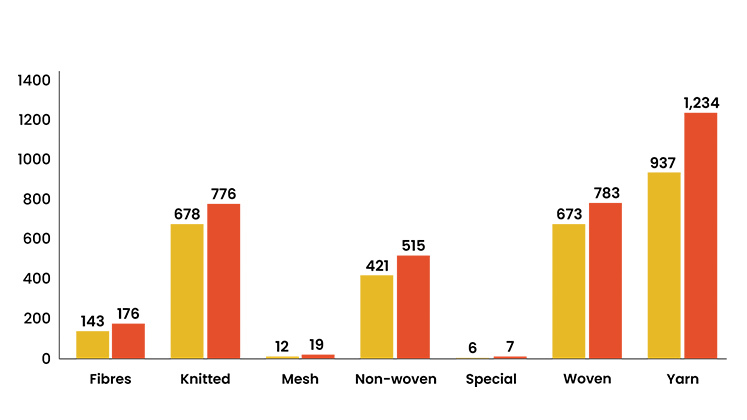
Despite India’s large textile manufacturing base, imports still play an important role in the woven fabric supply chain, especially for specialised constructions, advanced finishes, performance fabrics and costcompetitive options. China remains India’s main source of woven fabric imports (See Graph 2), particularly in synthetic and value-added categories. However, Vietnam is emerging as an important alternative sourcing hub (See Graph 3).
INDIA’S IMPORT OF TEXTILES FROM CHINA
INDIA’S IMPORT OF TEXTILES FROM VIETNAM
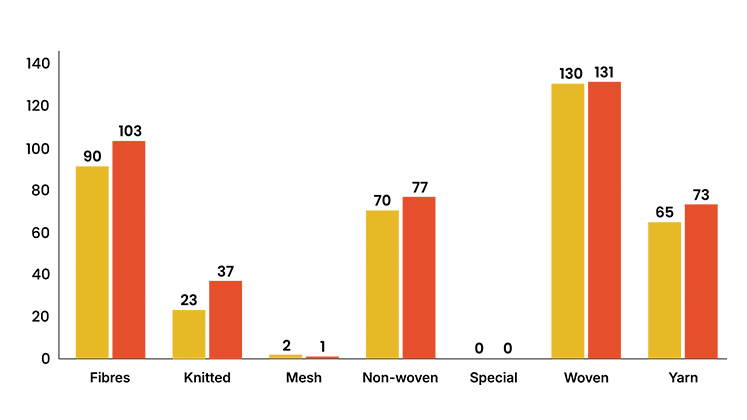
Industry players say Vietnam’s rise is not only due to its own textile capacity. In recent years, Chinese investments have moved into Vietnam as manufacturers diversified production bases amid geopolitical tensions, tariff issues and China-plus-one strategies. This has helped Vietnam build access to similar woven fabric supply chains and capabilities.
For Indian buyers, Vietnam is less a replacement for China and more a secondary sourcing option that helps reduce risk while still ensuring access to specialised woven fabrics.
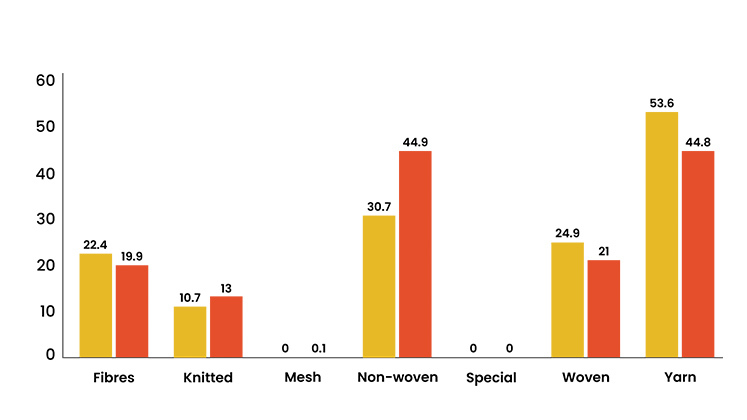
South Korea (See Graph 4) and Taiwan (See Graph 5) continue to play a limited but specialised role in India’s supply chain, catering to specific requirements in fabric construction, performance features and processing capabilities.
INDIA’S IMPORT OF TEXTILES FROM SOUTH KOREA
INDIA’S IMPORT OF TEXTILES FROM TAIWAN
To reduce reliance on imports, Indian woven fabric manufacturers are investing in MMFs, finishing technologies, technical woven fabrics and performance-oriented fabric developments. One such example is Vardhman Textiles, which has expanded its presence in man-made fibre (MMF) fabrics through its Vardhman Performance Fabrics (VPF) facility in Baddi. Fabrics now contribute nearly 35% of the company’s ₹9,587 crore revenue. According to Sagrika Vir, Executive Director, Vardhman Textiles, the company is increasingly focusing on outerwear and sportswear, segments that align with its woven fabric expertise and offer strong growth potential.
Arvind Ltd. too has strengthened its woven fabric portfolio through sustainability and performance-focused innovations in FY25.
The company commercialised COEX®, a patented flame-retardant biopolymer for cellulosic fabrics, and introduced QCOOL, a moisture-activated cooling finish. It also expanded its sustainable offerings through Fibre52, a lowtemperature cotton bleaching and dyeing technology.
Apart from established players, emerging companies are also experimenting with different fibre blends to improve fabric performance, manage costs, and reduce import dependence. Most of this shift is happening towards synthetic and blended fibres rather than cotton.
“The key pressure points today are imported nylon chip prices and the premium attached to recycled polyester filament yarn. We are also increasing the use of high-tenacity polyester as an alternative to nylon in select industrial applications, as it offers better UV resistance and a 15–20% cost advantage despite slightly lower abrasion resistance. In addition, we are developing 100% polyester woven bottomweight fabrics with mechanical stretch, reducing the need for spandex while lowering costs and improving recyclability,” said Borda.
India’s woven fabric industry is expected to grow further, supported by strong production clusters such as Surat, Ichalkaranji, Bhilwara, Bhiwandi, Solapur, Erode, Salem, and Ludhiana.
Surat alone produces around 60 million metres of fabric per day and is projected to reach 100–120 million metres per day over the next five years, supported by rising export demand and capacity expansion. Bhilwara’s textile sector, with an estimated ₹25,000 crore annual turnover, is growing at around 8–10% annually, backed by a strong base in synthetic and blended fabrics. Ichalkaranji continues to be one of the largest cotton greige fabric hubs in India, supported by a dense network of powerloom units supplying shirting and bottomweight fabrics. Alongside these hubs, other clusters also contribute significant volumes.
With FTAs being implemented with the US, UK and Europe, export demand for Indian woven fabrics is expected to increase further. At the same time, India’s domestic retail market is projected to rise from about US $120 billion to over US $200 billion by 2030. Together, these trends point to strong long-term growth for the industry.




 Bharat Tex Special Report 2026