If there were ever a vote on the textile industry’s toughest sustainability challenge, textile-totextile polyester recycling would probably top the list. Transforming discarded textiles back into high-quality new fibres at scale remains one of the industry’s hardest technological and commercial hurdles. That is why only a handful of companies globally are attempting it, and even fewer in India.
Yet, this is exactly the bet Filatex India, a leading polyester filament yarn manufacturer with over three decades of experience, is making. The company produces POY, FDY, DTY, ATY, PPY, narrow woven fabrics, and PET chips used across a wide range of applications including apparel, sportswear, home furnishings, upholstery, automotive textiles, and industrial products such as seat belts, zippers, and safety equipment. Through its wholly owned subsidiary Ecosis Limited, the company is trying to build what the textile industry has long chased but rarely achieved at scale: a true closed-loop recycling system where polyester waste can be turned back into virgin-grade material repeatedly. In the long run, this could fundamentally reshape the textile industry’s relationship with waste and raw materials.
To make this possible, Filatex has developed a three-step recycling process. First, depolymerisation breaks down complex polyester chains in textile waste into their basic chemical building blocks (monomers); next, purification removes dyes, additives, natural fibres like cotton / viscose and other contaminants accumulated during the fabric’s lifecycle; finally, molecular regeneration rebuilds these monomers into high-quality polyester that is chemically akin to virgin material.
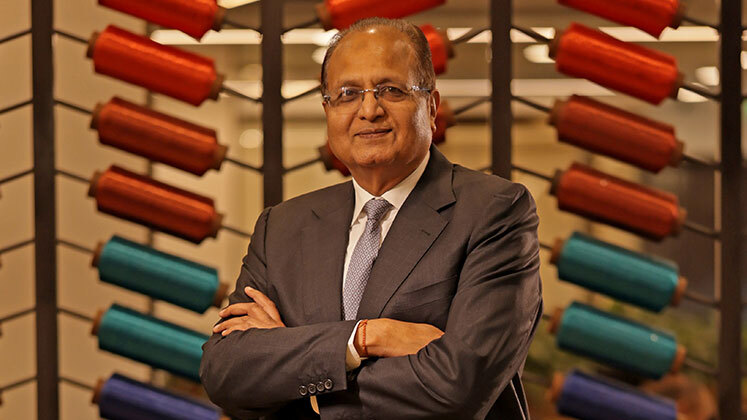
“We have tested this by recycling the same material, converting it back into product and breaking it down again, repeating the process several times. This works for both pre- and post-consumer waste,” said Madhu Sudhan Bhageria, Chairman & Managing Director, Filatex India.
Building on these results, the company is now moving toward commercial-scale production. Through Ecosis Limited, Filatex is setting up a new recycling plant in Dahej, Gujarat. The ₹300 crore (US $31.52 million) project is expected to commence operations by late 2026 and is projected to process 29,000 tonnes of textile waste annually.
The scale of the company also gives weight to the ambition. Filatex reported revenue of ₹4,160 crore (US $438 million) in FY’26. The company manufactures polyester and polypropylene multifilament yarns and polyester chips at facilities in Dadra & Nagar Haveli and Dahej, Gujarat, with production reaching 3,91,303 metric tons in FY’26.
Apparel Online spoke with Madhu Sudhan Bhageria to understand why the company, which began production of monofilament yarns in 1994, decided to enter textile-to-textile recycling, how it plans to make the model commercially viable, the response from brands, the challenge of waste segregation, and more. Edited excerpts.
AO: What made you look at textile-to-textile recycling and think, “okay, this is worth trying”?
The idea of textile-to-textile recycling came quite naturally. One day, during a discussion with our technical team over dinner, we were talking about another company working in this field. I remember asking, “If they can do it, why can’t we?”
That is how we started exploring the idea. We began with small lab trials, and once results looked promising, we set up a pilot unit to process around 50 kg of waste per day with an investment of about ₹40–50 lakh.
As we moved ahead, we also experimented with fabric waste recycling, which was much more complex due to blended fibres, dyes, and impurities.
Around 2022, we realised textile waste itself was the much bigger problem the industry needed to solve. It also became clear that the industry would eventually move towards textile-to-textile recycling. Europe was already discussing EPR (Extended Producer Responsibility) regulations, which would require brands to use more recycled materials while also making PET bottle manufacturers and companies using these bottles responsible for recycling bottle waste. As more PET bottles start getting recycled back into bottles, their availability for yarn production will reduce significantly. That means the industry will eventually have to recycle textile waste itself.
| “Initially, we thought the opportunity would mainly be in apparel. But as discussions progressed, we realised our solution can be used across many more categories. There is significant polyester usage in furniture, and footwear segment. |
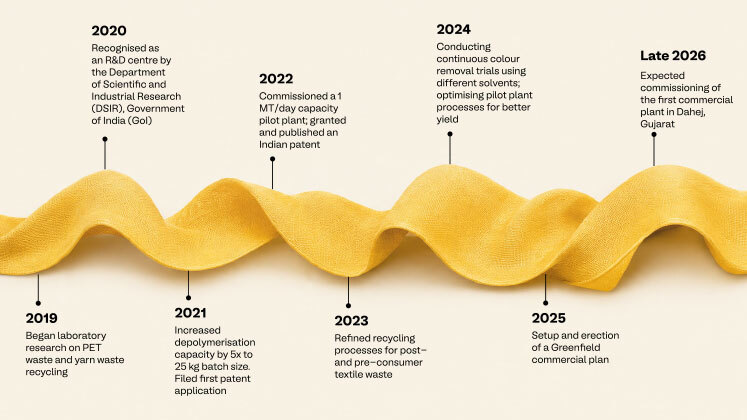
That is when we shifted our focus more seriously towards textile-to-textile recycling and commissioned a 1 tonneper-day pilot plant. Over the next few years, we kept refining the process for both pre-consumer and post-consumer textile waste, especially around colour removal, yield improvement, and process optimisation.
Globally, only a few companies are working on textile-to-textile recycling. One major advantage for us was our background in polyester manufacturing. Many companies in this space started as recycling startups, whereas we already had deep experience in polyester polymerisation, manufacturing, and process engineering. That helped us move faster and develop the technology at a much quicker pace.
The pilot facility has now been operating for the past three years, during which we continuously improved and stabilised the process. We also filed patents for our “molecular regeneration process” for polyester recycling, and these have already been granted in India and US, with EU being in the final stages of approval.
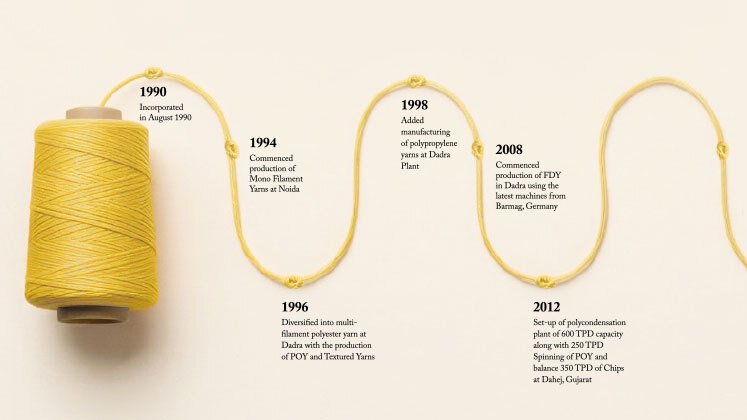
FILATEX INDIA’S GROWTH STORY
AO: Textile-to-textile recycling needs strong support from brands and retailers to scale. What kind of interest and collaboration are you currently seeing from the market?
We are definitely seeing growing interest from brands, particularly global players that already have sustainability and recycled content targets in place.
Right now, we are in active discussions and running trials with multiple brands and retailers in India, EU and USA. We cannot disclose all the names yet, but Decathlon is one example where we already have a MoU in place.
Because global supply is still very limited, many brands are already trying to secure long-term sourcing partnerships. In my view, demand could reach 3 to 5 million tonnes over the next few years, while still remaining only a small share of overall polyester consumption.
Initially, we thought the opportunity would mainly be in apparel. But as discussions progressed, we realised our solution can be used across many more categories. There is significant polyester usage in furniture, and footwear segment and are conducting trials with several companies in this space.
We are also in discussions with yarn spinners, carpet manufacturers, and accessory suppliers such as drawcord and zipper manufacturers, since these products also use polyester extensively. We are even exploring applications such as automotive textiles and car seats
These discussions are not limited to India either. We are working with companies in Vietnam and Europe as well. A large part of this demand is currently coming from international markets. Europe, in particular, is far more sustainability focused, and brands there are actively looking for solutions like this. India is still at an earlier stage because most customers here are not yet willing to pay a premium for sustainable materials.
In many ways, these trends usually move from West to East. Adoption starts with global brands and international markets, and then gradually expands as awareness and availability improve.
AO: Brands often talk about long-term partnerships but remain quite price-sensitive. How are you making the model commercially viable at scale?
Right now, textile-to-textile recycled polyester is still a niche product and, over the next five years, I think it will largely remain a premium segment. But in the long run, this business cannot rely only on premium pricing. For it to scale meaningfully, costs will eventually have to come much closer to conventional polyester
That is why scale becomes extremely important. As production improves and capacities increase, costs can come down significantly. For me, this first commercial plant in Dahej is like a blueprint. Once it stabilises and runs successfully, future expansion becomes much easier and more cost efficient.
At the same time, we are not looking at this as just selling yarn or chips. We are trying to provide a complete solution to brands. For example, we can help brands recycle their own textile waste and convert it back into usable raw material. That creates a more circular system and also reduces supply chain inefficiencies.
We are also building digital traceability into the production process. Our goal is to create end-to-end traceability, from waste collection to the finished garment. Eventually, a customer should be able to scan a QR code and see the complete journey of the product.
One challenge today is verification. There is still no clear industry-wide system to fully verify textile-to-textile recycled content. In some mechanically recycled products, certain parameters like IPA (Isophthalic Acid) levels can help identify recycled material. But in textile-to-textile recycling, there is still a gap between sustainability claims and physical verification
We are actively working on this as well. One approach we are exploring is embedding identifiers or markers into the material itself, so the yarn can be physically scanned and verified. The idea is to create a system where authenticity can actually be checked, not just claimed.
We are developing these systems closely with brands and retail partners because the model also has to work commercially for them. Their feedback is important in deciding what is practical, scalable, and useful at market level.
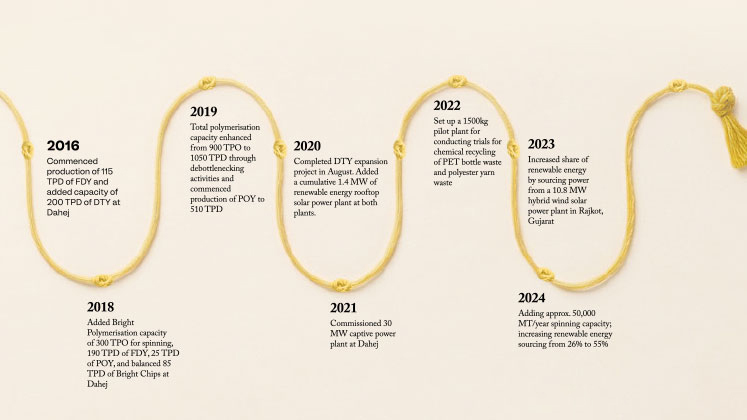
ECOSIS’ JOURNEY
AO: Building a scalable recycling process must have been a herculean task. What were some of the biggest technical and operational hurdles you faced?
One of the biggest challenges was achieving consistent quality at a viable cost. Textile waste is highly inconsistent. Every batch is different. Some fabrics may contain 20% cotton, some 10%, while others may have different blended fibres, dyes, and impurities.
Removing colours and impurities was especially difficult because they directly affect the quality of the final output. We had to continuously refine the process to ensure the recycled material remained consistent and reliable.
Another major challenge was building the process at an industrial scale. The machinery required is highly specialised, and in many cases there was no existing reference point because very few companies globally have done this at scale.
At every stage, we had to figure out what kind of equipment would actually work. Standard machines may already exist in the market, but the way they need to operate for our process is very different. Even decisions around compressors, filtration systems, mixers, and grinders required extensive experimentation.
For example, in the case of removing color and contaminants, our research spanned several years to figure out the correct filtration process, equipment and filtrate material. We then had to run several simulations and trials to optimize this process for high degree of variability in our feedstock.
A large part of the work involved collaborating closely with equipment vendors, running repeated trials, and gradually scaling up from small tests to larger setups. We could not rely only on theoretical calculations. Every machine and every stage had to be validated through pilot trials before moving to commercial scale.
Scale-up itself was another major challenge. A process that works at oneton scale can behave very differently at 75 tons. That is why we always built buffers into the system and tested everything extensively before scaling up further.
We also had to ensure the plant could operate continuously because these are 24/7 operations. Even a short interruption can lead to significant losses. In continuous polymerisation, even a one-second power failure can disrupt the process, break threads, and downgrade material quality.
That is why process stability became extremely important. Some sections can operate in batches, but the final polymerisation stage runs continuously and cannot afford interruptions.
In many ways, we were building both the process and the equipment together.
AO: One of the biggest challenges in textile recycling is collecting and sorting waste efficiently. How are you approaching sourcing for both preand post-consumer waste?
The collection and sorting ecosystem is improving rapidly. Around Surat itself, there are already many aggregators who collect, sort, and segregate textile waste. We have been sourcing material from them for our trials, and based on what we have seen, the available quantity is significantly higher than our current requirement.
For our first commercial plant, we will require around 80 tonnes of textile waste per day. On an annual basis, that translates to roughly 29,000 tonnes of waste for the first commercial-scale facility alone.
We are also working with various local players who have strong experience in waste collection and segregation in India. They help collect and sort postconsumer textile waste for our recycling trials.
In Europe, the textile waste challenge is even larger because garment life cycles are much shorter. A large quantity of clothing eventually becomes unsuitable for reuse, and many companies are actively looking for recycling solutions for that waste. Our MOU with Waste Wear & Revti allows us to import post consumer waste from US & EU for the sole purpose of recycling and helping solve one of the biggest problems that Apparel brands are facing in the West.
We are also exploring sourcing opportunities in countries like Vietnam, where many brands are willing to share production waste as part of their sustainability goals.
Over time, more brands are moving towards models where products are made partly from their own production or post-consumer waste. Some companies, such as H&M, have already started take-back programmes to support this approach.

AO: Sustainability today goes beyond products to how companies design and run their factories. How is Filatex addressing this across its operations, including the Dahej plant?
Sustainability has always been built into how we run the business, not just the end product.
The Ecosis plant in Dahej is being developed as a Gold LEED-certified facility and follows a zero liquid discharge system, with green energy usage (roof top solar panels), biomass as our heating source and an aggressive plan to get to 100% renewable energy usage.
This philosophy is also guiding Filatex, and we are placing strong emphasis on cleaner energy. Around ₹30 crores is being invested in a hybrid renewable energy project with Torrent Power. In this structure, we will hold close to 26% equity and operate as a captive consumer. The project combines wind and solar, with 26 MW from each source, and is expected to generate around 115 million units annually. This will help reduce our carbon footprint and also improve cost efficiency, with estimated savings of about ₹25 crore per year.
We already have similar renewable energy arrangements in place, including about 10.8 MW from one partner and 12.5 MW of solar from another. With the Torrent project, our overall share of renewable sourcing will rise to about 55%, and we plan to complete this within this calendar year
Along with these green initiatives, we are highly focussed on driving efficiency and automation across our plants. We are utilizing excessive steam from our captive power setup and supplying it as process steam to nearby industries like pharmaceuticals and chemicals.
AO: Polyester still leads global fibre markets. What shifts are you seeing in its end-use landscape?
In most textile value chains today, polyester is present across nearly every category, from apparel to home textiles, largely through blended applications.
Today, polyester accounts for about 60 to 65% of the global fibre market, while cotton is around 24%. Most of the incremental growth in fibre demand over the last few years has also come from polyester. For instance, global fibre demand increased from about 125 million tonnes in 2023 to around 132 million tonnes in 2024, and almost 100% of that growth was driven by polyester.
The main reason is scalability. Cotton is constrained by land and water availability, so it cannot expand freely. Other fibres like wool and silk are naturally limited, while viscose and rayon remain relatively small and more expensive to scale sustainably. This makes polyester the most practical fibre for large-scale demand.
From an application point of view, polyester has expanded significantly because of its cost advantage and performance benefits. In many categories, it has replaced higher-cost fibres rather than being replaced itself. Sportswear is a clear example. Earlier it was largely cotton-based, but today most activewear uses polyester because of properties like moisture management, quick drying, and comfort.
There is also continuous innovation in polyester in terms of softness, durability, and functional features like odour control, which is improving overall wearability. At the same time, I believe India still has significant headroom in polyester. China is roughly 8 times larger than India in this space. China is at around 54 million tonnes, India is about 7 million tonnes, while the next largest markets are below 1 million tonne.
Interestingly, around the year 2000, India was almost at par with China, but we did not scale polyester aggressively and missed that growth cycle. Today, there is still an opportunity, but if policy support does not improve in the next 2 to 3 years, we risk missing the next phase as well, while countries like Vietnam and Bangladesh continue to move ahead.
AO: What comes next for Filatex India, and how do you plan to make a bigger impact on the industry?
We are currently in a structured expansion phase, with a total planned capex of around ₹690 crore.
A large part of this investment is already allocated,. Besides the ₹300 crore going into Ecosis, Filatex has a slew of other investments: ₹235 crore into filament yarn capacity enhancement, ₹85 crore into our steam monetisation project, and about ₹40 crore into automation. This includes robotics for material handling, automatic bobbin doffing, and automated packing systems to make operations more efficient and consistent.
At the same time, we are increasing spinning capacity at Dahej, including POY at 19,800 MTPA, FDY at 28,800 MTPA, and DTY at 14,400 MTPA. Demand for FDY is currently strong in the domestic market.
We will continue to expand based on market needs, but we are not rushing into large capacity jumps for Ecosis.
First, we want to fully stabilise and prove the model at scale. Once that is achieved, we will look at setting up one or two larger plants, potentially one in India and one outside India. At that stage, Ecosis will become a much more central part of our long-term growth strategy.





 Bharat Tex Special Report 2026