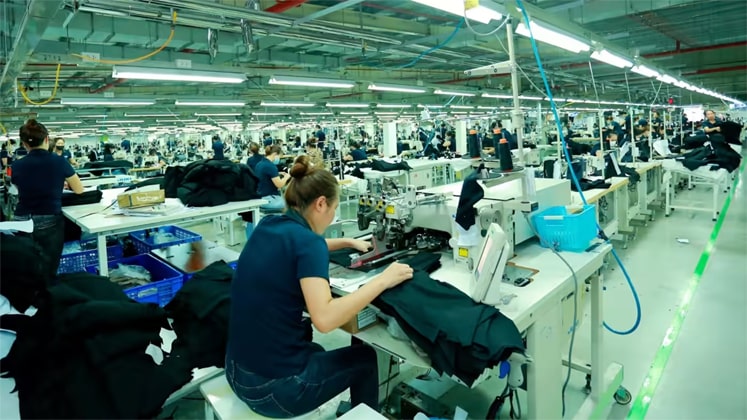
Japanese apparel manufacturers are shifting sea production from China to other South East countries to compensate for the rising cost of raw materials. Taking advantage of the reduction of customs duties on merchandise imports because of the Regional Comprehensive Economic Partnership (RCEP), major apparel companies such as Adastria, Aoyama Trading and suppliers of Uniqlo are moving some of their production bases.
The President of Aoyama Trading, Osamu Aoyama said, “Over the medium to long term, the ratio of production in China will likely decrease further.”
Matsuoka Corporation, a contract manufacturer for Uniqlo, further plans on decreasing the production in China from 50 per cent to 29 per cent and plans to increase the production in Bangladesh to 34 per cent from 28 per cent and in Vietnam to 28 per cent from 16 per cent by 2025.
Due to the increase in labour costs because of the rapid economic rise in the Chinese economy, the onset of the zero-COVID policy, which mandates an initial suppression phase and so on, companies are now looking to shift bases to other countries.
Through a comparative analysis of the data collected by the Japan External Trade Organisation, it has been found that the average monthly salary in Vietnam’s Ho Chi Minh City and that in Dhaka, Bangladesh are US $ 270 and US $ 120 respectively whereas the average monthly salary of a factory worker in Guangzhou, China, is about US $ 670.
The same data shows that China as a source for Japanese apparel has declined from 2 trillion yen in 2011 to 1.5 trillion yen in 2021, whereas the sourcing of Japan’s apparel in Vietnam has increased from 0.25 trillion yen in 2011 to 0.5 trillion yen in 2021.





 Bharat Tex Special Report 2026