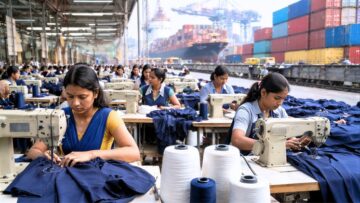
Economic development is a matter of pride for any country, more so if it happens to be a least developed country (LDC) that has a scope to graduate to the next level.
However, considering the implication of the coronavirus pandemic on Bangladesh, especially on its readymade garment sector, the principal driver of the economy, analysts and experts have called upon the Bangladesh Government to try and defer the LDC graduation process, as COVID-19 has already turned the economy upside down.
It may be mentioned here that on the back of consistent economic growth and development in the last few years, LDC graduation for Bangladesh is supposed to take effect from 2024. Bangladesh, though, may continue to receive duty-free benefits on exports to developed and developing countries for longer than expected, as the United Nations Centre for Development Policy (UNCDP) could delay the country’s assessment for graduation from an LDC by 3-5 years.
The UNCDP was scheduled to evaluate certain LDCs, including Bangladesh, for promotion to the developing country category in 2021. “However, the assessment could now be delayed by 3 to 5 years in consideration of the global economic losses caused by the ongoing coronavirus fallout,” underlined Mustafizur Rahman, a distinguished fellow of the Centre for Policy Dialogue (CPD), adding that the assessment could now be carried out in 2024. However, if this is not feasible for any reason, then the UNCDP may consider alternative measures, some of which have already been proposed by the LDCs.
One such alternative is that the UNCDP will conduct assessments in 2021 as initially planned and allow qualifying countries to complete their graduation as scheduled. The key difference, though, is that developing and developed countries will be asked to continue to provide zero-duty benefits for the newly graduated countries for additional 5 years.
“The UNCDP is considering both the options,” said Mustafizur, further adding that the global movement has been launched for the deferment of the LDC graduation process, and the World Trade Organisation (WTO) on behalf of LDCs raised the demand for extending the existing trade benefits for a certain period for the nations, which will achieve the developing country status.
In light of the above, experts have advised policymakers to engage in the ongoing lobbying for further extension of the existing trade benefits that Bangladesh now enjoys as a least developed country.
The suggestions recently came at a virtual dialogue on ‘International Trade in COVID Times: Impact and Way Forward for Bangladesh’, jointly organised by the Dhaka Chamber of Commerce and Industry (DCCI), the Metropolitan Chamber of Commerce and Industry – Dhaka (MCCI), Policy Exchange, Chittagong Stock Exchange (CSE), and Business Initiative Leading Development (BUILD).
Benefits of being an LDC
There are a lot of benefits that Bangladesh enjoys as an LDC. Some of which are 12 per cent preferential margin on its export to the European Union countries, which provides a substantial price advantage over other countries; relaxation (one stage transformation) in provision of rules of origin in exporting commodities to EU countries; receiving aid in absolute terms from the aid target of 0.15-0.20 per cent of donors’ GNI; assistance from LDC fund constituted under United Nations Framework on Climate Change (UNFCC) to mitigate the effect of climate change; Technology Transfer to the LDC under the article 66.2 of TRIPS (Trade Related Intellectual Property Rights), etc.
But the most important questions, which merit attention and deserve to be closely examined, relate to the possible impacts of graduation on the country’s flagship sector, the export-oriented readymade garments industry. What will LDC graduation mean for the future of the RMG sector in terms of its competitiveness and performance? How will the implications be felt at the enterprise level? In which ways, will LDC graduation impact as to how RMG entrepreneurs conduct their business and marketing? What initiatives will need to be undertaken towards technological upgrading, social compliance, labour standards, and rights compliance? In order to address the post-graduation challenges, all the above will need to be evaluated in depth in such a scenario.
Pitfalls of graduation
Post-LDC graduation, one of the major challenges for the exports would be that it would lose the duty-free market access to major markets, including the European Union, Canada, and Australia, where local products have to face duty ranging from 6.0 to 18 per cent, especially RMG, home textiles and footwear.
As per some estimates, the loss of preferential market access may result in total export reducing by 5.5 to 7.5 per cent.
It may be mentioned here that even if Bangladesh graduates from an LDC by 2024, it will get 3 more years as a grace period for preparation. Normally, the EU does not give trade benefits under the EBA after a country’s graduation. So, after 2027, Bangladesh will have to either be granted the GSP Plus or the extension of the current EBA to enjoy the zero-duty benefit to the EU, the destination for 64 per cent of Bangladesh’s annual garment shipment of US $ 34 billion.
However, considering EU’s stance towards labour rights status in the country, many feel getting GSP Plus will not be that easy for Bangladesh.
The Commerce Ministry, as such, has sent a letter to the EU in this direction requesting the continuance of EU’s generous Everything but Arms (EBA) scheme, meant for the LDCs.
The importance of European Union from Bangladesh’s perspective is anything but vital. It is not only the largest export destination for the country’s apparel offerings, but also the second largest source of FDI to Bangladesh. From 2008 to 2015, the EU imports from Bangladesh have almost become threefold. Riding high on the zero-duty benefit, Bangladesh’s exports to the EU have made significant progress over the years, which helped it to a great extent to become the second biggest apparel exporter globally, after China. According to data from Bangladesh’s Export Promotion Bureau (EPB), Bangladesh exported garment items worth US $ 21.13 billion to the EU in 2018-19 fiscal year – up from US $ 19.62 billion and US $ 17.75 billion in the previous 2 fiscal years.
Also to be considered in this direction is Vietnam, Bangladesh’s closest competitor in the realm of garment manufacturing and export.
“A huge paradigm shift is to be happening and it will be difficult for us. So, we need to translate comparative advantages into competitive edges immediately,” said Mustafizur.
The Vietnam angle!
The National Assembly of Vietnam officially approved the EU-Vietnam Free Trade Agreement (EVFTA) on 8 June, which is expected to be taken into effect as early as in August 2020. Once implemented, the EVFTA will eliminate nearly all tariffs (over 99 per cent) between the European Union and Vietnam. Experts say that the EVFTA is expected to give Vietnamese companies a host of opportunities to raise exports.
Rahman, thus, urged local suppliers to brace for the 12 per cent export duty they will face when shipping goods to the EU once the country completes its graduation. Vietnam has already signed a free trade agreement (FTA) with the EU, and if Vietnam enjoys such benefits while Bangladesh pays a 12 per cent duty for goods bound for the EU, then the country’s competitiveness will fall significantly, Rahman underlined. At the same time, he also suggested that in such a scenario, Bangladesh needs to sign a number of Comprehensive Economic Partnership Agreements (CEPA) with certain countries and regions for preferential trade benefits since FTAs alone do not cover all incentives (for example, FTAs only cover tax privileges while the CEPA covers all duty, investment and domestic market-related benefits).
China in the mix as well
The recent decision of the Chinese Government – to offer duty-and quota-free access to 8,256 export items from Bangladesh effective 1 July, which occupies almost 97 per cent of the country’s export items to the world’s second largest economy – has opened new avenues for Bangladesh, more so at a time when exports in the traditional strongholds took severe beatings on account of COVID-19.
It may be mentioned here that that there are more than 5,000 goods that enjoy the same benefit under the LDC coverage from China.
“Making most of the Chinese duty-free market access will be a game changer for exports,” said Dr. Abdur Razzaque, Director, Policy Research Institute of Bangladesh. He also added that currently 30 per cent export potential in China can be utilised, and if Bangladesh can increase its market share to 1.0 per cent, export earnings can be increased substantially.
However, explaining the LDC graduation impact on the Chinese market, he said that 78 per cent of exports will face duties higher than 10 per cent after the graduation, which could lead to a potential export fall by 19 per cent of current shipments to China.
The same would be the issue for Bangladesh in many of its other export destinations – traditional as well as new – if it graduates from the LDC.
Considering the implications of the same, more so in view of the coronavirus pandemic and how it had pummelled the country’s economy in the recent past, experts suggesting that the Government should try its best to ensure that Bangladesh continues to enjoy the benefit of an LDC seems not just reasonable but imperative as well, in the current context.