India has been a pioneer in the textile segment for long now and it also contributes to 7 per cent of industrial output in terms of value, 2 per cent of India’s GDP and to 15 per cent of the country’s export earnings. Also, the textiles and apparel industry in India is the second largest employer providing employment to 45 million people across the country. While this segment is continuously growing for good, it is also witnessing an inclination towards luxury side of the business with growing demand for all things luxury among the Indian consumers. According to Statista, revenue in luxury apparels segment amounts to US $ 1,136 million in 2020 and the market is expected to grow annually by 6.1 per cent (CAGR 2020-2023). In line with this up and coming industry and a growing market for luxury fabrics across the country, Italy’s revered brand, Moda Biella, offering truly top-notch superfine exotic fibres and fabrics, entered India with OCM Pvt. Ltd., which has a reputation of being one of the faster growing worsted fabric manufacturers offering wool and wool-blended fabrics. OCM, which operates under Donear Industries Ltd., prides in its brand assortment which includes Grado, Siena, Ferrara and Moda Biella.
Moda Biella has its roots in the ancient town of Biella in Italy where the history of textile industry can be traced back to year 1245 with the first references to wool workers and a ‘Weavers Guild’. With a line-up of finely designed Italian fabrics in exotic blends and excelling in technical innovation, Moda Biella is deep-rooted to its heritage of making world-class fabrics, as also it is entrenched in forecasting and pioneering contemporary market trends. The Italian luxurious heritage brand is working in an endeavour to bring back the skill, the art, the craft of the weavers and artisans to the Indian market. Apparel Resources gets candid with Malcolm Campbell, European Advisor for Moda Biella, to know about the brand and the intricacies of textile designing and importance of textile education for the industry as also about its plan for the Indian market.
AR: Tell us about yourself and about Moda Biella.
Malcolm Campbell (MC): I have been in the industry for 50 years, trained as a textile designer and as a weaving apprentice, back in 1969. And, for 50 years, I’ve worked with some of the top weaving mills. I’ve worked with The Woolmark Company as the Commercial Director, so I’ve been very much involved in the textile industry.
Talking about the brand, Moda Biella was launched last September (2019) in Dubai, where we invited 150 of Indian tailors because the whole marketing is not just Moda Biella craft, but the art, craft and the skill of the tailors who would make a bespoke suit. We use mostly the Merino wool that comes from Australia, New Zealand and Tasmania.
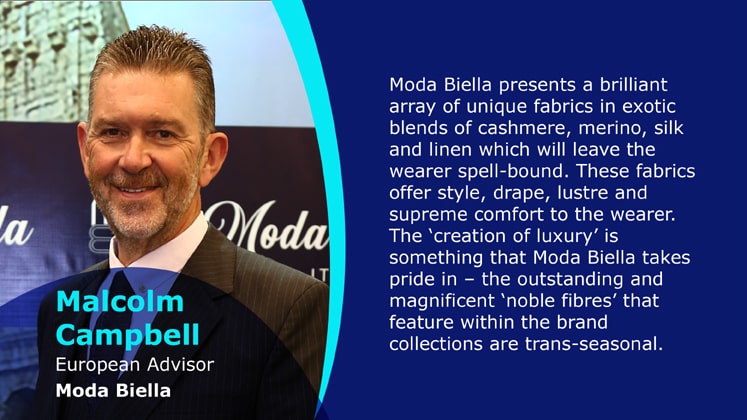
Moda Biella presents a brilliant array of unique fabrics in exotic blends of cashmere, merino, silk and linen which will leave the wearer spell-bound. These fabrics offer style, drape, lustre and supreme comfort to the wearer. The ‘creation of luxury’ is something that Moda Biella takes pride in – the outstanding and magnificent ‘noble fibres’ that feature within the brand collections are trans-seasonal. The key to natural fibres success is that they have been created by nature. They are nature-friendly and eco-sustainable. The breeds of animal or plant from which the fibres originate play an important role. Temperature within their given location also has an effect on the fineness of the fleece that produces soft, luxurious yarns. It could be in the heat of Australia with the Merino sheep, or the cold high plains of Mongolia with fine cashmere; each location encourages a fleece to be grown that is fine and protective of the animal. When converted in to yarn, a cloth and a garment, these fine fibres become protective, comfortable and stylish for the wearer too.
These noble natural fibres are naturally breathable, wicking away moisture from the skin, have natural thermal management, keeping you warm when it is cold and cool when the outside temperature is hot.

AR: Elucidate on the design language and overall process of designing at Moda Biella. What makes Moda Biella stand out?
MC: The key to Moda Biella’s design language is in our logo, Moda Biella Italy – the heritage of Italian Fabric. Our endeavour is to promote Italian design and Italian heritage and finishing. The design process is an intricate and complicated one. From time immemorial, people are trying to outsell the competition by coming up with colours that are better, designs that are better and values that are better too. What Moda Biella has decided to do is to look at the product that will be best for the tailors to make suits. Many people have made their ranges simpler because of price deflation. Moda Biella wants to offer products that will be the best for tailors to make suits. Many people have made their ranges simpler because of price deflation. They have stopped making so many colours, complicated finishes, intricate textile designs as they used to be. The skill, the art, the craft of the weaver and artisans have died to an extent and Moda Biella wants to reintroduce that craft and skill. The products do not have to be old-fashioned; it can be a jacket in beautiful colour like brick, sea-blue, jade green; in check designs, it can still be worn with denims, with flannels, trousers, open neck shirts, polo shirts, etc. We want to appeal to the younger consumers as well.
From a design point of view, we look at magazines, we travel to fairs, we go to premieres, we also visit top fashion retailers in New York, Paris and Milan and come up with colour palettes. The process is very much under the purview of the team.
AR: How important is textile education for retailers? What are brands and manufacturers doing in this respect?
MC: Textile education is crucial. I believe it has dumb(ed) itself down as well as the prices have deflated. A retailer who’s selling clothes and doesn’t know anything about them is not going to sell the best of clothing and that’s why price deflation has crept in because the customer will ask for the cheapest. We, at Moda Biella, are training our executives about the weaving processes and are making them well-versed with the entire process like from where the wool comes to the types of weaves that we make, the finishes, the weight of the cloth, etc.
To be able to sell is a skill in itself. Moda Biella could sit back and only provide what the retailer wants and what the customer wants at a less expensive price. We don’t believe that’s the way forward; we believe that luxury, heritage, craft and passion for clothing are what should go ahead.
AR: Introduce us to the collection and product range by Moda Biella, launched in India and also the collection to be launched next season. Who are your target consumers?
MC: The range under Moda Biella is very comprehensive. We have top quality ranges like merino wool with cashmere, merino wool with silk; we have different blends with polyester, cashmere and merino wool which give you the performance as well as luxury of having different finishes like clean cut finishes One of the most popular fabrics sold in India is tweed and I couldn’t understand this relation because of the temperatures in India. But the Indian consumers travel a lot and they need clothes relevant to the season. So we’ve tried to come up with trans-seasonal fabrics so that a jacket can be worn in Autumn or Spring.
So we are looking at trans-seasonality of clothes, age of the customer and at the same time performance of the cloth, besides taking care of the suit and what the tailors want, what they’re selling, etc. We’ve realised that our customers or tailors could be selling more fabric for weddings. So we thought to look at jacquards that can be worn in Indian ethnic styles and what we’re looking at doing are tiger prints or peacock prints, lotus flowers, using designs that are significant to India so that there’s a story behind everything. Education, stories and the craft of textiles are crucial. We believe what we’re doing with Moda Biella will establish textiles back again to the pinnacle of excellence of affordable luxury.
AR: Tell us about your seasonal calendar. How many collections does the brand Moda Biella introduce annually?
MC: At the moment, there’ll be one collection per season. We’re looking at it as a trans-seasonal collection. The problem with retailers is that they have a Spring range, an Autumn range but the weights of clothes have gone down. When I started my career, the weight of spring cloth was around 450 gms and weight of an autumn cloth would be 650 gms. Today the ideal weight for a suit is 280 gms, which is perfect for spring and perfect for autumn. So we’re going to be looking at trans-seasonal clothes because it means they can buy clothes for all seasons. We’re looking at customers to buy 3 suits, 2 jackets, 3 pairs of trousers, and from these 10 garments, they can do permutations. So the trans-seasonality in a man’s closet is important because it is about the collection of garments that can create your style.
AR: What do you think are the opportunities in this industry? Also talk about the potential of Tier-2 and Tier-3 regions for a brand like Moda Biella.
MC: This fabric is not only meant for the metros and mini metros. It is prevailing in the Tier-2 and Tier-3 towns as well. People have a tremendous paying capacity and this is targeted towards them. We have got a great market in these towns also. In essence, the consumer psychography is not limited to the urban male personnel. Therefore, for us to introduce a product such as Moda Biella which is more westernised in its approach, discerning of Italian influence is to offer these to the consumers who are a lot more educated about the end product. They understand the quality and richness of the product which they fail to get otherwise.
AR: Tell us about your marketing strategies.
MC: With Moda Biella, which essentially was launched in October last year, we wanted to have an aggressive advertising strategy and also desired to smartly market this luxury product. Therefore, we did a burst of TVCs. We’ve done a lot of advertising to educate the customer not only about this wonderful fabric and the nuances of Italy but also conduct several retail-centric activities in order to engage the customers in their last mile of purchase. We have even honed and crafted the entire brand imagery right from the conceptualisation of the logo to colours, taglines, themes, brand identity, aesthetics. There are more new initiatives that will come to the limelight soon.
AR: What are the retailing techniques that are best suited to a brand as luxurious as Moda Biella?
MC: We’re working on window displays, stories from Biella, tradition of textiles from Biella. We’re looking at sales and promotions within the stores and plan to make little cards that can go in the pocket of the jacket and will tell the consumer how to take care of their garments; little linen glasses that we can gift to the sellers so that they can get the customers to look at the cloth and explain the twill diaries; to the teams and retailers; besides the weaving story booklet, etc.
While currently, we don’t have any stores for Moda Biella, but it is available at the stores owned by the company. OCM has a large MBO channel as compared to EBOs but their market is mass to mass luxury.