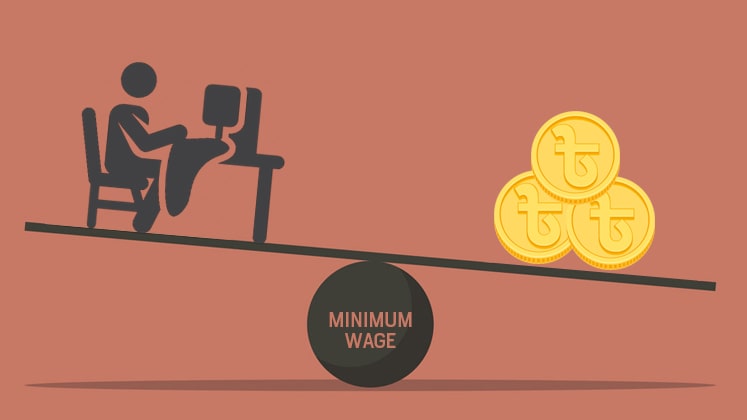
After a long wait, workers employed in Bangladesh’s readymade garment sector have something to cheer about, or do they really? The country’s wage board after a long-drawn exercise, which witnessed several upheavals with stakeholders proposing diverse range of minimum wage, ultimately decided to fix the new minimum wage, expected to be implemented from December this year.
The issue of fixing the new minimum wage has been quite an exercise to say the least! If the Government had to withstand the pressure from NGOs, labour unions and rights’ bodies on one hand so as to make sure that the new wage is not so high than it would shorn the country of its so-called competitive edge of cheaper sourcing destination.On the other, it had also to tackle the pressure from the entrepreneurs and refrain from making a token hike that would hardly be enough to ensure economic well-being of the workers while at the same time guarantee that the garment makers — who are already under pressure due to rising overheads and falling margins— are not disadvantaged.
In 2013, the minimum wage was fixed at Taka 5,300 (US $ 69) per month, which was an increase from Taka 3,000 (US $ 37), adopted in 2010 and now it is Taka 8,000 (US $ 96). Despite worker unions’ demand for Taka 12,020 (US $ 142) and employers’ proposal to seal the deal at Taka 6,360 (US $ 75), the Government felt feasible to strike a balance between the two and settle for Taka 8,000 (US $ 96) as the new minimum wage.
Notwithstanding the conscientious efforts, the minimum wage issue has hit the headlines once again,following allegations of overlooking recommendations put forth by the workers’ bodies, just when it is about to see the light of the day.
As per recent media reports, the country’s Wage Board for Garment Workers has finalized its recommendations and forwarded the same to the Labour and Employment Ministry for further course of action.In a gazette notification issued on October 8, the Wage Board reportedly recommended its new minimum wage of Taka 8,000 and sought written objections/suggestions on the draft recommendations from trade unions and factory owners within 14 days of the notification,before it could pass on the same to the concerned ministry to take things to a logical conclusion.
In these 14 days, the wage board has reportedly received at least 12 recommendations/suggestions from the labour unions, none of which had allegedly been incorporated in the final draft. This has infuriated the labour leaders no end, with some even maintaining that the very provision of entertaining recommendations/suggestions should be done away with if they are not to be paid any heed to at the end of the day.
“The Government should scrap the provision for seeking written objections, if any, or suggestions on the recommendations of wage board in 14 days, as the board in most cases ignores the received objections,”underlined an upset Salauddin Swapan, Secretary General of the IndustriALL Bangladesh Council.
In the final proposal, the board reportedly proposed Taka 8,000 as minimum wage for the workers of grade VII, which includes basic pay of Taka 4100, 50 per cent of basic pay as house rent, Taka 600 as medical allowance, Taka 350 as travel allowance, and Taka 900 as food allowance. For grade VI the wage board has reportedly finalised Taka 8,399 as gross monthly pay with Taka 4,366 as basic pay; for grade V, Taka 8,855 as gross pay with Taka 4,670 as basic; for grade IV, Taka 9,245 as gross pay with basic at Taka 4,930; for grade III, Taka 9,578 as gross pay with basic at Taka 5152; for grade II, Taka 14,621 as gross pay with basic pay at Taka 8,514; and Taka 17,504 as gross pay with Taka 10,436 as basic pay for the grade I.
“In line with the 5 per cent annual increment on basic salary, the minimum wage for a seventh-grade worker stood at Taka 8,900, but the Government set Taka 8,000 per month as the minimum wage,” argued an equally dejected Taslima Akhter, President of Bangladesh Garments Sramik Sanghati adding, “With this amount, it is impossible for a worker to meet the basic needs. That is why we urged the board to increase the basic salary and give proportionate increments to other grades in our objections.”
However, now that the final recommendations have been submitted with the concerned ministry,chances of substantial amendment seem remote. “We have received the final wage structure from the Minimum Wage Board, and subsequently formed a committee to review the recommendations,” stated Minister for Labour and Employment Md Mujibul Haque Chunnu. He further added, “It will be finalized after revision, but there is no chance of changing the gross salary, as the amount was unequivocally agreed by representatives from workers, owners, and the Government.”
Regarding the demand for proportionate increments to other grades, the minister reportedly underlined that it would depend on the findings of the committee, but there will be no changes unless there are major problems.