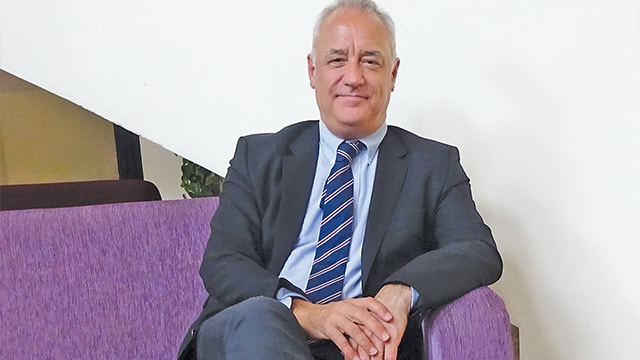
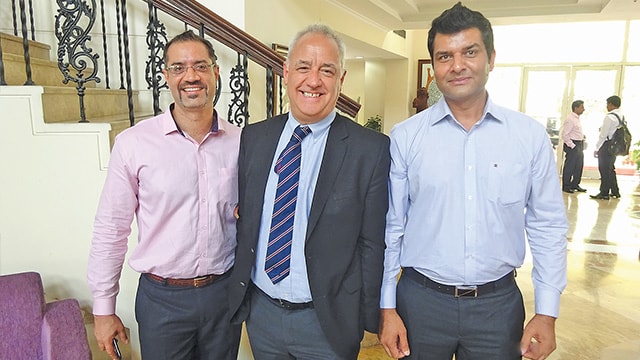
Ensuring human rights and assuring ethical standards, communication, training while increasing productivity and efficiency, are the top priorities for Chris L Grayer, Head of Supplier, Ethical Compliance for Next Retail Ltd. With more than 32 years of experience in manufacturing, quality, supply chain, Chris has previously worked for Burberry, Talbots Inc., Dewhirst Group…, and since the last 5 years, he is leading the Global Code of Practice at Next in achieving sustainable ethical goals in their supply chains. Chris was in India recently to create awareness among Next suppliers regarding Human Rights and the introduction of the UK Modern Slavery Act and for illustrating current challenges in the supply chain. In a candid interaction with Team AO during the visit, Chris touches upon various global- and India-specific issues of the apparel industry.
He emphasized that ‘exploitation’ is not an issue specific to only Asian countries, but has also taken place in UK and Turkey – it is a universal issue that needs a fresh approach. “We welcome the new Human Rights and Modern Slavery Legislation, which has been in the coming since a long time. We have always placed human rights at the centre of our ethical trade; we consider implication of salient risks that occur to those employed within our supply chain. Salient risks could be anything such as slavery, exploitation, bonded or child labour, and it also includes payment of a fair living wage, illegal land grabbing, the denial of the provision of adequate water supply and sanitation. The correct understanding of Human Rights requires understanding of where the salient risks are taking place and then thinking about how these can be mitigated by implementing what needs to be done to remove or potentially reduce the salience of the risks and then deciding what more we need to do and who/how do we do it,” explains Chris.
He further adds that the most important aspect is to have a level playing field of standards by agreeing on a singular approach for all suppliers, as many suppliers complain that “What I have to do for this brand is different from what I have to do for another brand.” After the introduction of the UK legislation, other countries such as France, Australia and Germany are also considering similar legislations, which is good news. “So, the next step is that hopefully we get a broad agreement of the same standards, then the same process can be applied and we will get the same approach and extend the level playing field to all. Collaboration is vital in achieving the change,” reasons Chris.
Give people responsibility and accountability; you can’t make people accountable without giving them the relevant responsibility.
Living wage is giving a fair wage; it is also recognising skills and efforts to provide the investment that can provide the correct remuneration for that job.
Give people a career not just “a job”. Workers have aspirations; I have seen some of the best factory managements coming from the shopfloor. You don’t need a degree to be a successful factory manager or a technical manager.
According to him, the Bangladesh Accord made a huge difference to the way people work. It was a manifestation of the realization between the Trade Unions, NGOs, and the Brands that the systemic risks in the industry can only be resolved together and that one has to have realistic achievable standards, combined with a level of tolerance as the progress is being made. Chris explains, “The approach was to come together strategically under the Accord and set the standards and then rapidly improve by remediation, the result of the Accord is that mercifully there have not been any further such incidents in Bangladesh, as we are now able to manage risk. The Bangladesh RMG industry is now rapidly growing to be world class. Initially, there were major concerns which were going to cost a lot of money but the investment has actually added value and quality to the Bangladesh RMG industry.”
Taking the collaborative approach forward, Next has joined the ACT Project. “We are working together with other brands within the supply chain through The ACT (Action, Collaboration and Transformation) project, which 19 European brands and IndustriAll have signed as an MOU to look at the challenges of providing living/fair wages achieved through freedom of association, collective bargaining, and how can these be advocated or implemented practically,” shares Chris. He adds that there are huge variations in minimum wages across the world, and to build a better industry, we need to recognize that there has to be investment in learning productivity and efficiency to move away from the reliance on ‘cheap labour’.
As a company, the ethical focus for Next is to have its own team to support suppliers achieving the required ethical standards, so that they do not use third party auditing agencies. “Being directly involved means we build relationships with suppliers and have much more time for training and communicating directly with our vendors, rather than just focusing solely on checking what’s happening. Auditing provides our own diligence; it not only measures a supplier’s ability but also the metric of the effectiveness of our own operations of investing in prevention and training. Our COP (Code of Practice team) is not there to find fault in the factory but to make improvements,” emphasizes Chris positively.
Chris notes that many companies in India have now embraced ethical standards and understand the need to ‘change’ to improve workers conditions, and he also stresses that production efficiency is one of the key areas that need improvement. In his words, “The RMG industry in India has grown quickly in both scale and ability and there is no reason why the industry can’t continue to mature, but there should be more governmental support for the industry and acknowledgement on how important the employment that it provides is. Our focus is to support women in the work place. How can you have a binary discrimination between a male and a female worker in any modern industry? It is vital that this discrimination is halted, as it is blight on the Indian RMG industry.” He even states, “We believe in transparency; the more the transparency, the stronger will be the collaboration. In this commitment, Next is about to make its entire supplier list public.”
Dwelling on his three-decade long journey in the apparel industry, Chris feels that the journey was challenging as well as exciting. “I would like to do it again, it is a great industry. I think one has to understand the opportunities that are there and always be prepared to move quickly. The global and the Indian RMG industry have rapidly changed; there is lot of ethical negativity driven by price and cheap garments. Not so long-ago, customers used to cherish a garment, wear it time-and-again; fast fashion clothing too has become disposable. I am happy that the momentum of change is now including the conditions of workers, improving their lives, and I also believe this will only continue to get better,” says Chris on a concluding note.