
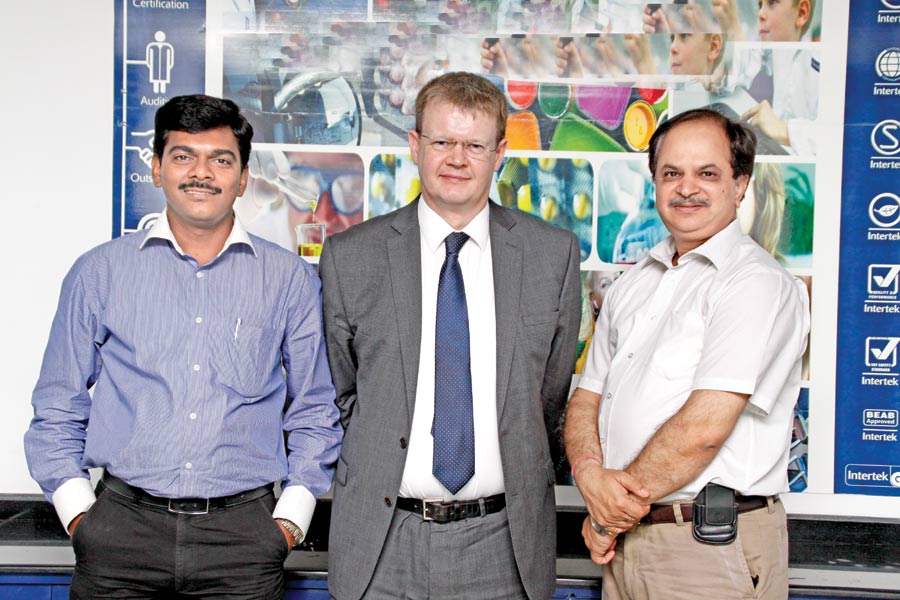
Colour is what attracts a customer and only after that material and fit comes into play, thus knowing colour and imparting the same in the fabric or a garment is critical to product sale. SDC’s agenda is to impart training in colour management to garment manufacturers, retailers and buying offices, making them understand how a colour would react or look on a particular fabric or under different lights. Dilip Gianchandani, Regional Director, Intertek has recently been nominated on the Board of Trustees of SDC – India. Team StitchWorld was invited to have a one o’ one interaction with Dr. Graham Clayton – CEO (SDC – UK) and Yogesh Gaikwad, Technical Manager – Asia at Intertek’s office in Gurgaon to understand SDC’s agenda in India…
We have 29 Chartered Colourists in India to help the industry to understand colour management be it in textiles or leather segment; we undertake, training and, consultancy programmes for all levels, be it retailers, garment manufacturers or processors. We are now even taking our training sessions to small clusters like Chandigarh, Ludhiana, Amritsar and Surat,” informed Graham.
Society of Dyers and Colourists (SDC) is a Bradford (UK) based leading independent, educational charity organization dedicated to advancing the science and technology of colour worldwide. The clear mission of SDC is to communicate the science of colour in a changing world to members of the society, with membership open to professionals, individuals, colleges, companies and students. It provides Professional Colouration Qualifications – that are recognized by industry worldwide.
India is significant for SDC as it is a huge textile base. It is important for designers, merchandisers, technicians to understand how to communicate about colour; how the same colour looks different in different settings.
Though SDC doesn’t have its own labs, it imparts training through testing labs of established players where their trainers go and give training sessions.” We are working very closely with AATCC for our Colour Index (CI) which is an online database for all molecules of dyes and chemicals by referring to which one can find out the uses and the functional areas of the particular molecule and which helps the dye houses to pick up the right dye which has the right molecule in it, points out Graham.
Reducing water consumption in dyeing is another agenda which SDC wants to promote in India. “The international standard for dyeing one kg of cotton is by using 100 litres of water, but now with latest technology, 1 kg of cotton can be dyed in just 35 litres of water; basically saving 75 litres of water along with drastic reduction of effluent discharge,” explains Yogesh.
Colour management is a three module technical course provided by the SDC in which their prime emphasis is on how to communicate colour. “In their first module they teach about what is colour and all the basic ingredients that constitute a colour. In the second and third module people are taught how the colour changes when subjected to different light which is actually the concept of metamerism. Most of the lights fitted in our houses or offices do not have D65 illuminate which is responsible for producing day light effect and that’s why colour looks different when seen in tube light or in day light,” explains Yogesh.
SDC has formal test for colour blindness which is called ‘Ishihara’ to check the level of colour blindness. “It’s a proven fact that males vis-à-vis females are more prone to colour blindness. It is very important for a colourist to know whether he/she is colour blind or not as that is a basic requirement for a technician,” informs Yogesh. So if your merchandiser is a female and she approves a colour, your technician at the shop floor who is a male may disapprove the same colour… hence it is very critical to understand colour and take all necessary precautions to ensure that colour is read properly.


