Vietnam is a great opportunity market which every textile supply chain partner understands including Shima Seiki, Japan which is serving the market from last six years through its dealers and has recently opened a subsidiary office in the country to get direct connect with its customers. The company, which is already an established knitting machine solution provider, has 2,000 machines in operation in the country. “Most of the foreign investors in Vietnam are already aware of our technology and the challenge for us is not so much to create market buzz, but to be near our customers to support them technically,” says Nobuhiro Nishimine, the newly appointed General Director of Shima Seiki Vietnam Co. Ltd.
The company is very honest in its approach and admits that TPP was one of the reasons to invest in Vietnam, but this is not the only reason.
“The other two reasons are equally strong. For one, Vietnam already has a large number of foreign investors and they are the type of companies that Shima Seiki is interested in for its knitting machines; and secondly, the company sees Vietnam as a good market for its automatic cutting machines, which are as of now sold mostly in Japan,” says Nobuhiro.

Many Vietnamese factories are looking to upgrade, and the one area that has really opened up is the cutting segment, which hitherto was done manually. “The more established names in cutting solutions are very high-end and too complicated for those who are just starting the use of automatic machines. In contrast, we have a very simple to use machine, which we are confident will appeal to the local Vietnamese companies,” says Nobuhiro. The new showroom that houses the cutting machine will be an ideal location to demonstrate the technology and also serve as a one-point solution and service centre.
In fact, the strategy of the company is very clear; garment factories are looking for much more than just machines and that is why the new focus area is on providing production management systems.
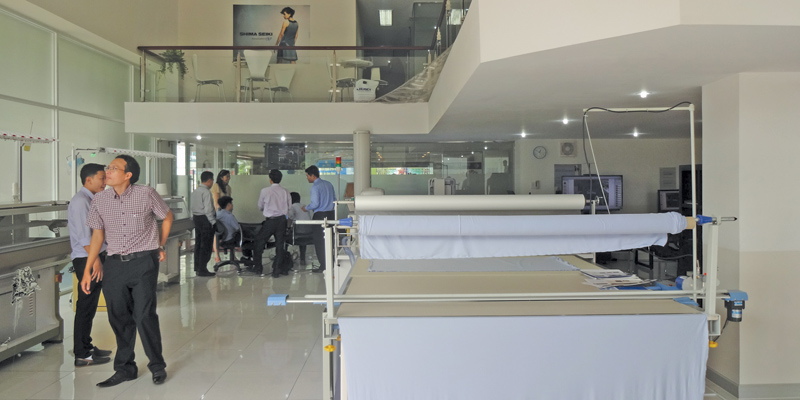
“Today, competition is about being more efficient and saving on resources; companies who can master the art of managing their production processes most efficiently are going to be the long-term gainers. Shima Seiki not only recognizes this shift but has also strategically moved in that direction to support the industry,” says Nobuhiro. The company offers Shima Network Solutions for networking multiple systems, data transfer, archiving, production monitoring and management, and remote data access. Using the latest in networking technology and production management software, Shima Network Solutions can be customized according to the specific needs of any factory’s configuration. It is thus possible to begin with an entry-level system, then perform upgrades to keep up with growing business and production capacity.
The focus for the new office will be on engaging with the industry to understand their needs and update them on what Shima Seiki has to offer.
“We want to move beyond the tag of being a knitting technology provider and so there will be regular seminars, workshops and private shows to communicate with existing and potential customers,” says Nobuhiro. The new subsidiary and the big office space engaged will be the nerve centre for all these activities.
In the knitting segment, the company would prefer to work with foreign companies that invest in huge number of machines that could go into thousands, rather than local companies that look at purchasing maximum of 10 machines. “Initially we are showcasing all basic machines, but once the market matures, the more advanced versions will be introduced,” shares Nobuhiro. The next office is planned in Hanoi, which is fast becoming the ‘quantity’ hub for garments, as many China- and Hong Kong-based companies are investing in the region and these customers are the core customers for Shima Seiki on a global perspective.
The new office led by Nobuhiro, a Japanese, has five local Vietnamese speaking employees who will be the marketing team, while technical support will initially continue to come from Japan. “To succeed in any market, it is important to communicate in the local language and also understand the local culture. So more than Japanese staff we are relying on locals, but the expertise of our Japanese technicians will be available and till the local staff is equipped to handle every query, the company will be tightly connected to the head office,” says Nobuhiro, who signs off with a very positive comment on expectations of growth. “We cannot predict how the business will grow, but for sure we have the right strategy to tap the potential,” he concludes.