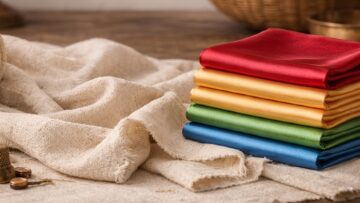
The Delhi-NCR region is known for its high value ladieswear, and most of the exporters have built systems to feed this market with flexible quantities and varied value additions. At the core of most of the products is fine/sheer fabric which is used creatively for manufacturing blouses, dresses, skirts and other ladies wear. Handling this fabric is not easy and each company, whether big or small, has devised ways to work effectively with focus on quality and varied styles. While a company like Scorpio Apparels, has set benchmarks in working with high value products, mostly in fine fabrics, companies like Pyoginam, Fiori Creations, Cotton Harbour and Lilly Fashions are no less innovative with clearly defined focus areas.

Scorpio Apparels
Creating benchmarks in manufacturing high fashion ladies garments
To prevent defects such as wavy grainlines and fraying at edges while spreading, sheer fabrics are spread only up to 3m in length with maximum 70-80 plies with sheet of paper alternatively placed every 15-20 plies with fabric snipped at ends as opposed to conventional cutting method. – Rakesh Gupta, Managing Director
Located in Faridabad (Delhi-NCR) and Okhla in New Delhi, Scorpio Apparels is one such factory which has specialized in handling such delicate fabrics and is consistently innovating, manufacturing processes to make camisoles, blouses, shirts, jackets, overcoats and even trench coats in an FOB range of US $ 7 to US $ 135.
The company equipped with 950 stitching machines and 15 multi-head ZSK embroidery machines, makes either 6,500 units of basic styles or 4,000 units of value added garments per shift in order quantities ranging from 50 to 50,000 pieces according to buyer’s requirement. Rakesh Gupta, Managing Director, Scorpio Apparels is the mastermind behind the growth of the company from exporting to their upmarket brand ‘Nitya’ for the French market and also catering to other European and US buyers like Mount Swan, Max Spree, Ralph Lauren and Max Mara.
Efficient greige fabric, cutting and embroidery process management

Sourcing chiffon, georgette from Surat and handmade voile from Coimbatore, the fabric which is much in demand in Europe, the company also imports blended fabrics like silk chiffon, poly-satin, silk, chambray and georgette from China and linen from Italy. However, Scorpio prefers to work with Indian fabrics which require 15 days to deliver, unlike the imported fabrics which take around 50 days. Moreover, at times the company gets stuck with substandard fabrics from China which creates quality issues.
No doubt, working with dimensionally unstable and stretchable fabrics requires extra care to inspect it for holes and tags. Not taking any chances, the company does 100% fabric checking and follows the 4-point system for both greige and processed fabric, using glass tables for inspection to avoid damage.The usual problems associated with sheer fabric or fine fabric is its instability, stretch and yarn pulling, which also creates difficulty in laying, cutting and marking since there is frequent fraying of edges and slippage while laying more number of plies in a single lay. Another critical issue faced in these fabrics is the wavy grain line which tends to distort the fabric when cutting the fabric ends. To prevent this, small layers with maximum length of 3 metres are prepared and a maximum of 70-80 plies are cut in one go.

During the laying of sheer fabrics, usually one sheet of paper is put following every 15-20 plies after which the fabric is snipped and torn at the end of the lay as opposed to conventional cutting to ensure that spreading takes place ‘on grain’. Some of the parts (especially smaller ones) are first block cut and then re-cut on band knife to ensure greater accuracy. For panels, where embroidery needs to be done, allowance of 3 cm is kept in order to have correct placement of embroidery and then re-cutting of the panels is done. These panels to be embroidered are initially cut in blocks and then forwarded in the embroidery section. In case of handloom voile where fabric is starched, the fabric has to be laid and stretched for duration of 1- 2 hours. In some cases of poly-satin, poly chiffon, cello tape is also fixed at places where there is no marking and after placing, the patterns are pinned by paper pins to maintain accuracy while cutting. In fabrics like polyester where unravelling is frequent, edges are sealed by heating. In case of defects in the middle of plies of fabrics, a cut strip of fabric is placed in that area to identify the area where splicing needs to be done.
Special trolleys with separate section define to keep fabric rolls colour wise and style wise for carrying at least 5 rolls of fabric are being used for material movement. Fusing of such fabrics in collars or plackets is done after parts have been cut in flat continuous fusing machine by maintaining correct temperature and pressure combinations for interlining and fabric. Confident of the company’s proficiency in effectively managing the entire process from cutting to the allotment of cut parts of garment to the sewing lines, Rakesh said “Our expertise has been in handling of light weight fabrics and embroideries and that is what we do best to demand an FOB of US $ 135 for some of the styles.”

At the sample stage, basic embroidery templates called khaka are created by tracing the design on paper first and then over fabric in form of dotted lines using zinc oxide. The mock is first hand stitched and then approved by the buyers. While doing mass production of these designs, the khaka is given for recreation in EPCwin embroidery software from ZSK, for making the same ready for machine embroidery. The company has 20 and 36 head embroidery machines with capacity of doing 9 different colours on both individual fabric panels and overall fabric. In some cases, to further control the quality and precision of embroidery of some critical designs, all the fabric panels to be embroidered are sewn together with strips of greige or waste fabric making a long vertical strip, which is altogether put on the embroidery machine.
Work aids and correct machine settings of utmost importance

Parameters like needle size, presser foot type, feed dog, and throat plate size all impact seam appearance and if proper equipment are used, they will help in putting check on formation of sewing marks, holes along with seam grinning, seam puckering and seam slippage arising in sheer fabrics. Keeping all these factors in focus and to control the defects, the company uses sewing machines from Brother – Exedra model and also Juki’s DDL-8300N in its assembly lines. Scorpio Apparels uses ball point needle of size 7 because when this needle hits the yarns of fabrics, it doesn’t damage the yarns. Narrow throat plates aid in restricting the fabric to get stuck in the hole of throat plate. The pintucks which were earlier done by chainstitch machines has now been replaced with lockstitch machine with pintuck folders to avoid thread breakage. Even bottom hemming is done by hemmer attachments which ease handling of garments. To ensure equal feeding while sewing sheer fabrics to achieve pucker-free garments, Scorpio Apparels has sewing machines with top and bottom feed for maintaining seam quality. Due to the slippery nature of the fabrics and the smooth sewing table surface, operators find it difficult to handle fabrics during sewing for which paper is being used to cover the table surface making it non-slippery. In case of silk chiffon where fabric doesn’t attain stability even after fusing, the parts are stitched with paper as in collar and then pressing is done, which brings stability before it moves on to assembly line. The paper is later removed at the final stage.
For streamlining production process and reducing rejections, assembly line is divided into parts preparation and final assembly line with inline material movement between the two line with trolleys marked with bundle numbers so that components are tracked correctly.
For streamlining the production process and reducing rejections, assembly lines are divided into part preparation for construction of small parts like collar, cuffs and pin stripes and final assembly lines. For inline material movement, special trolleys with bundle numbers marked are used by the company for passing bundles from one machine to another, so that cut parts do not get mixed within the sewing line when being passed from the part preparation to final assembly.
Productivity ranges from 10-12 pieces per hour per person in such kinds of garments with average efficiency of 60% to 70% per operator. The most important factor at Scorpio is the training provided to the sewing operators which is a 10 day program comprising of educating the operator on how to handle fabric and sewing. “Work place ergonomically is equally important for building efficiency of workers for which we provide comfortable chairs to sewing operators with cushions,” says Rakesh.
Quality Management System
Work aids with abacus type tools and sloped glass bases are being used to calculate the number of defects in apparels which simplifies their complex checking procedures and also minimizes paper and labour wastage.
Focusing on quality rather than saving time, Rakesh reasons, “We would rather invest a few more minutes in making these garments carefully, rather than saving minutes and getting the defective pieces.” Standard operating procedure (SOP) has been made for each and every operation in the entire process which includes not only the sewing operation but also the finishing department to the use of different steam and pressure setting along with appropriate use of vacuum. For the final checking, stands have been put through the entire checking area to hang the garments after finishing for final checking; it’s a flexible method of maintaining continuous checking.
Even defect calculating work aids have been devised by Scorpio which have sloped glass bases where measurement check sheet is placed and below that, abacus type tools is attached which is being used to mark out defects in different areas like chest, shoulder, waist measurement, etc. These work aids minimize paper and labour wastage since reading of the abacus needs to be noted only at end of each hour and then final checking of measurement is done.
An AQL level of 2.5 is being followed throughout for checking the quality. Special inverted U-shaped work aids like pallets are used after final checking to prevent shape distortion. Interestingly, the button attachment is done after the final checking has been completed. Why?
Since diverse type of garments like skirts, camisoles, blouses need to be shipped to the buyer together and in correct shape; a mock of 40 feet container has been created to analyze the quantities which can be placed in the particular container for shipment.
Cotton Harbour India

The company believes in doing small order quantities with perfection rather than taking up larger order quantities. Currently, the company is producing high fashion ladies garments in voile, georgette and knit fabrics. Offering value additions like wax embroidery, Adda embroidery and tie and dye, sampling of value added garments with embroidery is done in Moradabad and the FOBs range from US $ 5-25. The product development is done according to tech packs and in order to cut down lead time of sourcing fabric, Cotton Harbour buys the yarns and gets the fabric made from neighbouring areas.
To reduce slipping of sheer fabrics while cutting, the company is using brown pattern making sheet and laying only 40-50 plies at once. For quality checking of garments AQL level of 2.5 is being followed. “Experienced tailors on piece rate system are recruited to handle sheer fabrics for quality production… it cannot be done with inexperienced operators even if trained,” says Sanjay Chawla, MD, Cotton Harbour India.
Cotton Harbour also deals in niche products like equestrian apparels and yoga clothes made of bamboo apart from manufacturing uniforms for Army. The company was started in 1991 with manufacturing of knitwear which gradually diversified its business catering to different brands like UBC, Red Cats, Nisca, Li & Fung, Cole Water Creeks among others.
Pyoginam
Focusing on training to handle critical fabrics

With 1050 sewing machines spread across 3 different units in Gurgaon and Manesar, Pyoginam has registered consistent annual growth of around 15-20% on self-improvement and best practices in all areas from fabric sourcing to shipment. Headed by Yoginder Mukim and Poonam Mukim, this ISO 9001:2008 certified company, touches an annual turnover of Rs. 70 crore and makes value added ladies tops in woven fabrics like polyester, chiffon and georgette. Very particular about quality, Pyoginam has a dedicated centre for testing and controlling quality of fabrics and trims. For easy accessibility of new developments for product development team, an exclusive fabric sample store has been added, adjacent to sample making room where only fabric for sample making has been stored.
Care is taken for controlling issues like expansion of fabric after sewing collar or increase in chest measurement during pilot run with same fabric from actual lot so that all parameters for sewing the garment along with control measures are defined before the mass production in order to prevent rejection and reworks.
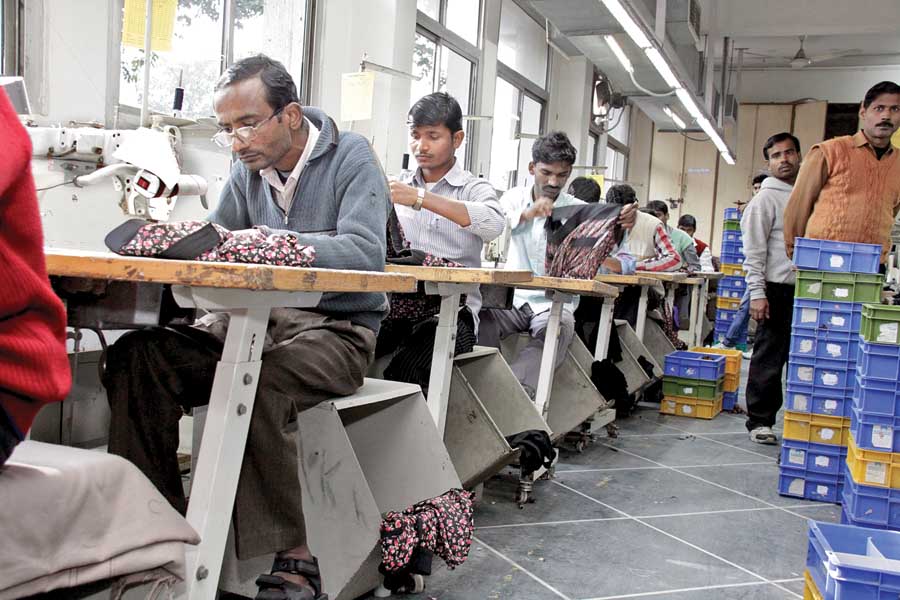
Relying on flexibility of operations to cater to quantities ranging from 700 pieces to 1 lakh pieces, Pyoginam uses its 20 years of experience to get efficiencies in all cases. A production planning meeting involving production manager, merchandisers and maintenance team is carried out prior to starting up any new style with Standard Operating Procedures for production which would include needle type, stitch type and machine type. At the centralized cutting and finishing unit in Manesar, the fabric is cut manually with tissue paper or greige fabric placed after every 15-20 plies so that the fabric does not slip during cutting for accuracy and then transported to the other units for stitching. Since the fabric is delicate and prone to soiling when passed from one operator to another in an assembly line, special stools have been developed for operators to sit which have perforated box shaped work aids below the stool, where the pieces are deposited and on completion of a bundle passed on to the next operator in order to prevent frequent touching of the garment, which usually causes soiling; this also keeps the workplace clean.
A special focus for ensuring quality at Pyoginam is in-house training of both fresh workers and experienced operators. Earlier tailors were recruited on basis of acquaintance and commission given to production managers, the practice has now been stopped and there are impartial tests conducted for recruitment. With this the company gets trainable and educated workforce which has noticeably reduced rework time and margin of errors. The entire process does not only allow 98% cut to ship ratio but also saves on manpower cost since there is no requirement of production managers to supervise quality checkers. The tailors sewing the garments can usually handle all types of fabrics due to deskilling and experience, but some of them are kept specifically to do only some critical fabrics in which they are very good at. For training freshers, the company has seven-day theory based training programs in areas of spreading, cutting and checking, which include tests like literacy and proper eyesight.
For recruitment of sewing operators, a special test is conducted in which they are asked to construct shirt placket or collar wherein the technical team judges them on various parameters like how are they handling the product; how much time they are taking and their efficiency levels, accordingly they are graded A, B and C. The operator; who has been given ‘A’ grade is paid Rs. 200-400 higher than ‘B’grade operator and so on, this acts as a motivation to go for higher grades by producing more effectively. Yoginder himself monitors the progress of the trainees on a daily basis. “Our training program is so good that our people have been found to have better working knowledge than operators in other export units for the past three years,” says Yoginder proudly.
Lilly Fashions

Living by the philosophy that the correct choice of fabric, embellishment, detailed designs and quality add to the value of the product, Lilly Fashions with an annual turnover of Rs.20 crore has registered annual growth of 5-10% from its 2 units housing 100 machines. Manufacturing high fashion ladies garments from tops to dresses with heavy sequin embroidery both by machine and hand with FOB’s between 20-30 Euros, the company caters to mainly Italian buyers followed by France and Spain. Order quantities ranging from 400 to 4000 is being produced.
The company follows 100% inspection from fabric checking to packing stage due to high value of these garments. The karigars are selected as per the design requirements and also on the basis of requirement of design whether it has to be done by hand or machine. “For quality we produce khaka for every style, which has to be followed by the karigars, some coloured copies or samples which has to be done and also details of inspection procedures,” informs Sandeep Handa, MD, Lilly Fashions.
Fiori Creations
New designs with multiple value adds is the niche

Fiori Creations produces garments like evening gowns, tops, blouses, and dresses, mostly in fine fabrics with FOB’s starting from 15 dollars and catering majorly to France with order quantities ranging from 200 to 2000 pieces per style. Having 300 sewing machines the core competency of the company headed by Vikramjit Singh is offering multiple varieties of value additions ranging from hand embroidery, sequins and stone attachments to machine embroidery. The value additions are outsourced to limited number of people identified on the basis of their expertise in different areas of hand embroidery, Adda work and embellishment attachments.
All benchmarked practices are followed when handling the delicate fabric including 100% checking on glass tables since these fabrics are transparent and spotting defects is too difficult and using metallic clamps while spreading for fabric stability. For sewing the seams, ball point needle with SPI of 2mm while stitching is used in addition to feed dog with more teeth and narrow throat plate. The thread ends are held by hand to prevent being sucked by needle plate with no slackness in fabric while sewing so that no puckering is caused.
Training the operator is critical for handling of fine fabrics, for which NITRA and OGTC consultants have been used, and the emphasis is on quality assurance. In addition to inline and endline checkers, the company even has a group of roving inspectors to keep the rework and rejection range between 5 to 10%.