Drawing inspiration from the striking beauty of nature, homegrown label Tintory was born as an earthy brand that houses a range of contemporary, plant-tinted garments that are purely natural in all ways possible.
“Our brand ‘Tintory’ originated from the notion of tinting clothes using elements available in nature. Tintory is a made up word denoting a workplace that tints clothes naturally,” Nivedha Vignesh, Founder and Creative Head of Tintory, told Apparel Resources (AR) in an exclusive interview.
Tintory strives to provide a green clothing experience to the consumers of today, by working with 100 per cent natural fibres, and natural dyeing and printing techniques to make the wearer feel close to nature.
In order to impart an artisanal touch to its clothing line, the label involves many hands in the process of hand spinning, hand weaving, hand printing and also, for its signature handmade packaging.
Keeping in mind the pollution caused by fast fashion industry, Tintory aims to create timeless pieces that would not only reflect its love for nature and Indian art forms but also its affinity towards the rawness of handmade.
“We want our brand to be a medium for disseminating the need for sustainable fashion and therefore we take efforts to incorporate our core values in every stage of production – from start to finish,” Nivedha said adding, “Our ultimate goal is to make fashion and nature a peaceful coexistence.”
An Engineer by education, it didn’t take long for Nivedha to discover that her passion lay in dressmaking. After a brief period in the IT industry that didn’t interest her at all, she decided to put a full stop to her IT career and moved on to pursue her heart’s true calling.
Prior to launching Tintory, Nivedha opted for a small course in fashion to familiarise herself with the basics of the industry, and simultaneously started interning with a few designer studios in order to make up for the time she lost while studying for her Engineering degree.
PRODUCT ASSORTMENT AND PRICING
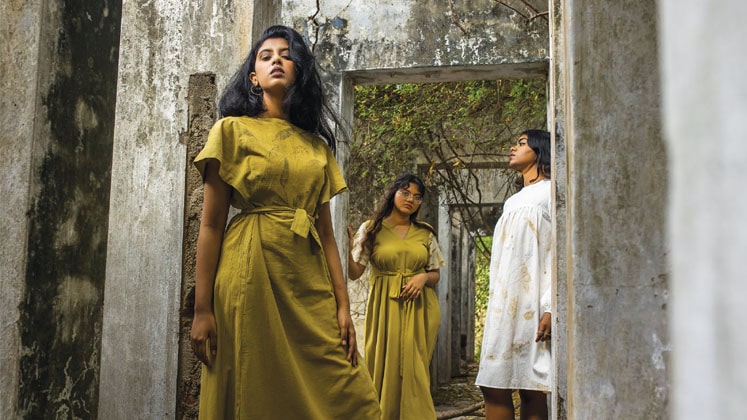
Tintory currently specialises in womenswear and is also equally equipped to handle menswear, but is looking for potential demand in the market before getting into it completely. The label is in the initial stages of launching a zero waste accessories project, which would take a while to hit the market.
Priced between Rs. 3,000 and Rs. 6,000, Tintory offers western silhouettes comprising dresses, jumpsuits and tunics, but the styles change with each collection.
One thing that remains common in all the collections is the fit of the garments. Tintory provides a very relaxed fit that can be adjusted as per the wearer’s preference.
Tintory also does not make use of any plastic trims such as zippers and buttons to make the garment snug. The wearer can decide how closely the garment should fit and adjust the fit accordingly using their attached belts and drawstrings.
USP AND TARGET CLIENTELE
Tintory’s core values are the foundation of the label’s origination. The label stands for sustainable practices and slow living abides by the same.
“Our values have helped us seek for solutions that would eventually pay justice to our brand ideology. Our style of depicting the love for nature from the start i.e, right from collecting fibres, to getting the final product packed for the consumer in the most earth-friendly way, is what makes us stand out,” Nivedha highlighted, adding, “Our aim is to attain a clientele who are sensitive and conscious about how these products are made, what they are composed of, and their subsequent impact on the environment. We also believe in complete transparency of the production processes to encourage conscious consumerism.”
PROCESSES AND TECHNIQUES

Tintory originated from the notion of tinting clothes using elements of nature. Out of the many problems in the fashion industry, one that bothered Nivedha the most was the use of synthetic dyes in the fashion industry and their unregulated disposal.
That’s where it all started.
Being an ardent nature lover, the budding designer chose to address the issue right at the root, by applying age-old methods of utilising only natural sources to tint her garments.
Tintory extracts dyes from plant-based materials for tingeing.
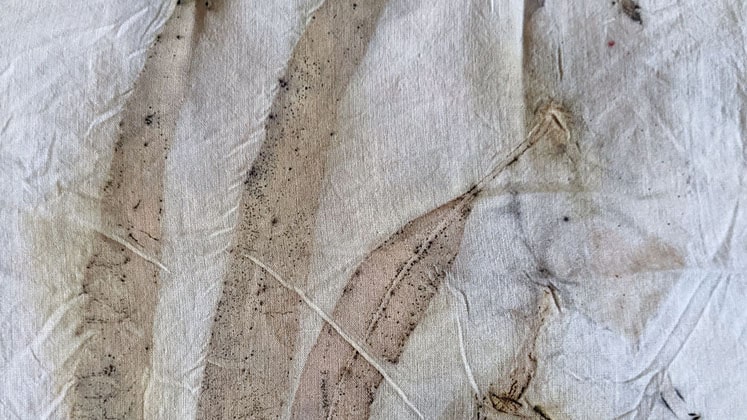
For its debut collection, the label used actual leaves to create imprints on fabrics by extracting dyes from them. According to Nivedha, it is a way of imparting the rawness of nature onto their garments.
“So far in our collections, we have implemented techniques that help make the aesthetics of our clothing range richer. For example, we used the technique of contact printing where certain medicinal leaves are used to create imprints on the fabric keeping its appearance intact. We even use the ancient block printing technique to print on the fabrics using natural paste and hand-carved wooden templates. We are researching to incorporate more such modernised versions of ancient crafts in our upcoming collections,” Nivedha explained.
MANUFACTURING AND SOURCING
Currently, Tintory operates as a small team comprising Nivedha, a pattern maker, a tailor and a few helpers – all in-house. The label’s associated group is large and includes handloom weavers, natural dyers and palm leaf box weavers.
Their main unit is based out of Chennai and their fabrics are woven and dyed at a unit handled by a non-profit organisation in a village located in South Tamil Nadu.
After the fabrics are procured, printing and tailoring is carried out in-house at their main unit in Chennai.
Corroborating on the same, Nivedha said, “We strive to source all our fabrics and raw materials locally, as this lowers the carbon footprint and also helps in empowering the artisans associated with such crafts, further preserving the art and culture of such regions.”
Being a supporter of locally made products, Nivedha stresses that she would rather get associated with small producers who ethically produce raw materials than any large firm that mass produces.
“It’s hard to retrace how the fibres are treated and produced in factories and hence, I refrain from sourcing from any renowned hubs or mass markets where ethicality is compromised for business,” Nivedha expounded adding, “I prefer sourcing from small businesses and communities who are transparent and like-minded.”
UPHOLDING INDIAN ARTISANS AND CRAFT CLUSTERS

Being a worshipper of handmade products herself, Nivedha wants her clothing range to exude the uniqueness and feel of non-automated crafts. In order to ensure the same, Tintory works closely with a weaving community managed by a charitable organisation in the southern region of Tamil Nadu that mostly comprises women. The label plans to continue collaborating with more such organisations throughout India, to celebrate the crafts of respective regions.
These skilled women handle hand spinning and hand weaving through and through to arrive at yardages.
“We work with block printing artisans in the city who are determined to carry the art in its original form,” Nivedha said adding, “For our packaging, we are associated with an all-women palm leaf weaving cluster who are known to skillfully mould palm leaves to form boxes of varied shapes and sizes. Our notion is to celebrate locally made products and to sustain the livelihood of such artisans.”
END TO END SUSTAINABLE
Tintory’s signature handmade packaging is 100 per cent natural, biodegradable, reusable and sustainable.
It consists of an outer woven palm leaf box casing that is woven with high precision in order for it to be reusable in the household. Inside the box, garments are wrapped in a reused brown sheet that is collected from a local supplier who accumulates packing wastes for recycling from all over the region. The box is finally secured with a jute string to keep all the items intact.
WHAT GOES INSIDE A PIECE OF TINTORY
The brand’s motto is to disseminate the need for sustainable fashion through every aspect of its production processes.
Tintory is continuously researching for appropriate fabrics to work with for their upcoming collections. The key characteristics that the label looks for while selecting and approving fabrics are – whether they are composed of natural fibres, are handloom made, the trans-seasonality of the material, and breathability and versatility aspects.
“We haven’t gotten over our love for the khadi cloth which is known to be the most sustainable cloth in many aspects. We have been religiously working with it in our collections,” Nivedha highlighted.
The label outsources its textiles from the weaving community mentioned above, and uses them as canvas for their surface design techniques.
Nivedha plans to explore the world of textile design once Tintory’s unit expands.
RETAIL MODEL AND STOCKISTS
Following a drop-based model, Tintory offers trans-seasonal pieces that are made to order.
“We follow a minimalistic approach when it comes to our inventory. Keeping in mind the waste generated by the fashion industry, we adopted the practice of only making when in need so that it prevents unnecessary wastage of fabrics, time and labour,” Nivedha stated, adding, “So far we have not stocked any garments. This is also one of the sole reasons why we operate online and don’t have a physical store yet. The only products we stock are the samples we make for the launch of the collection which are used for our photoshoots and marketing purposes.”
Tintory is available to shop on the label’s official website www.tintory.in, and is also underway to be launched on some of India’s largest sustainable online marketplaces.
The label plans on widening its connections with handmade communities all over India so as to provide a more diverse range of products infused with Tintory’s inherent style and aesthetics.
“Our ultimate goal would be to bring out hidden indigenous crafts to the world and prove the goodness of Indian culture by of course taking the earth-friendly route,” Nivedha said.