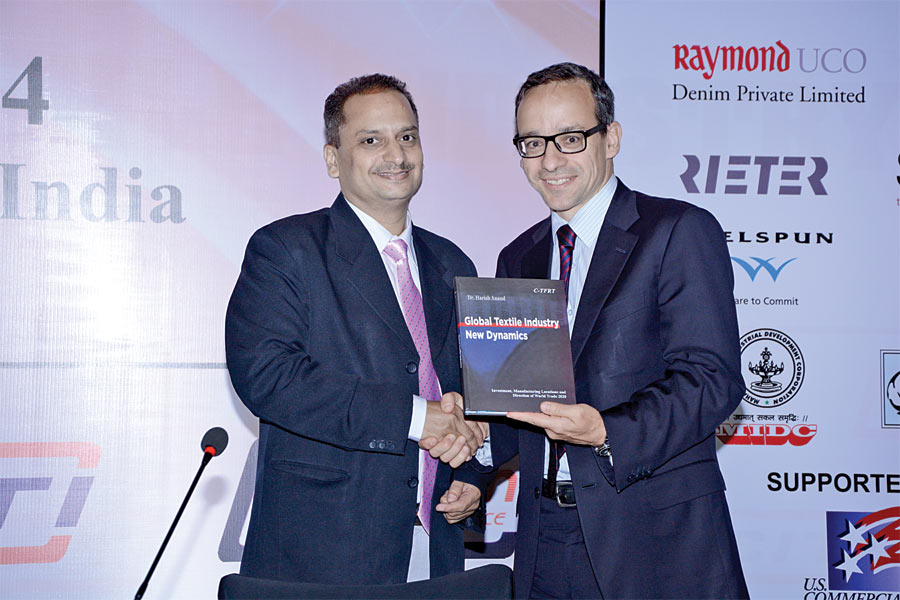
Dr. Harish Anand, a professional economist with 20 years of experience in textile industry who has been vocal over the years on major Government policy decisions, and is today an advisor to a large textile organization in economic affairs and strategic planning, penned a book titled Global Textile Industry New Dynamics Investment: Manufacturing Locations and Direction of World Trade 2020. The book was recently released at the 8th Asian Textile Conference, held in Mumbai by Christian Schindler, Director General of ITMF, Switzerland. The publication is a comprehensive guide to all involved in global textile supply chain from fibre to fashion stage as well as textile machinery suppliers. The research evaluates the changing influence of the traditional factors of competitiveness, effectiveness of international trade arrangements and new developments on global competitiveness of textile producing countries.
The new publication builds a perspective on textile industry for 2020 in terms of estimated output and investment; likely shift in textile manufacturing locations; world installed capacities; world textile fibre consumption; new dynamics influencing world trade in textile and clothing; role of PTAs/RTAs/FTAs and Rules of Origin (ROO) in improving market access of member countries against non-member countries; and direction of trade including scope of intra regional trade especially in Asia.
Vital findings of the study highlighted in the book
According to Dr. Anand’s estimation, the textile industry may attract an investment of about US $ 370 billion by the year 2020. This is based on the fact that about 54 million spindles by 2020 will be added in the world installed capacities, largely in the Asian countries. The study has projected world textile fibre consumption at 108 million tonnes by the year 2020.
The book is designed to enhance skills of textile professionals and give management orientation for strategic choices to be made for the growth of business and industry.
The book predicts that the world spun yarn production may grow to 44 million tonnes and selected group of countries like China, India and Pakistan would be having a large share in it globally. The findings of the study suggest that LDCs can gain more from liberal trade policy by allowing import of textile materials, including yarns and fabrics for making garments for the export market.
To gauge the scope of intra-Asia trade in textiles, the study has also contemplated Bangladesh RMG exports prospects for the year 2020, wherein exports are projected to increase to US $ 36 billion in the first scenario, US $ 42 billion in the high growth scenario and US $ 50 billion in the ambitious scenario.
The study also explains Bangladesh and Vietnam’s growing share in the EU and US’s clothing imports, respectively in the absence of large textile industry base in these countries. The study in addition explores the reasons of their competitiveness and possibility of growth of integrated textile industry in such countries by the year 2020 which will have definite consequences for existing yarns and fabric exporters in Asia.
The growth trajectory of the textile industry in Asia suggests that the textile industry revealed a tendency to grow in clusters, especially in the last decade. Therefore, it is critical to understand the evolution of such clusters and their characteristics in terms of fibre composition as well as exports prospects.
Under WTO regime, the role of market forces in the performance of developing countries in world trade in textile and clothing has become more prominent. The share of top five developing countries in world trade in clothing has increased from 43 per cent in the year 2004 to 55 per cent in 2012.
The EU’s revision of GSP scheme, with the introduction of GSP plus scheme, is an attempt to rationalize the benefits available under GSP scheme and direct them towards those countries, which have been lagging behind due to their peculiar socio-economic conditions. The new arrangement is likely to alter the competitive position of different textile economies like Pakistan, China, India, Turkey, Indonesia and others. Product wise change in competitive position is also discussed in details.
The international business environment especially for textile and clothing trade is replete with large numbers of FTAs/RTAs/PTAs. Rules of Origin in different trade agreements are discussed to highlight their implications for competing textile economies. The study explores the chances of global cotton market facing volatility linked with China’s policy of liquidating cotton reserve in different scenarios.
The book is stocked with easy to use 76 tables and 17 figures covering entire gamut of global textile industry. It is designed to enhance skills of textile professionals and give management orientation for strategic choices to be made for the growth of business and industry.