Myanmar RMG factory owners overrule decision of rehiring fired employees

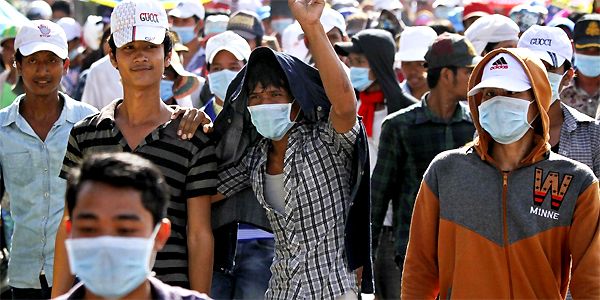
Myanmar RMG factory
Image Courtesy: scmp.com

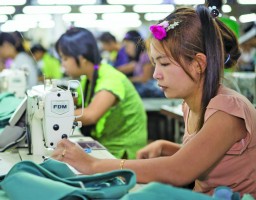
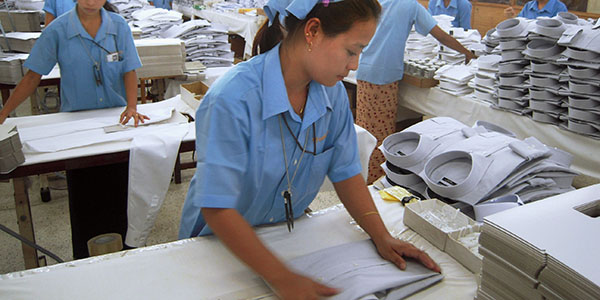
Since the rise in minimum wages of apparel workers of Myanmar in September last year, several employees were fired, including union members and leaders. Although the arbitration council intervened and ordered the factory owners to rehire the employees, but there seems to have a little or no effect on them.

At South Korean-owned World Jin garment factory, 34 employees were fired, out of which 33 could be laid off with compensation and one had to be rehired, as per the arbitration council’s ruling. “Although we accepted the council’s decision, the factory owners haven’t complied with the ruling. The owners don’t want to pay the compensation,” said Ma Phyo Yu Wia, a former worker representative from World Jin. The owner of the factory however denied taking anyone back citing reasons that the workers were troublesome and their demands interrupted the factory’s productivity.

Also ReadHundreds of Myanmar garment workers observe strike

The arbitration council, however, has been accused of taking the employers’ side more while negotiating disputes. The factories that disobey the decision of the council are made to pay a penalty fee of up to K1 million, which is preferred more by the RMG factory owners. Lawmakers have rejected the requests for introducing imprisonment as a punishment for those who contravene council rulings.

Another union leader, Ko Kyaw Kyaw Myint from Han Jen factory informed that he was not even given a proper reason for his firing, and that the council’s decision allowed five other union members to be compensated but not him. “The district council’s decision to fire me was not logical. When I asked them to explain the legal basis for their decision they told me I have no right to ask about it,” he said.

While on the contrary, U Aung Win, Vice-Chairman, Myanmar Garment Manufacturers’ Association (MGMA) believes that the owners did what is best for their business. “Factories don’t want to rehire the workers who don’t obey the rules, and if they do rehire these workers, then factories are in a difficult situation and cannot control the workforce,” he said.

 

Hundreds of Myanmar garment workers observe strike

Garment Workers Strike
Image Courtesy: cliparthut.com

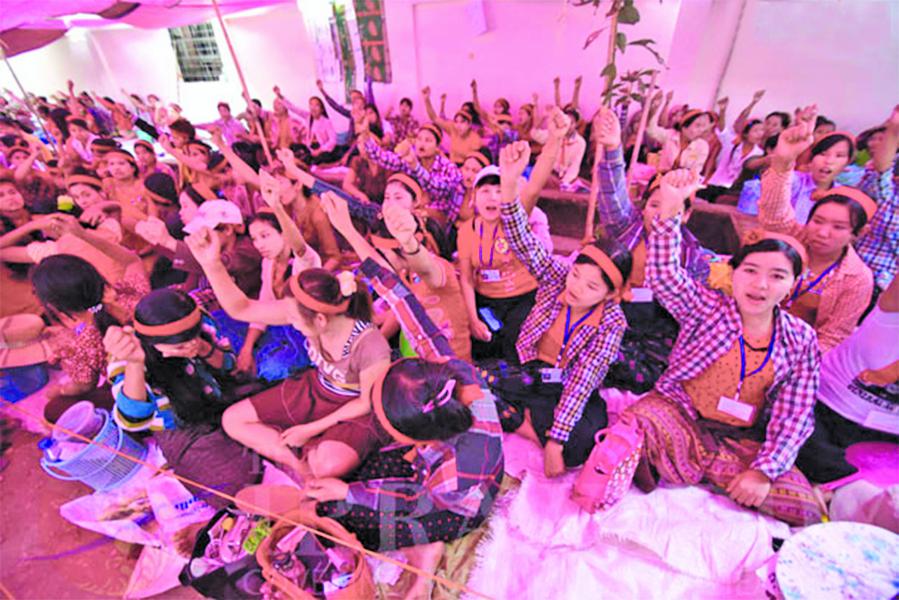
More than 200 garment workers in Yangon, the business capital of Myanmar, marked the seventh day of strike yesterday. The workers are demanding full wage for the month of November, after the owner of the Hteik Tan Myanmar Garment Manufacturing unit withheld half of their pay for failing to meet manufacturing targets.

The protesting crowd comprises more than two-thirds of the labourers of the Hteik Tan Myanmar Garment Manufacturing unit. They have been protesting at the entrance of the Zone No. 4 of Yangon’s Hlaingthayar Industrial Park, since December 7.

Moe Sanda Myint, one of the employees at the unit stated that the manufacturing unit proprietor paid them for less than 15 days for November, though they laboured for the complete month. Although the administration had promised to carry talks with the employees, however they are reluctant to pay the labourers their full wage.

Myint added, “They accused us for failing to work as expected. However as we laboured for the whole month, we’ll proceed with our demand for full wage in discussions with the manufacturing unit’s proprietor, the Federal Government and the Employee’s Union.”
Right from the time the strike started workers were barred from using the manufacturing unit’s ferry and dormitory.

Also ReadMyanmar workers protest for higher minimum wage

Htet Thu Aung, Employee’s Union secretary, who was fired from the company stated that around one hundred workers have also gone to meet Thein Sein, President, Myanmar to file a grievance towards the proprietor of their manufacturing unit for “violating employee’s legal guidelines, but they were stopped by the authorities”.

Apparel exports from Myanmar to US allowed temporarily

Apparel Exports
Image Courtesy: mmbiztoday.com

With Myanmar in the process of forming its new Government after Aung San Suu Kyi’s recent victory in elections, the USA has announced a temporary relief to the exporters in Myanmar, as they will now be allowed to send their goods such as apparel to Myanmar, till next six months. A general license issued by the US Department of Treasury’s Office of Foreign Assets Control declared that companies can now ship goods and nonfinancial services in and out of Myanmar without any sanction problems.

Also Read36-month project concludes successfully in Myanmar

The US companies based in Myanmar would now be able to ship goods through the Yangon port in Myanmar, which is owned and operated by a company on a US sanctions blacklist. As the US Government is not sure if the sanction can be dropped entirely, the license does not allow direct transactions with people who are blacklisted for their ties to the former military regime. The move is said to have been made to avoid the US banks from pulling out entirely from the market due to fear of sanctions risk, and increasing compliance costs and burdens. The restrictions were put to solve a different set of problems connected to use of critical infrastructure, but was unintentionally affecting exports to and from Myanmar. This will certainly help Myanmar in increasing its apparel exports to US.

US businesses operating in Myanmar, including the likes of Gap Inc., General Electric Co. and Coca-Cola Co. have been lobbying the administration to address this issue, and now breathed a sigh of relief. A senior administration official from the Office of Foreign Assets suggested that the six-month license could also be renewed, as they have received numerous written applications for relief.


Wage increase results in high attrition in apparel industry

The implemenWage increase results in high attrition in apparel industrytation of the new minimum wage of US $ 2.80 per day, instead of hope and happiness, heralded despair and frustration for a large section of the workforce engaged in the garment manufacturing units of the country with factory owners resorting to fire around 1,000 factory workers in the wake of the new minimum wage to cut down on the manpower costs, according to the Ministry of Labour. 

In a stark departure from previous year’s astounding growth when a new factory opened every other week (according to the Myanmar Garment Manufacturers Association’s count), one garment manufacturing unit at the Hlaing Tharyar Industrial Zone, has already shut shop, just before the minimum wage came into effect, rendering almost 200 employees jobless with fears of many other units following suit looming large. Though roughly around 237 former workers of the unit have been compensated but there future seem to be in quandary as jobs are in short supply in the once a thriving garment manufacturing industry with numerous units resorting to trimming manpower to accommodate the new salary floor. However, many garment manufacturing units claimed shedding the workforce was majorly related to the declining orders and productivity and have very little to do with the implementation of the new minimum wage while largely South Korea and Chinaowned factories hinted that thousands of jobs would be at risk if the Government compels them to accept and implement the new salary floor. 


Business keyboard_arrow_right Sourcing keyboard_arrow_right News

Myanmar gets its first label and tag factory

Image Courtesy: pixshark.com
                       Image Courtesy: pixshark.com

Myanmar got its first label and tag factory set up in Shwe Pyi Thar township, Yangon, by a Hong Kong based company Baolaixin Industry Development. While there are other garment accessories manufacturers in the country that produce hangers, carton boxes, and polyethylene bags, but this is the first company to produce different types of transfer print woven labels and hang tags of international standard for garments. Earlier Myanmar had to import all such inputs from different countries, but with the growing apparel companies in the country, investment in trims manufacturing setups is also increasing.


36-month project concludes successfully in Myanmar

36-month project concludes successfully in Myanmar
                     Image Courtesy: eu-myanmar.org

EU-funded 36-month long programme with focus on improved Garment Manufacturing and Boost Production concluded successfully. Started in January 2013, The SMART Myanmar Compliance Academy project aimed to teach and train factories in increasing compliance level, promoting social responsibility, increasing productivity, improving safe working environment and labour rights.

“When we first started here in 2013, no one here knew about international standards regarding working condition, no one knew about it… but when the factory started to learn what it means and that is also precondition to enter European markets, factory were very keen to learn and to introduce procedure to make the working condition better for the factories,” Project Director, SEQUA gGmbH, Simone Lehmann said.


Myanmar likely to slash tariffs on fabrics imported from Taiwan

Image Courtesy: housewizard.wordpress.com
        Image Courtesy: housewizard.wordpress.com

Following an economic dialogue between Myanmar and Taiwan, Myanmar is considering the possibility of lowering its tariffs on fabrics imported from Taiwan. The decision came post a Taiwanese delegation led by Yang Jen-ni, head of the ministry of Economic Affairs’ Bureau of Foreign Trade visited Yangon to meet the economic authorities in the country. A joint statement pledging facilitation of trade and investment between the two countries was also signed. Taiwanese fabric importers currently pay import duties of about 5-15 per cent, and fabrics imported, account for 14 per cent of the total imports in Myanmar from Taiwan. 


Job loss – Side effect of increased minimum wage in Maynmar

Image Courtesy: jto.s3.amazonaws.com
               Image Courtesy: jto.s3.amazonaws.com

From September 1, garment workers in Myanmar industry were supposed to get new higher minimum wage of K3600 but many of them have lost their job as garment factory have shut. Though just one factory has so far closed, but more than 1,000 workers have lost their job which includes almost 200 employees at a garment factory in Hlaing Tharyar Industrial Zone – Ministry of Labour has confirmed this.

“We are trying the best we can to quickly create more jobs for those laid off workers,” said U Aung Htey Win, Deputy Director General of the Labour Ministry. Ma Myat San Win, Director of UMH Garment Factory at Shwe Pyi Thar Industrial Zone, where more than 400 labourers have been dismissed, said “We cannot continue operating the garment business with these runaway costs. Therefore, we have had to lay off the workers and give compensation.”


Myanmar: Government to enact the Minimum Wage Law

MyanmarGovernment to enact the Minimum Wage LawMyanmar’s Labour Ministry is encouraging prompt negotiations between employers and employees in Yangon’s garment factories to get a proposed figure for the national minimum wage to be submitted in the Parliament for debate and approval. The speaker of the Parliament has suggested that both the parties consider the daily wage level of 3,000 Kyats (about US $ 3) – for Government employees set by the Ministry of Finance and Revenue – as a standard for setting the minimum wage level for workers. The minimum daily wage levels ranges from 900 Kyats to 1,300 Kyats currently.

Welcoming the efforts of the Myanmar Government to enact the Minimum Wage Law, H&M also expressed concern that it has not been implemented in the past two years despite its enactment in March 2013. “In setting a minimum wage level, we advise that the Government set a uniform level across all industries in compliance with the ILO C.131 Minimum Wage Fixing Convention. If the garment industry’s wage levels are lower than other industries, it will not be able to attract and retain skilled labour force, which it needs to develop and grow into a thriving economic driver,” observed H&M’s management.


$2.80 daily minimum wage from September 1

$2.80 daily minimum wage from September 1
          Image Courtesy: obdc.com

After two years of often acrimonious debate From September 1, Myanmar has set a minimum wage of 3,600 kyat (US $2.80) for an eight-hour work day. The current daily minimum wage is 3,000 kyats (US $2.59). The step is expected to boost investment in the fast-growing country’s garment industry as well as motivation for workers. It did not mention overtime compensation. Buyers like H&M, Gap have pushed for creation of a minimum wage. Now Myanmar’s minimum monthly pay would be around $67 a month, based on a six-day work week, giving it a competitive advantage over thriving garment makers such as Vietnam and Cambodia where the monthly minimum wage ranges from $90 to $128. It is also being said that the approved wage would apply to workers across all sectors, but exclude small and family-run businesses that employ fewer than 15 people.

According to the Global Trade Atlas, Myanmar exported US $1.5 billion of apparels and materials in 2014, up from US $1.2 billion the previous year.

Events keyboard_arrow_right News

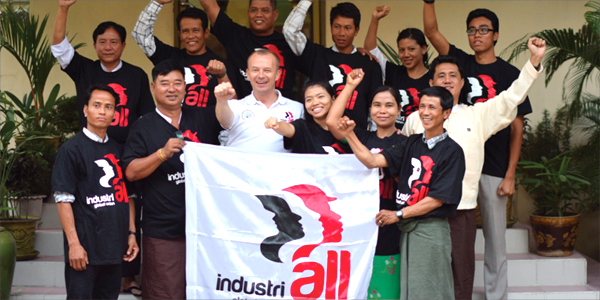
IndustriALL organises workshop on living wage in Myanmar

 Image Courtesy: industriall-union.org
                     Image Courtesy: industriall-union.org

Recently, IndustriALL held a workshop on living wage in Yangon, Myanmar. Participants at the workshop discussed how to use wage-fixing mechanisms, how to combine a minimum wage strategy with collective bargaining, and how to extend collective bargaining agreements to sub-contractors and to cover contract and other precarious workers. There was an agreement over the collective bargaining process that it should have some tripartite mechanism to monitor it, which may lead to reducing the number of strikes. Furthermore national unions can get help from the global trade union federations to apply pressure. National unions should get the Government to agree to a contract for precarious workers. Contract workers should be covered by the factory’s collective bargaining agreement, as well as the minimum wage.

IndustriALL aims to strengthen affiliate actions to achieve a living wage in Myanmar, improve understanding of how unions can use the different wage-fixing mechanisms, explore how IndustriALL’s global living wage campaign can be used to improve wage outcomes in Myanmar, and further develop the affiliates’ campaign for implementation of the new minimum wage of US $ 3.2 per day.


Angelina Jolie and Aung San Suu Kyi meet garment factory workers in Myanmar

Angelina Jolie and Aung San Suu Kyi meet garment factory workers in Myanmar
Image Courtesy: dailymail.co.uk

United Nations’ special envoy and Hollywood actress Angelina Jolie along with Aung San Suu Kyi, , a Burmese opposition politician met the garment factory workers, largely women workforce, in Hlaing Tha Yar, a town on the western outskirts of the city. The two talked to the workers about their living and working conditions as well as their aspirations for further education.

Jolie on her four-day tour was in Myanmar at the invitation of Suu Kyi, according to the British Embassy, which is working with Jolie as part of the Preventing Sexual Violence Initiative that promotes prosecutions of sexual violence perpetrators.