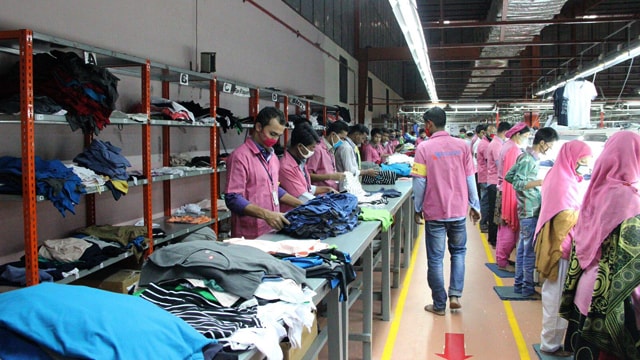
Bangladesh’s ready-made garment exports achieved a substantial growth in all its major export destinations including the European Union, the US and Canada in the first two months (July and August) of the current fiscal year 2017-18.
A report published by Bangladesh Export Promotion Bureau (EPB) has announced the latest figures.
According to the EPB, Germany has outstripped the US to become Bangladesh’s biggest apparel export destination in the last two months. The export has grown by 9.72 per cent to US $ 992.39 million from US $ 904.4 million in the same period of FY 2016-17.
The export earnings, however, from the Asian countries including China, Japan and India declined in the reporting period.
Garment exporters and business experts maintained that the growth rate has been satisfactory so far and Bangladesh is enjoying benefits of the recent rebound of the Euro against the American dollar.
Though the Chinese market is a promising one for Bangladesh’s apparel industry, it has been failing to gain market share there due to lack of competitiveness. Vietnam is, however, gaining market share rapidly, they added.
RMG export earnings from China in July-August period of the FY 2017-18 fell by 6.80 per cent to US $ 62.38 million from US $ 66.94 million in the same period of FY 2016-17.
Meanwhile, earnings from the readymade garment export to the US market in the first two months of the FY 2017-18 grew by 9.62 per cent to US $ 990.81 million from US $ 903.89 million in the same period of the FY 2016-17.
Apparel export to the UK, the 3rd largest export destination for Bangladesh, rose to US $ 733.78 million from US $ 567.17 million with 29.38 per cent growth during the period.
Bangladesh apparel industry is expected to remain as the top apparel sourcing destination for international fashion brands and retailers over the next five years, highlights Mckinsey & Company’s latest survey.
The competitive prices offered by the country and China’s shrinking market share are the factors contributing to the sector’s growth.
Mckinsey & Company, an influential worldwide management consulting firm, prepared the survey titled ‘Digitization: The next step for the apparel-sourcing caravan’. The report is based on the interviews of Chief Purchasing Officers (CPOs) of 63 leading global apparel retailers and brands that buy garment items worth US $ 137 billion a year.
According to the survey, the CPOs were asked to name three countries which they expect to be the top sourcing destinations over the next five years. In response, 49 per cent of the CPOs mentioned Bangladesh as their first choice, 43 per cent chose Ethiopia, 37 per cent opted for Myanmar, 35 per cent for Vietnam and 22 per cent selected India.
“Bangladesh retains the top spot, selected by nearly half of all respondents, similar to its rating in 2015,” the survey underlined.
Bangladesh, the second-largest apparel exporter globally after China, exported apparel items worth US $ 28.04 billion in the recently concluded 2016-17 fiscal year, securing 0.20 export growth rate year-on-year.
Although the last year’s growth rate was the slowest in last 15 years, the promising sector of Bangladesh has rebounded and increased by 14.05 per cent on year-on-year basis to US $ 5.52 billion in the first two months (July-August) of the current fiscal year.
“I certainly believe Bangladesh will be the top choice of global retailers and brands as the garment sector improved workplace safety and other compliance after fixing the structural, electrical and fire loopholes,” said Siddiqur Rahman, President of Bangladesh Garment Manufacturers and Exporters Association (BGMEA).
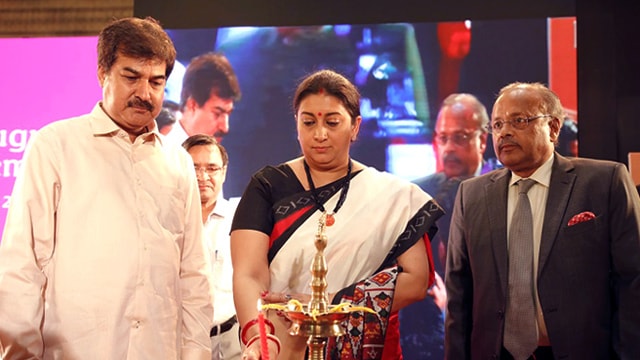
India’s Union Textile Minister Smriti Irani lightening the lamp at the inauguration ceremony of Vastra 2017 in Jaipur, Rajasthan
The Union Minister for Textiles and Information & Broadcasting Smriti Zubin Irani inaugurated the 6th edition of the four-day international textile and apparel fair VASTRA 2017 at the Jaipur Exhibition and Convention Centre (JECC) in Rajasthan on September 21.
The event is being organised by the Rajasthan State Industrial Development and Investment Corporation Ltd. (RIICO) and Federation of Indian Chambers of Commerce and Industry (FICCI).
At the inauguration ceremony, Irani said, “The textiles sector, which provides direct employment to over 45 million people and indirectly impacts close to another 20 million households, is growing exponentially in the country. The influx of Foreign Direct Investment (FDI) has been vital in its growth in recent years.”
The Government is providing skill opportunities and incentives to support the industry in reaching new heights, she added.
Over 250 exhibitors from 13 states, around 300 overseas buyers from more than 50 countries and about 200 representatives from around 100 Indian buying houses/agents are participating in the 2017 edition of Vastra.
The Textile Minister also expressed satisfaction on the inclusion of design and other workshops in VASTRA 2017.
Hong Kong-based fashion group Esprit Holdings Ltd. has announced financial results for the year ended in June 2017.
Jose Manuel Martínez, Group Chief Executive Officer of Esprit said, “FY 2016-17 has been a year of good progress and marks the completion of the strategic plan that was announced in the year 2013.”
During the year under review, the fashion retailer noted a threefold increase in its net profit to HK $ 67 million from HK $ 21 million in the 2016 fiscal year. The profit is in line with the company’s expectations of HK $ 50-80 million.
However, Esprit recorded a decline in its revenue from HK $ 17.8 billion last year to HK $ 15.9 billion this year. The company is considering to shut its underperforming retail stores now. It currently operates over 900 stores globally.
The retailer expects a marginal drop in its revenue in the next fiscal year as well.
Esprit, however, has plans in place to improve its gross profit margin by cutting down on discounts and promotions. Additionally, the operating expenses are expected to come down next year which will give better margins to the company.
As shirt manufacturers gear up competencies and expertise to cater to new and potential markets, the importance of quality standards and value-additions have become vital parameters deciding the success and failure of businesses. Apparel Online spoke to a prominent accessory supplier and some top-of-the-line testing labs to know what they think about the shirt business and what is it that they have to offer to achieve value-addition and set new benchmarks in quality and standards.
KDS Accessories
Based out of the port city of Chittagong, KDS Group is one of the leading multi-national apparel and textile conglomerates in the country. KDS Accessories has selected its products finely intertwined with not only the evolution of its accessories business but also with the dynamic nature of the country’s apparel industry. It all started with manufacturing of corrugated cartons for packaging purposes and was sequentially followed by sewing threads, polybags, plastic hangers, tags, labels, polyester button, etc. Debasis Daspal, CEO of KDS Accessories, shares his views.
Shirt Business
Shirt as a product category has good potential to grow but currently is facing some operational challenges to meet the global high standards of quality and craftsmanship. However, the growth rate of shirts significantly lags compared to that of denim and lingerie items in Bangladesh. But as more and more entrepreneurs are inclining towards higher value creation, the possibility of higher number of shirt manufacturers coming up besides capacity augmentation of existing manufacturers seems not so far.
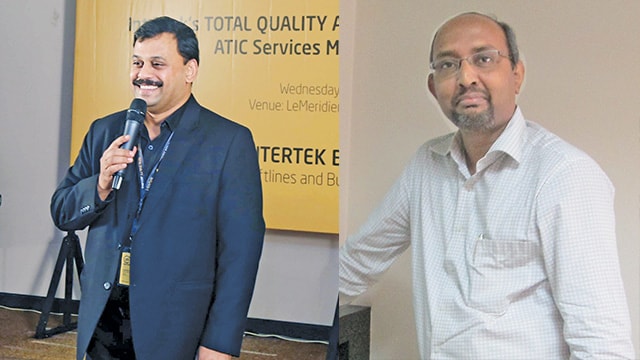
Dr. Karthik N.D., Country Managing Director, Intertek Bangladesh and Debasis Daspal – CEO of KDS Accessories
Accessory requirements
The total number of different trims and accessories is quite substantial in various kinds of shirts depending on styles and sizes. The general requirements of some major accessories in a shirt are: Buttons (2%), Labels & Tags (1%), Carton & Poly (5%), others (7%).
[The percentages are average in terms of FOB value of a garment].
Apart from the considerable value that accessories play in garments’ FOB, the complexity and varieties of any trims are also significant.
Special Buttons
There have been so many special polyester buttons’ requirements for any kind of shirt. The need for variety of buttons range from normal pearl buttons to horn buttons to several types of fancy buttons. Apart from the polyester buttons, several types of metal buttons and snaps are also needed in denim shirts and childrenswear.
KDS’s strength to meet the accessories’ demands
KDS accessories, being the foremost trims and packaging player in the country, stands tall in supplying most of the accessories needs of a shirt manufacturer in the country. Starting from providing sewing threads, buttons, all kinds of labels and print material, hangers, poly and cartons, we are the one-stop trims solution providers to any shirt manufacturer.
Our button facility ramps up overall business by developing our fancy button facility – nickel quoting button (metal look), layer button and others.
Further, we can also develop butterfly, collar bone unit in plastic division which can help gear-up sales.
Over the years, KDS accessories has been working with some of the major shirt manufacturers in Bangladesh like Viyellatex, Interfab Shirt, Mohammadi Group, New Age App, Evince Group, Dressman/Shirt Maker, Shinest Apparels and several others.
Bureau Veritas CPS
Bureau Veritas Consumer Products Services is world’s leading testing, inspection and certification solution provider for the global consumer. It works closely with clients to effectively manage quality assurance needs throughout their supply chains and mitigate risks in terms of quality, health, safety, social responsibility and environment, thus protecting the brand’s reputation and minimize costs. Rasanga Ulluvis Hewage, Regional Chief Executive, responsible for BV Central Asia – covering Bangladesh, Singapore, Thailand, Malaysia & Myanmar, shares his views…
Bangladeshi exporters on scale of 10
Bangladesh is No. 2 in EU and No. 3 in USA, so we could give the country 9 or 8 on a scale of 10 in shirts.
Challenges…
Price and technical barrier to trade ZDHC MRSL, beside PRSL.
BV Support
We conduct technical meetings, seminars and awareness workshops regularly to help and support the industry in various aspects.
UL VS Bangladesh Limited
For over 120 years, UL has been developing scientific-based methods to test the quality, performance and safety of diverse key consumer products. Today, UL solves the safety, security and sustainability challenges of the 21st century. Around the world, UL along with its employees promote safe working and living environments for all people. UL tests, inspects, audits, certifies, verifies claims, advises and trains as well as provides software solutions. Md. Golam Sarwar, Consumer and Retail Services – UL VS Bangladesh Ltd., shares his views on shirts…
Bangladeshi exporters on scale of 10
I will give Bangladesh 6 out of 10 and this is so because we are still not strong enough for woven fabric manufacturing and we cannot accept shorter lead time like less than 45 days.
Five critical testing norms
Dimensional stability to washing, Appearance after washing, Seam slippage (light weight fabric), CF to washing and CF to rubbing.
If the fabric has been treated for easy-care properties, then tests for Formaldehyde, Appearance of seams and Appearance of fabric, includes the above mentioned tests.
Any new testing norm
Nowadays ZDHC (Zero Discharge of Hazardous Chemical) is a very sensitive issue and everybody should know the ZDHC roadmap.
Support from UL
As a third-party, we have expertise in state-of-the-art testing laboratory that can help industry to ensure garment performance quality. We have expert/qualified quality inspection team for garment and fabric inspection to support suppliers and buyers and ensure good quality products.We provide compliance audit like, SEDEX & BSCI that can ensure workers’ health & safety.
We are also offering ZDHC waste water testing, ZDHC audit and sharing knowledge about ZDHC by organizing vendor seminars.
Intertek
Intertek is a leading total quality assurance provider to industries worldwide through its network of more than 1,000 laboratories and offices and a dedicated workforce of over 42,000 people in more than 100 countries.
In Bangladesh and across the world, Intertek offers customers a Total Quality Assurance value proposition, assisting organizations as their trusted quality partner providing ATIC (Assurance, Testing, Inspection and Certification) solutions which go beyond just assuring the quality and safety of a corporation’s physical components and assets to also look at the reliability of their operating processes.
As the globally leading quality assurance provider, Intertek goes beyond physical quality control to provide total peace of mind through its innovative and bespoke assurance, testing, inspection and certification solutions for customers’ operations and supply chains. Country Managing Director of Intertek Bangladesh, Dr. Karthik N.D. shares his viewpoint on shirts…
Five critical testing norms
In physical/colour fastness parameters:
Seam strength/slippageb.
Button attachmentc.
Tearing strengthd.
Pilling resistance for synthetic blendse.
Appearance after washf.
Colour fastness to washing/light
Analytical/RSL:
If trims sourced from local factories or without nominated source the possibility of failure are as below:
Twill tape?Labels: Azo
Button/plastic accessories: Lead, Phthalate
Any new testing norm
Mainly ZDHC requirements and especially focusing on printed shirts/with embellishments, focusing on waste water testing, chemical management etc., in addition to product quality.
Support from Intertek
Increased capability for testing all requirements in Bangladesh, conducting awareness seminars/workshops – DETOX, TECHNICAL – Performance, Regulatory, Product Integrity, etc.
Besides, with a focus on “TOTAL QUALITY ASSURANCE”, we have introduced “ASSURANCE” services, enabling manufacturers and brands to avoid failures by technical collaboration from initial stage of product designing until complete supply chain cycle, till consumer management, named as ATIC services.
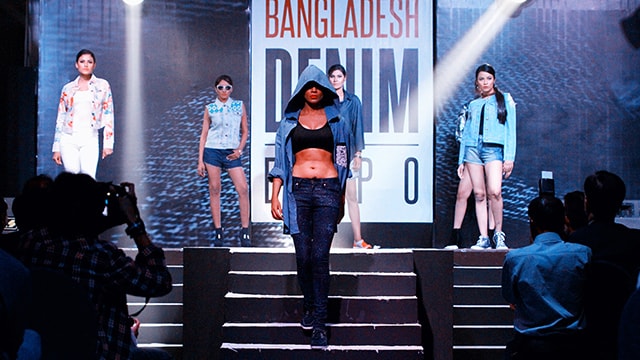
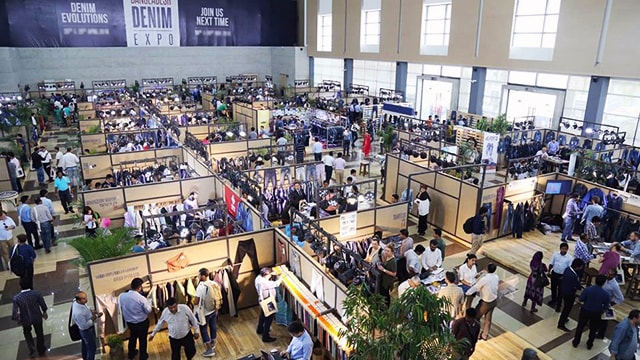
Fifty-eight exhibitors from 12 countries, over 5,000 visitors, four unique seminars and workshops and a bigger ‘Trend Zone’ with a brand new ‘Information Exchange Zone’, the 6th edition of the Bangladesh Denim Expo once again proved why it is one of the most sought-after and much-awaited denim show in the country.
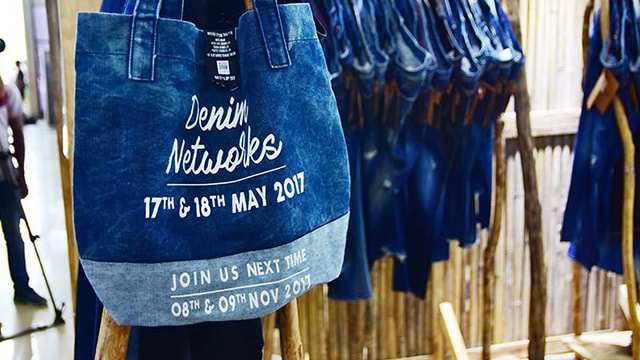
Themed ‘Denim Networks’, underlying the importance of global market in strengthening long-term relationships and mutual approach with focus on innovation and sustainability, the two-day denim extravaganza kicked off to a rousing start at the capital’s International Convention City Bashundhara on May 17, reinforcing the importance of forging business relationships and promoting best working practices.
Image Courtesy: bangladeshdenimexpo.com
Exhibitors from Bangladesh, Brazil, China, Germany, Hong Kong, India, Italy, Japan, Pakistan, San Marino, Spain and Turkey were present in full strength showcasing the latest developments in denim that drew in 5,545 visitors from 1,029 companies and 52 countries, surpassing even the organizer’s expectations, more so considering the security concerns following the string of unfortunate incidents that had rocked the country in the recent past.
Fabrics on the forefront
A regular participant in the Denim Expo, Shasha Denims Limited – one of the leading denim fabric producers in Bangladesh – was back again, and this time with products woven around the theme of sustainability, the company’s thrust area in terms of offerings in the last couple of years. “This time we introduced a new theme, ‘Blue is the new Green’, through which we want to share a message with all our buyers and the denim lovers in general. ‘Blue’ means Denim and ‘Green’ means Sustainability, thus ‘Blue is the new Green’. Whatever we’re producing currently and plan to do are/and would be sustainable,” proudly declared Mohammad Jamal Abdun Naser, Director, Shasha Denims Ltd.
Living up to the billing of the largest textile industry in Latin America which takes pride in innovation and novelty, Brazilian denim specialist that thrives on the concept of sustainability – Vicunha Textile showcased a wide range of products in the expo including the latest in innovation from their sable.
“We consider Bangladesh an extremely potential market and have come this time with our vintage authenticity, the authentic high ridges, our heavyweight denims, high-stretch items and luxury fabrics,” underlined Abdelkader Amouche, Regional Manager, Vicunha Textile, expressing satisfaction that the expo has been a decent business generator for them.
Image Courtesy: bangladeshdenimexpo.com
For NASSA Denim, another big name in fabric production in Bangladesh, the stage of Bangladesh Denim Expo was the apt setting it was looking for to display its latest innovation – antimicrobial fibres, fit for prolonged usage sans washing, thanks to the anti-bacterial properties! “This highly-specialized fabric has been used in hospitals and hotel industry earlier but never in denim jeans manufacturing and that too with dyeing…,” maintained Agha Nadeem Mirza, Head of Denim, NASSA Denim.
Despite increased production cost (almost 20 per cent compared to conventional fabrics), NASSA is more than happy with the buyer’s response and looking forward to market it in countries that have good demand for such products. “We may not sell this fabric to Bangladeshi manufacturers… We’re looking at Japan as the market there always seeks innovative and diversified offerings,” revealed Arafat Hossain, Executive, NASSA Denim, who like many others was all praise for the expo and vouched for its increasing popularity. “Earlier, we had to remind our overseas clients about this expo, but now the scenario has changed completely. They not only remember the dates (of the event) but also look forward to attending it,” said Arafat while advising the organizers to allow participation of only those who have a R&D team. After all, the platform of Bangladesh Denim Expo is about showcasing something new and unique, reasons Arafat.
China-based denim fabrics producer Guangzhou Foison Textile Co. Ltd. was also extremely delighted to be part of the event. The fourth time participant is a manufacturer of an array of denim fabrics such as overdyed, mercerized, mercerized stretch and even printed items. With its experience of more than 10 years in denim fabrics, Foison showcased a number of innovations. “For this edition of Bangladesh Denim Expo, we’ve a number of new developments in cotton, twill, rayon fabrics, etc. We’re here to showcase competitively-priced, superior-quality good-stretch fabrics to the customers,” stated Yoo, Country Manager of the company, who hailed the expo for the sheer significance that it carries for the denim fraternity. “With every edition they are breaking the record of visitors and exhibitors. It has become a very good platform to exhibit our products to the potential customers. It’s a big boost for our business… Dhaka also is a tremendous market for denim fabrics,” Yoo quipped.
Image Courtesy: bangladeshdenimexpo.com
Present in the event was also Nice Denim Mills Limited (NDML), a subsidiary of Noman Group, exhibiting its range of cotton stretch fabrics as well as blends in viscose, tencel, etc. “We have received very good response so far. The platform of Bangladesh Denim Expo is a very good opportunity to showcase our offerings,” underlined Nur-E-Yasmin Fatema, Deputy Managing Director of Noman Group, adding how NDML is all geared up to produce high-quality denim fabrics. One of the top-of-the-line denim mills in Bangladesh (considering the fact that it is integrated with weaving, spinning and processing/colouration), NSDL is equipped with state-of-the-art machines, including rope dyeing machines from Morrison and Greenvile (USA). “We have the capability to produce fabrics in line with what are being manufactured in Pakistan and China as we are using technologically advanced rope-dyeing machines,” added Fatema. NSDL produces around 2.5 million yards of fabrics per month to cater to names such as H&M, Marks & Spencer, Next, Aldi, Lidl, Levis, Lee, etc.
Fifty-eight exhibitors from 12 countries, including Bangladesh, Brazil, China, Germany, Hong Kong, India, Italy, Japan, Pakistan, San Marino, Spain and Turkey participated in the expo.
Altogether 5,545 visitors from 1,029 companies and 52 countries attended the event.
Technology – An important aspect of fashion denim
Not to be left behind, machine manufacturers, solution providers and accessories makers also came up with the latest developments. One such name in sustainable and efficient finishing technology was Jeanologia which introduced its laser solutions and ecosystems in this expo. The Spanish company which is operating in Bangladesh for the last 17 years and boasts of a rich clientele here, showcased novel solutions that are able to increase the production capacity of laundries, reduce the time-to-market and offer innovative, creative and ecological products. The ‘Zero Water Washing Plant’ of Jeanologia allows water savings of up to 95 per cent and 90 per cent chemical use in finishing processes of jeans. It further aims to transform Bangladesh’s denim production centres into eco laundries by integrating all technologies – laser, ozone and nano-bubbles.
Image Courtesy: bangladeshdenimexpo.com
Participating for the second time in this event, Jeanologia understands how denim expo has become a key platform for the Bangladesh denim industry over the years. “It has started to become well known internationally. In fact, we’ve many visitors from sourcing companies, and brands and retailers this time from around the globe. I think that it has got a real big impact and hope that it is going to be a good tool for the industry to improve the image of Bangladesh denim in the world,” said Jordi Juani, Director – Asia Division, Jeanologia.
Accessories impress…
One of Italy’s leading label producers (nominated supplier of some of the biggest European retailers), Panama Trimmings Ltd., was the sole Italian exhibitor in the Bangladesh Denim Expo. “The market here is growing a lot. It has great potentiality… I believe the demand will only increase by each passing day. But Bangladesh needs also to develop infrastructure to facilitate buyers, manufacturers and exporters as a whole,” observed Davide Menini, Area Sales Manager of the company.
Another torchbearer of sustainable production, ISA TrimTec, the leather trimming division of Germany-based global footwear brand ISA TanTec, presented the latest developments of leather patches and laces for apparels, shoes, bags and accessories in the exposition. Manufacturing from three different factories in China, Vietnam and USA, respectively, the label producing giant exhibited an array of labels for the Bangladesh market. “We’ve been focusing on credibility and sustainability as sustainability has become the buzzword for the industry. As Europe is our main market and being the nominated supplier of global retailer like TomTailor, we realize how important Bangladesh market is for us,” said Susan Fu, Sales Manager of ISA TrimTec. A first-time participant in the denim expo, Susan termed the exhibition a great opportunity for business generation. “This is our first time in this event. But we have already decided to participate here on a regular basis as we feel this expo can play a crucial role in helping us grow in Bangladesh,” Susan underlined.
From the visitors’ eyes
Considering the significance of Bangladesh Denim Expo as one of the prime business generating platform, most of the visitors were unanimous in their opinion that it has been a game changer for sure. One of the leading native denim manufacturers of Bangladesh and a regular visitor, Gazi Mahmudul Alam Director of Mahmud Group observed: “In Bangladesh we have two denim exhibitions, of which Bangladesh Denim Expo is better in my opinion…” The bi-annual nature of the event was not something which was up to Alam’s likings though, who suggested a sole edition of the exposition per year instead.
Notwithstanding its reputation and role in catapulting Bangladesh as the preferred denim hub globally, some visitors rued the so-called lack of directions in terms of products. “We look for open-ended products, stressed twill garments, open-ended denims with stretch. We tried open-ended products last time also but it wasn’t worth because of limitations. In this edition there are some exciting innovations, but I would like to see more in terms of trends and directions,” underlined Luke Langthorne, Design Manager, Next Sourcing Limited, London. A regular visitor as he claims, the design manager otherwise was happy with the denim expo, terming it “a great platform to exchange ideas, opportunities and generate business.” Speaking to Apparel Online Luke maintained, “It’s not all about price but also opportunities and trends… This one is a brilliant initiative at bringing all the stakeholders under one roof.”
Seminars add to the charm
Exhibitors apart, who were more than successful in drawing the attention of the visitors from across the globe, the vibrant expo also featured several special events among which were the ‘Tonello Denim Gallery’, ‘Sashiko Stitch’, the ‘Repair Display’ along with the special ‘Information Exchange’ and the absolute novelties of the ‘Virtual Reality Booths’, enabling one to take a virtual trip of a fabric mill, denim factory as well as laundry.
Amongst several seminars organized during the course of the two eventful days, ‘From ideas to technologies: Discovering a new age for garment finishing’ by Alice Tonello, R&D Manager at Tonello Garment Finishing and Piero Turk, a world renowned denim designer, is worth mentioning, which explored the new trends in finishing through cultural, economic, ecological and technical aspects.
The ‘Seminar on Total Quality Assurance: Holistic Approach for Business Excellence’ by Intertek Bangladesh was also a major attraction of the event, which highlighted the company’s assurance, testing, inspection and certification services to the textile and apparel industry of Bangladesh, presented by Dr. Karthik ND, Country Managing Director of Intertek Bangladesh.
Organizer’s perspective
“Bangladesh Denim Expo is an international platform showcasing the wealth of opportunities available in Bangladesh covering all aspects of the denim supply chain with exhibitors displaying fabrics, garments, threads, machineries, finishing equipment and accessories – a true top to toe representation of the denim industry,” observed the beaming CEO of Bangladesh Denim Expo, Mostafiz Uddin, commenting on the success of the 6th edition of the denim extravaganza. “And doing it with an international perspective, especially concerning the inevitable sustainable transition, we all must face, learn to promote and defuse sustainability as much as we can,” Mostafiz added.
The next edition of Bangladesh Denim Expo will be held on November 8th & 9th this year with its promise to overshadow the success and grandeur of the previous editions, keeping true to its tradition of setting new benchmarks in showcasing the latest innovations in denim.
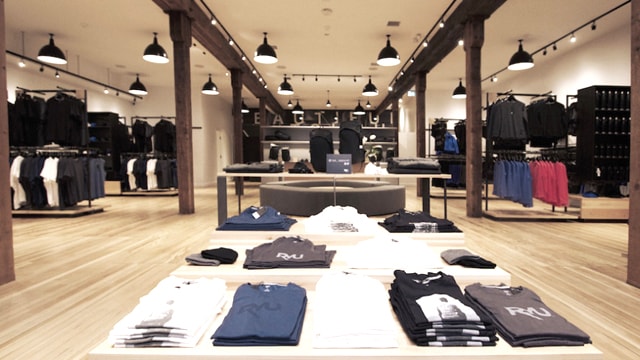
RYU Apparel Inc., a tailored technical urban athletic apparel brand engaged in the development, marketing and distribution of apparel, has inaugurated its first Toronto retail location on September 21. The store is on the iconic Queen Street West Strip.
The fashion retailer has been expanding its presence in the country since the opening of its flagship retail location in Vancouver at West 4th Avenue in 2015.
Rising store counts and booming e-sales jointly helped RYU Apparels to note quick growth during first two years of its foray into the Canadian market.
Retail store in Toronto is the RYU’s first retail presence outside of British Columbia.
After receiving interest from the athletic community in Toronto, RYU Apparel is optimistic and thrilled about setting up of a permanent home in the region.
The company is eager to increase its presence in Eastern Canada to set up a new community for the RYU brand, said Marcello Leone, CEO and President of the company.
Additionally, the Metropolis at Metrotown, the largest shopping centre in British Columbia is all set to get RYU store. This would be the fourth location for RYU Apparel in Greater Vancouver.
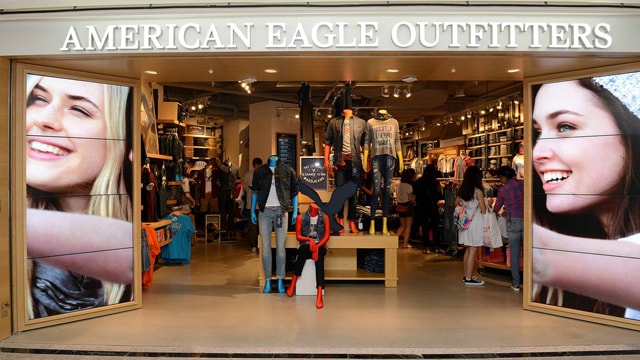
American Eagle Outfitters Inc., an American clothing and accessories retailer, is all set to make its debut in India.
The fashion retailer recently signed a license agreement with Aditya Birla Fashion and Retail Limited (ABFRL), a retail venture of Indian conglomerate Aditya Birla Group, to launch its standalone stores in India.
By virtue of the agreement, ABFRL now has the exclusive rights to retail the American Eagle Outfitters and Aerie brands in India through physical stores and online stores.
ABRFL was in talks with American Eagle Outfitters for the collaboration from past many months.
Andrew McLean, EVP – Global Commercial Operations averred, “Aditya Birla, with its vast market experience and broad retail capabilities, offers a great platform for both of our brands AE jeans collections and casual American style to create the niche in the Indian market.”
The company sees India as a country with a vibrant economy which is growing rapidly. The Indian market offers great business opportunities for international brands, thanks to its largest youth population in the world.
The first two American Eagle Outfitters stores will be opened in the two Tier I cities, Mumbai and Delhi, in September 2018.
Currently, the company operates more than 1,000 American Eagle Outfitters and Aerie stores in the US, Canada, Mexico, China and Hong Kong. The brands are also available in over 190 international locations operated by licensees in 24 countries.
With Marc Jacobs staging the concluding show of the New York Fashion Week’s (NYFW) official calendar, the fashion circus has finally fled across the Atlantic to see the rest of the Spring/Summer 2018 shows in London, Milan and then Paris.
Owing to the departure of four key designers (Altuzarra, Proenza Schouler, Rodarte and Thom Browne) who are planning to show in Paris this time, New York’s fashion prowl did get a bit dull but there is still enough talent in the city to keep the world on its toes.
The location switch may be more about business and retail-friendliness than directionality. However, the season’s overall theme was all about using ‘America’ as the key reference point.
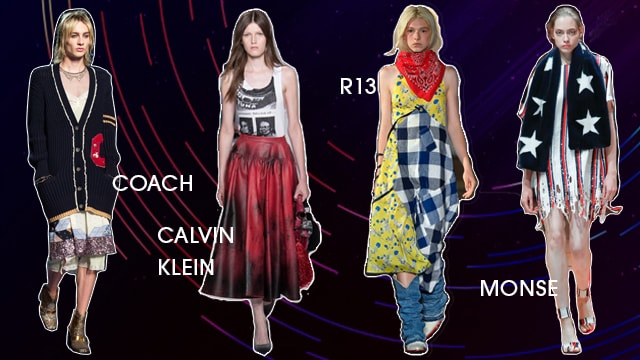
On one side, designers are taking notions of the ‘American Dream’ and completely twisting it over its head, while others like Monse are taking comfort in the idea of an older, simpler time with pioneer style dressing clearly coming back in vogue.
Another clear indication of this optimistic mood was the season’s hot pop colour story that danced between everything from bright yellow and tangy oranges to saturated marina blues.
While we will be doing in an in-depth coverage of the season’s colour palette at the end of fashion month, here are the key trends for Spring/Summer 2018 from New York Fashion Week.
AMERICAN PIE
Coach, Calvin Klein, R13 and Monse.
Designers are undoubtedly renegotiating their personal histories and relationship with the country as a way to distinguish their work, while also throwing light on the going political upheaval at the same time.
Calvin Klein’s homage to America took horror film plots on a high-fashion ride with wispy satin shirts, fifties style paint splattered full skirts in glove leather and eerie Warhol prints on everything from tanks to madcap dresses. Monse went into a celebration mode with varsity cardigans, sports jerseys and putting stars and stripes on almost everything.
LILAC PURPLE
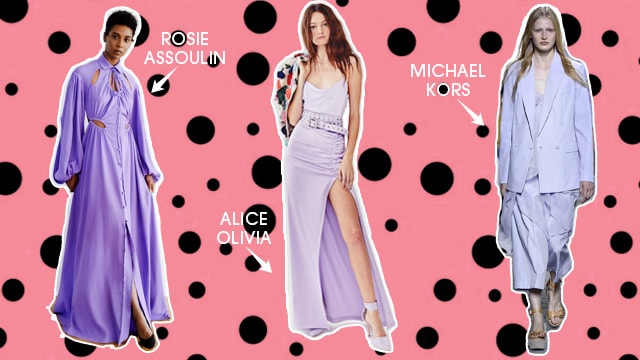
Rosie Assoulin, Alice + Olivia and Michael Kors.
The last season’s millennial pink has distended far and beyond the realms of fashion. While pink still has some momentum left, it has transitioned into the new hue for Spring 2018 collections i.e. baby lilac and soft purples.
Michael Kors made use of the shade’s serenity in floor-grazing skirts and palm print jackets and trousers; GCDS stuck to silk bomber jackets and Rosie Assoulin presented long, nonchalantly cut-out gowns in the colour.
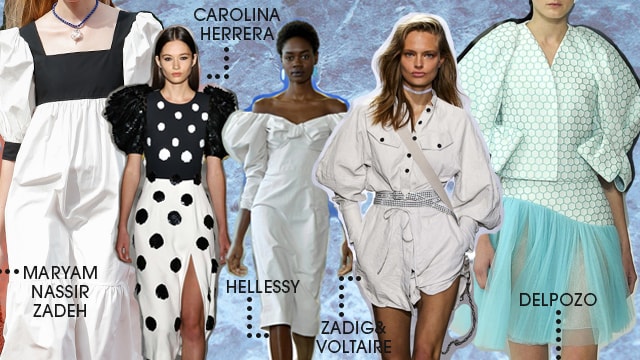
Statement sleeves have been going strong for at least a couple of seasons now and Spring/Summer 2018 will be no different. However, instead of the more seventies bell sleeve of last year, designers are really experimenting with poufy and oversized gigot sleeves this season.
Spotted at Maryam Nassir Zadeh in monochrome mid-length dresses, at Carolina Herrera adorned with large paillettes and at Delpozo in honeycomb prints, this is a trend to watch.
OPTIMISTIC LINES
Derek Lam, Diane Von Furstenberg, VFiles and Jonathan Simkhai.
Stripes in the free-flowing silhouettes and candy cane colours are adding just the right amount of fun to silhouettes that are actually quite wearable. The lines, which are mostly vertical this season, are crafting a balanced dose of business with pleasure at designers like Diane Von Furstenberg and Derek Lam.
Stripes were spotted on PVC fabrics at VFiles and in artfully cut and spliced cotton(s) at Jonathan Simkhai.
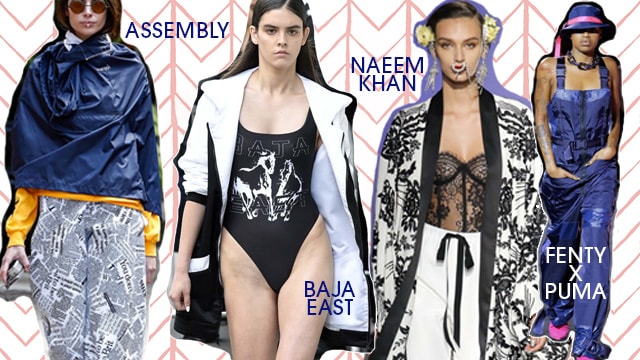
GLAM-SPORT
Assembly, Baja East, Naeem Khan and Fenty x Puma.
The next phase of athleisure is already here and it is far more fashion forward than its elder cousin. Designers are taking utilitarian sportswear looks and taking it out for a bourgeoisie glamour spin.
Rihanna’s sportswear collaboration with Puma is perhaps the best embodiment of sport-glam. Her vaguely technical sportswear was dotted with cargo pants, swimsuits and nylon jackets.
Apart from the pop star, luxury brands like Assembly, Naeem Khan and Baja East are keeping up with the trend as well.
WORKER’S JUMPSUIT
Adam Selman, Marc Jacobs, Colovos and Creatures of Comfort.
As contrasting rebuttals on gloom and polity keep going strong in global culture, so will the utilitarian detailing in fashion apparels. Taking a breather from sequins and all that jazz, the designers have kept jumpsuits very raw to its roots this season. Creating separates that look like worker’s uniforms and racing style suits are brands and designers like Creatures of Comfort in super minimalist details, Colovos in business stripes and Adam Selman in clean dark denim.
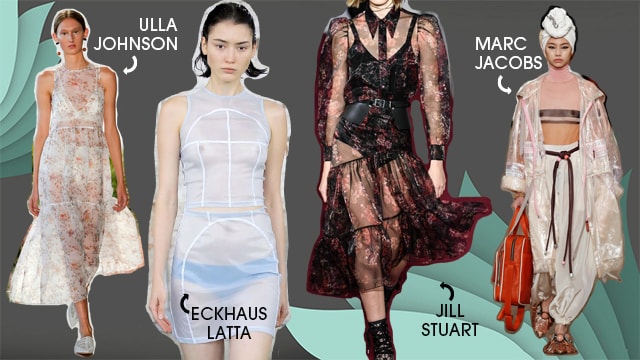
SEE‘ING’ THROUGH
Ulla Johnson, Ekhaus Latta, Jill Stuart and Marc Jacobs.
On one side, there are brands like Gucci and this season’s Gucci look-alike Coach 1941 who are going all out on maximalism; there are plenty of designers still keeping things clean and minimal.
Celebrating all things feminine and beautiful, sheer and semi-transparent fabrics like gossamer-light georgettes, organza and chiffons are reigning strong. Eckhaus Latta showcased a collection that was almost completely see-through; Jill Stuart went for prairie girl florals in pioneer dresses and Marc Jacobs took the sporty bend with plastic-blend jackets.
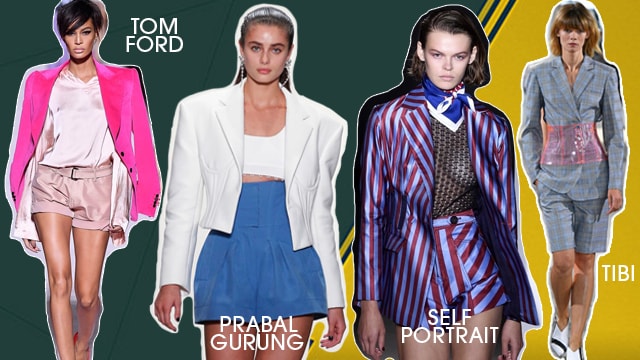
BUSINESS SHORTS
Tom Ford, Prabal Gurung, Self Portrait and Tibi.
Hemlines of both dresses and skirts may be dropping lower and lower this season but shorts are staying in their pin code. However, the silhouette is becoming supremely ‘work-appropriate’ by pairing this young favourite with suit jackets and formal blazers.
As seen on multiple runways like Prabal Gurung, Tom Ford, Self Portrait, and Tibi in combinations that go from matching separates to complete intermixes, this is definitely the silhouette to watch out for Spring/Summer 2018.
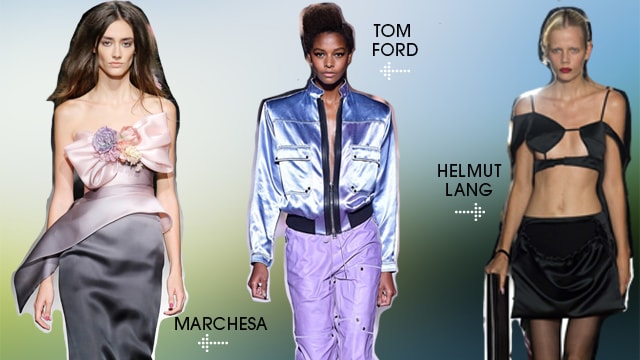
SHINE BRIGHT
Marchesa, Tom Ford and Helmut Lang.
Although daytime sequins might have petered out this season, there is enough summer twinkle still in place. Seen at Tom Ford’s popularly proclaimed ‘fabulous’ collection in almost everything from suit sets to hot pants, silk satins are very much luxurious shine of choice. Helmut Lang created structured bra tops and deconstructed skirts in the fabric, while Marchesa kept things commercial and pretty with ruffled gowns and off shoulder dresses.
PLOT TWIST
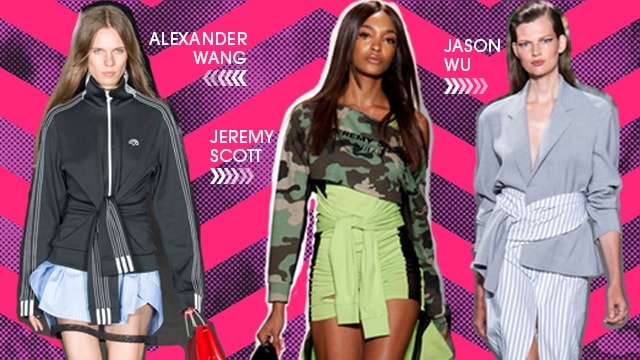
Alexander Wang, Jeremy Scott and Jason Wu.
A perfect simile for fashion month inspirations, fabric manipulation basics like twisting, knotting and over-pulling are the season’s favourite draping trend. The classic trend of tying your shirt around the waist was the go-to nineties waist clincher and designers like Jason Wu, Alexander Wang and Jeremy Scott are making it more of a garment detail this season where there is no need for an extra layer because the knots come attached with the skirt or dress already.
Pakistan has reported an increase of 5.9 per cent in its textile and apparel exports to US $ 2.18 billion in the initial months (July and August) of the ongoing fiscal year. The Pakistan Bureau of Statistics (PBS) disclosed the figures.
The country recorded US $ 2.06 billion revenue in the corresponding period of 2016.
The knitwear segment, in particular, noted US $ 439.26 million in revenue.
Meanwhile, readymade garments (RMG) exports reached US $ 418.63 million (with an increase of 15.7 per cent) during the reporting period. Bedwear exports increased by 8.1 per cent to US $ 384.32 million.
However, cotton cloth exports declined by 7.9 per cent during the first two months of the current fiscal.
Pakistan’s textile industry, which employs 30 per cent of the country’s working population, intensified its efforts to grab benefits of the textile incentive package (Rs. 180 billion) announced by the Government earlier in this year. This contributed to the growth attained in the review period.
The incentives offered by the Government are further expected to increase the export revenue by at least US $ 3 billion by the end of the current fiscal year.
Concessions on duties and exemption from sales tax and customs duty on import of cotton and textile machinery are among few perks offered under the package to boost the industry.
The increase in textile export has come as a breather for Pakistan which had been struggling for quite some time.
A deadly fire breakout in a clothing factory in Munshiganj area of Bangladesh killed at least six on September 20. The area is only 20 kilometres away from the capital Dhaka.
The fire reportedly exploded on the ground floor and quickly engulfed the four-storey building. The ground floor was loaded with chemicals and dyes that fuelled the fire.
Alamgir Hossain, a police officer reportedly said, “The mill was closed during the time of calamity but we found few workers and six bodies including one woman worker from the accident-prone area.”
The Munshiganj fire accident is the second this year in the world’s second-largest garment export country. Earlier in the month of July, Medlar Apparels Factory, an eight-storey building in Ashulia, went up in flames. However, no casualties were reported.
Bangladesh’s garment industry earns around US $ 28 billion annually and employs over 4 million people. The sector generates about 80 per cent of the country’s total export earnings.
This is high time for the country to ensure safety measures for workers after continuous mishaps in the factories.
Inditex, the owner of Spanish clothing and accessories retailer Zara, has reported an increase of 11.5 per cent in its revenue to € 11.7 billion in the first half of the current financial year 2017-18 ended July 31.
The fashion company’s net profit in the first six months stood at € 1.37 billion, up 9 per cent from the same period last year. Its sales during the period too soared 12 per cent to reach € 11.67 billion.
In the first six months, the like-for-like sales for Inditex grew by 6 per cent.
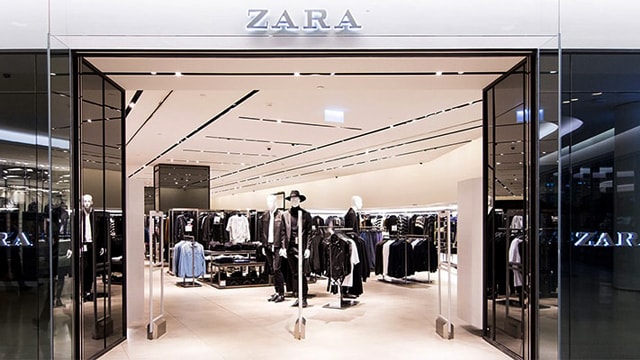
Inditex launched around 113 new stores, including a Zara store in Mumbai (India), Madrid (Spain) and Astana (Kazakhstan). The company’s total number of stores now stands at 7,405 against 7,096 at the end of July last year.
Additionally, Dow Jones Sustainability Index (DJSI) placed Inditex among the most sustainable companies in the retail industry for the second year in a row during the period under review.
The retailer will now launch its online services in India (on 4 October this year). The launch of the online platform will further add fuel to its market size in the country. Currently, Inditex operates in 94 markets, 46 of which have an online presence.







 Bharat Tex Special Report 2026