With Marc Jacobs staging the concluding show of the New York Fashion Week’s (NYFW) official calendar, the fashion circus has finally fled across the Atlantic to see the rest of the Spring/Summer 2018 shows in London, Milan and then Paris.
Owing to the departure of four key designers (Altuzarra, Proenza Schouler, Rodarte and Thom Browne) who are planning to show in Paris this time, New York’s fashion prowl did get a bit dull but there is still enough talent in the city to keep the world on its toes.
The location switch may be more about business and retail-friendliness than directionality. However, the season’s overall theme was all about using ‘America’ as the key reference point.
On one side, designers are taking notions of the ‘American Dream’ and completely twisting it over its head, while others like Monse are taking comfort in the idea of an older, simpler time with pioneer style dressing clearly coming back in vogue.
Another clear indication of this optimistic mood was the season’s hot pop colour story that danced between everything from bright yellow and tangy oranges to saturated marina blues.
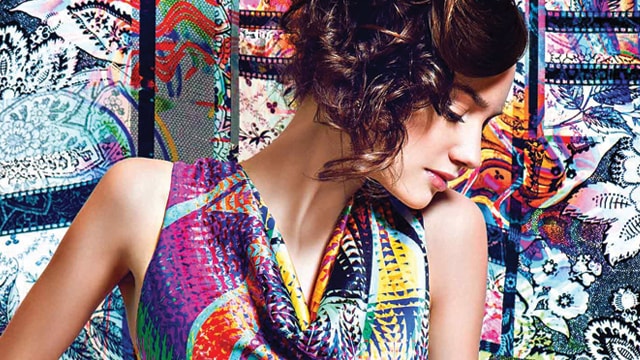
While we will be doing in an in-depth coverage of the season’s colour palette at the end of fashion month, here are the key trends for Spring/Summer 2018 from New York Fashion Week.
AMERICAN PIE
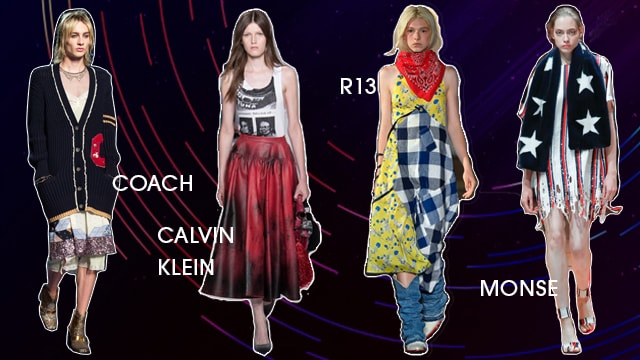
Coach, Calvin Klein, R13 and Monse.
Designers are undoubtedly renegotiating their personal histories and relationship with the country as a way to distinguish their work, while also throwing light on the going political upheaval at the same time.
Calvin Klein’s homage to America took horror film plots on a high-fashion ride with wispy satin shirts, fifties style paint splattered full skirts in glove leather and eerie Warhol prints on everything from tanks to madcap dresses. Monse went into a celebration mode with varsity cardigans, sports jerseys and putting stars and stripes on almost everything.
LILAC PURPLE
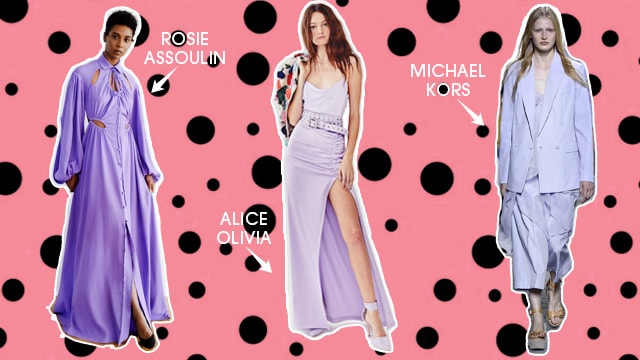
Rosie Assoulin, Alice + Olivia and Michael Kors.
The last season’s millennial pink has distended far and beyond the realms of fashion. While pink still has some momentum left, it has transitioned into the new hue for Spring 2018 collections i.e. baby lilac and soft purples.
Michael Kors made use of the shade’s serenity in floor-grazing skirts and palm print jackets and trousers; GCDS stuck to silk bomber jackets and Rosie Assoulin presented long, nonchalantly cut-out gowns in the colour.
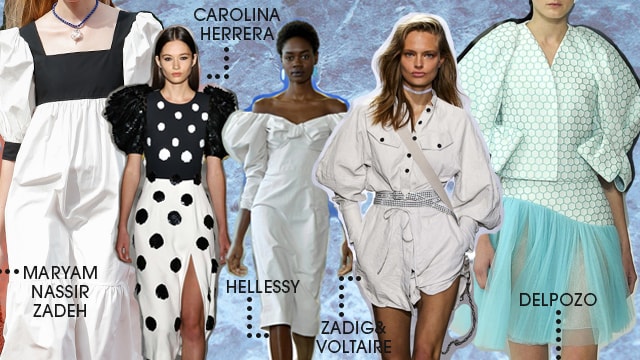
Statement sleeves have been going strong for at least a couple of seasons now and Spring/Summer 2018 will be no different. However, instead of the more seventies bell sleeve of last year, designers are really experimenting with poufy and oversized gigot sleeves this season.
Spotted at Maryam Nassir Zadeh in monochrome mid-length dresses, at Carolina Herrera adorned with large paillettes and at Delpozo in honeycomb prints, this is a trend to watch.
OPTIMISTIC LINES
Derek Lam, Diane Von Furstenberg, VFiles and Jonathan Simkhai.
Stripes in the free-flowing silhouettes and candy cane colours are adding just the right amount of fun to silhouettes that are actually quite wearable. The lines, which are mostly vertical this season, are crafting a balanced dose of business with pleasure at designers like Diane Von Furstenberg and Derek Lam.
Stripes were spotted on PVC fabrics at VFiles and in artfully cut and spliced cotton(s) at Jonathan Simkhai.
GLAM-SPORT
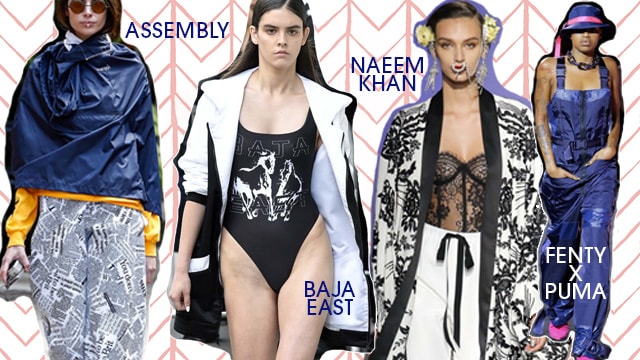
Assembly, Baja East, Naeem Khan and Fenty x Puma.
The next phase of athleisure is already here and it is far more fashion forward than its elder cousin. Designers are taking utilitarian sportswear looks and taking it out for a bourgeoisie glamour spin.
Rihanna’s sportswear collaboration with Puma is perhaps the best embodiment of sport-glam. Her vaguely technical sportswear was dotted with cargo pants, swimsuits and nylon jackets.
Apart from the pop star, luxury brands like Assembly, Naeem Khan and Baja East are keeping up with the trend as well.
WORKER’S JUMPSUIT
Adam Selman, Marc Jacobs, Colovos and Creatures of Comfort.
As contrasting rebuttals on gloom and polity keep going strong in global culture, so will the utilitarian detailing in fashion apparels. Taking a breather from sequins and all that jazz, the designers have kept jumpsuits very raw to its roots this season. Creating separates that look like worker’s uniforms and racing style suits are brands and designers like Creatures of Comfort in super minimalist details, Colovos in business stripes and Adam Selman in clean dark denim.
SEE‘ING’ THROUGH
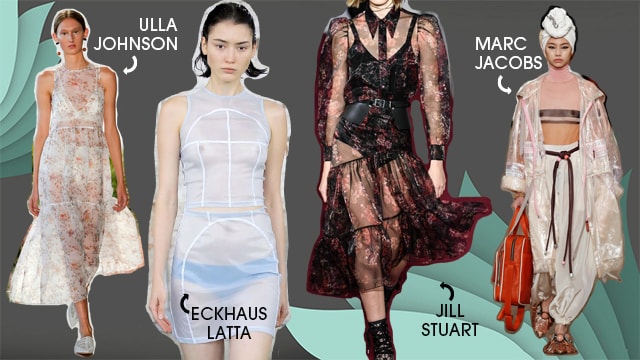
Ulla Johnson, Ekhaus Latta, Jill Stuart and Marc Jacobs.
On one side, there are brands like Gucci and this season’s Gucci look-alike Coach 1941 who are going all out on maximalism; there are plenty of designers still keeping things clean and minimal.
Celebrating all things feminine and beautiful, sheer and semi-transparent fabrics like gossamer-light georgettes, organza and chiffons are reigning strong. Eckhaus Latta showcased a collection that was almost completely see-through; Jill Stuart went for prairie girl florals in pioneer dresses and Marc Jacobs took the sporty bend with plastic-blend jackets.
BUSINESS SHORTS
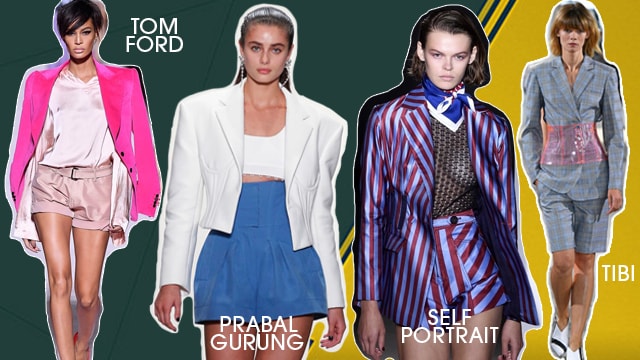
Tom Ford, Prabal Gurung, Self Portrait and Tibi.
Hemlines of both dresses and skirts may be dropping lower and lower this season but shorts are staying in their pin code. However, the silhouette is becoming supremely ‘work-appropriate’ by pairing this young favourite with suit jackets and formal blazers.
As seen on multiple runways like Prabal Gurung, Tom Ford, Self Portrait, and Tibi in combinations that go from matching separates to complete intermixes, this is definitely the silhouette to watch out for Spring/Summer 2018.
SHINE BRIGHT
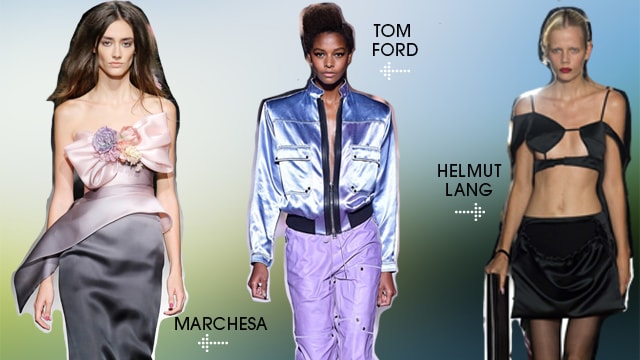
Marchesa, Tom Ford and Helmut Lang.
Although daytime sequins might have petered out this season, there is enough summer twinkle still in place. Seen at Tom Ford’s popularly proclaimed ‘fabulous’ collection in almost everything from suit sets to hot pants, silk satins are very much luxurious shine of choice. Helmut Lang created structured bra tops and deconstructed skirts in the fabric, while Marchesa kept things commercial and pretty with ruffled gowns and off shoulder dresses.
PLOT TWIST
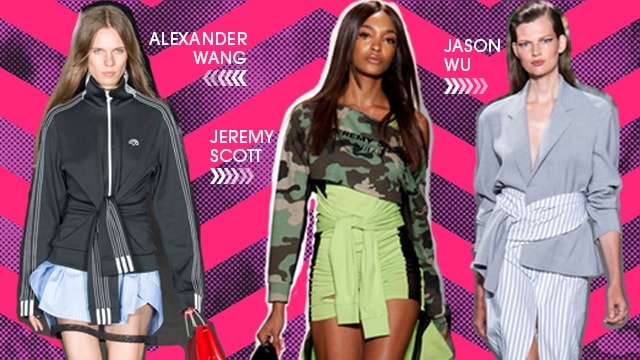
Alexander Wang, Jeremy Scott and Jason Wu.
A perfect simile for fashion month inspirations, fabric manipulation basics like twisting, knotting and over-pulling are the season’s favourite draping trend. The classic trend of tying your shirt around the waist was the go-to nineties waist clincher and designers like Jason Wu, Alexander Wang and Jeremy Scott are making it more of a garment detail this season where there is no need for an extra layer because the knots come attached with the skirt or dress already.
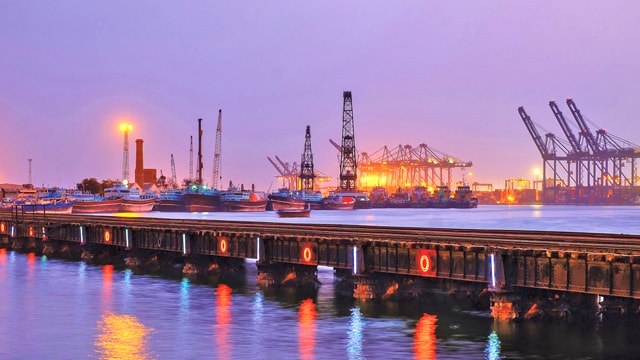
Pakistan has reported an increase of 5.9 per cent in its textile and apparel exports to US $ 2.18 billion in the initial months (July and August) of the ongoing fiscal year. The Pakistan Bureau of Statistics (PBS) disclosed the figures.
The country recorded US $ 2.06 billion revenue in the corresponding period of 2016.
The knitwear segment, in particular, noted US $ 439.26 million in revenue.
Meanwhile, readymade garments (RMG) exports reached US $ 418.63 million (with an increase of 15.7 per cent) during the reporting period. Bedwear exports increased by 8.1 per cent to US $ 384.32 million.
However, cotton cloth exports declined by 7.9 per cent during the first two months of the current fiscal.
Pakistan’s textile industry, which employs 30 per cent of the country’s working population, intensified its efforts to grab benefits of the textile incentive package (Rs. 180 billion) announced by the Government earlier in this year. This contributed to the growth attained in the review period.
The incentives offered by the Government are further expected to increase the export revenue by at least US $ 3 billion by the end of the current fiscal year.
Concessions on duties and exemption from sales tax and customs duty on import of cotton and textile machinery are among few perks offered under the package to boost the industry.
The increase in textile export has come as a breather for Pakistan which had been struggling for quite some time.
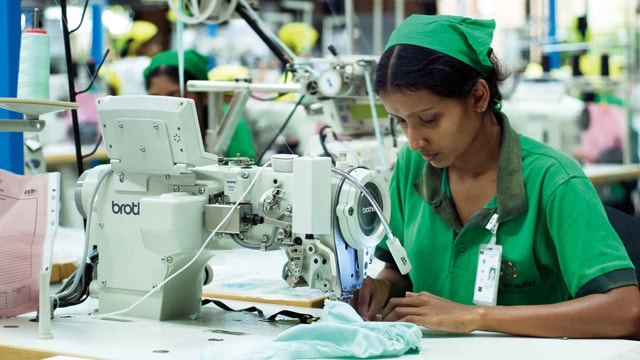
A deadly fire breakout in a clothing factory in Munshiganj area of Bangladesh killed at least six on September 20. The area is only 20 kilometres away from the capital Dhaka.
The fire reportedly exploded on the ground floor and quickly engulfed the four-storey building. The ground floor was loaded with chemicals and dyes that fuelled the fire.
Alamgir Hossain, a police officer reportedly said, “The mill was closed during the time of calamity but we found few workers and six bodies including one woman worker from the accident-prone area.”
The Munshiganj fire accident is the second this year in the world’s second-largest garment export country. Earlier in the month of July, Medlar Apparels Factory, an eight-storey building in Ashulia, went up in flames. However, no casualties were reported.
Bangladesh’s garment industry earns around US $ 28 billion annually and employs over 4 million people. The sector generates about 80 per cent of the country’s total export earnings.
This is high time for the country to ensure safety measures for workers after continuous mishaps in the factories.
Sri Lanka has recently regained the Generalized System of Preferences Plus (GSP+) status from the European Union (EU). The country is expecting the facility to help increase its apparel exports by around US $ 400 million.
“We have received the GSP Plus status and the apparel exports are projected to increase further,” claimed Minister of Industry and Commerce Rishad Bathiudeen.
The GSP facility allows the developing countries like Sri Lanka, Vietnam and Bangladesh to pay fewer or no duties on exports to the EU. The status gives them a vital access to the EU market which contributes to their growth immensely.
The media reports claim that the EU is offering a concession worth Euros 2.6 billion for exports from Sri Lanka each year.
The country reported overall apparel exports worth US $ 4.8 billion last year. In the first half of the current year, the Sri Lankan apparel industry has already recorded US $ 2.7 billion in revenue from exports.
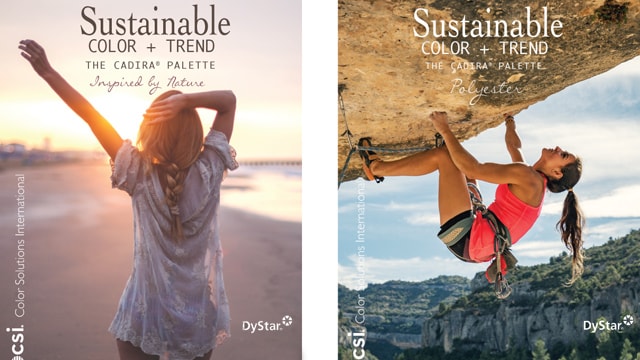
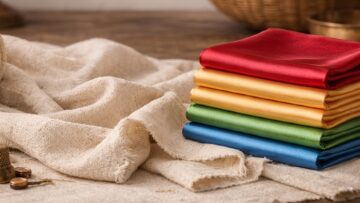
Singapore-based DyStar, together with CSI (Colour Solutions International) colour team, has announced to launch two new issues of their Sustainable Colour and Trend magazine. The magazine will incorporate the details of Cadira colour palettes.
The first one is a ‘reactive-issue’, Inspired by Nature, which offers colour palettes with softer, muted tones, earthy shades of green and levels of neutrals.
Another one is ‘Polyester issue’ which offers options of more vibrant and saturated colours. This edition is dedicated towards colours for active outerwear.
The magazine will inspire colour managers and designers as it will offer eco-friendly palettes and colour combinations, said DyStar.
Image Courtesy: dystar.com
According to the company, the magazine will also provide colour validation in CSI’s Relative Color Popularity (RCP) information. Additionally, it will also give in-depth details on sustainable dye recipes that are based on the Cadira resource optimization process.
Furthermore, the company stated that Cadira concept helps in shortening lead times as well as reducing water and energy consumption. The magazine is said to focus on these parameters.
Moreover, the CSI informed that the colour palettes with ecological dyes are its top-most priority as it assists in executing low-impact processes while offering colour and trend information to customers.
Ron Pedemonte, Vice President (Sales and Marketing), DyStar and CSI, Americas, commented, “We are conscious about our environment so we wanted to create a magazine with an ecological colour and optimized processes so that our customers can pick the right colour that will help them reduce their environmental impact in the design process.”
The second largest garment exporter globally, the contribution of shirts in shaping the destiny of the Bangladesh garment industry is beyond question. Starting its journey as an apparel export hub in 1980s with quality formal shirts, shirt as a product category has been a key growth driver for the Bangladesh apparel industry over the years, complemented aptly by knits and bottoms (non-denim and denim) at later stages that helped the country cement its position as the preferred sourcing destination for the global buyers. With increased efficiency and expertise, the shirt manufacturers have started catering to all the major brands and retailers globally including names such as H&M, US retail giant Walmart, British retailer Primark, Germany’s posh brands Hugo Boss and Olymp (formal shirts), and many, many more.
In the global shirt market (as per data from Statista, one of the biggest data management company in US and EU), which stood at US $ 51 billion with total consumption of 2.5 billion pieces in 2016 and is expected to reach US $ 58.5 billion (in terms of value) and 2.83 billion pieces (in terms of volume) by 2020, Bangladesh’s role – which contributed around 10 per cent to the total global shirt import in 2016, is expected to play a pivotal part in shaping the global landscape as far as shirts are concerned.
But despite this positive projection, shirt as a product category has somehow failed to keep pace with the growth of other products. “Of late we are getting more demand for sweaters, jackets, denim and other products which found base in Bangladesh after shirts. This is not to say that there is no demand for shirts, but the increase is only marginal, while for other products, the growth is very significant,” says Khondoker Mahibur Rahman, Managing Director, Stanley Fashion B.D., a buying office that sources shirts in 100% cotton, cotton polyester blends, PV, tencel, modal blends, with fabric mainly coming from China.
Rahman’s statement is not a one-off case and there are facts to substantiate his claim. Data records from BGMEA show that in 1996-97, the export earnings from shirts was US $ 759.57 million, while for trousers, jackets, T-shirts and sweaters, the value of exports were US $ 230.98 million, US $ 230.98 million, US $ 391.21 million and US $ 196.6 million, respectively. Fast forward to 2015-16, in terms of value (export), shirt stood at US $ 2,317.09 million while trousers, jackets, T-shirts and sweaters registered drastic growth to touch US $ 6,319.00 million, US $ 3,774.08 million, US $ 6,118.53 million and US $ 3,182.47 million, respectively. Today knits and bottoms account for a major share of the country’s apparel exports, a trend which is rather surprising considering that formal shirt was the mainstay of Bangladesh’s exports until the early 1990s.
Image Courtesy: tookapic.com
In fact, even as late as 2006, US retailers imported about 33 million pieces of shirts worth over US $ 2.4 billion and nearly one of every four shirts, was made in Bangladesh, but now that the US market is diverting to higher value-added and fashionable shirts, the country is trying to find better efficiency and product development skills in making casual shirts with value that comes from different fabrics and styling options. On the other hand, better technology is also moving in as some high-end brands from Europe are looking at sourcing formal shirts, which is another challenge. Few years ago, Hugo Boss started sourcing T-shirts and formal shirts from Bangladesh from limited number of very compliant garment factories and though the volumes are not so high, it has encouraged some bigger companies to invest in the shirt segment. The company is increasing its volume in the country every year with the improvement of the working environment and compliance practices. Another German high-end brand Olymp has also started sourcing formal shirts from Bangladesh.
In the meanwhile, the unprecedented growth and popularity of denim (Bangladesh has overtaken China to become the largest denim supplier to the European Union and also the third largest denim supplier to the US after China and Mexico) in the last one decade is seen by many as a major reason behind shirt’s fledgling show. Rahman shares that about 75% of his demand is for denim today. “The way the industry has been investing in denim is unprecedented in itself, no other product has grown like this and today we have integrated strengths that did not exist about a decade ago, and this has been pushed by buyers who now look at Bangladesh as a major supplier, both in the basic and fashion segment,” reasons Rahman.
Corporate Shirts
Contributing further to the slowdown in shirt growth has been the diminishing profit margins in the basic shirts and challenges in value addition consequent to inadequate local supply of quality fabrics. Many companies have shifted their focus to other products. One such company is NIPA Group, which has invested heavily in jackets, where the margins are much better and growth opportunities still largely unexplored in the country. “We are offering a wide variety of jackets and the buyers are very happy with our infrastructure, so the product is our growth engine. In shirts, which was once our biggest category, we are mostly now doing casual denim shirts, which is another hot product today, for our existing buyers but there is no real focus on the category as there are many players in the segment and the price offered is very competitive,” shares Md. Khosru Chowdhury, Chairman & MD, NIPA Group.
Are shirts really a stagnant segment or is its growth being overshadowed by emerging categories?Apparel Online interacted with some of the prominent shirt manufacturers and exporters to get the pulse of the shirt business in Bangladesh today and where they feel it’s headed for…
The journey continues…
Given the challenges and bottlenecks that a shirt manufacturer is faced with, one might wonder if shirt as a product category has many takers. On the contrary, there are multitude of garment makers who not only loath at the idea to give up on shirts as yet, rather they have devoted all their resources and energy to carry forward the rich legacy of shirt making which once used to be Bangladesh’s forte; and they have their reasons for it!
Considered an integral part of a man’s wardrobe – wheather one’s style is chinos or suit and tie – there’s no denying the importance of shirts… A white shirt still holds its sway amidst the array of fancy apparels in anybody’s closet. Be it a business meeting with clients or a weekend get-together with friends and family, white shirt continues to be the preferred choice, which finds an apt reflection in the business forecast for shirts.
As per predictions of Statista, if the global demand for shirts stands at US $ 53.36 billion (in terms of value) and 2,580 million pieces (in terms of volume) in 2017, the same would register a steady increase in the coming years to touch US $ 55.17 billion (in terms of value) and 2,657 million pieces (in terms of volume) by 2018 to further increase to US $ 56.8 billion and 2,740 million pieces respectively by 2019.
In this issue dedicated to shirts, Apparel Online handpicked a few shirt manufacturers, who have upped their capacities and competencies to cash in on the opportunity that the global shirt market has to offer.
BSA Group
Currently working from its four production units, BSA Group chiefly supplies formal shirts besides trousers in addition to kidswear to US retail behemoth Walmart. Managing Director of BSA Group, Sarwaruzzaman Khan, shares his views on shirts.
Shirt business today
It is not bad, but is running quite smoothly.
The demand scenario
The demand for shirts is not bad, but overall the demand is more for casual shirts than the formal, which again is dependent on seasons. In terms of percentage, I would say 70% demand is for casual and 30% for formal.
Major buyers
Walmart… Apart from Walmart, we are currently in talks with Carter.
Potential market (USA/Europe)
As we work for Walmart, our two main markets are USA and Canada.
Fabric
We source the fabrics from nominated suppliers only, who are mostly from China.
Bangladesh’s strength – yarn dyed or solids…
Both, I would say.
Production capacity/expansion
We have expanded our business over the years. Now we can produce about 2 million shirts per month, and even more sometimes. Apart from the existing units (with combined machine strength of 7,000 machines), we have established another factory with 16 blocks, with each block containing around 100 machines.
We’re also going to set up another factory within 2-3 months in Sagorika area of Chittagong. This factory will have about 15 to 16 blocks, which will increase our production capacity by about 10-15%.
FOB range
From US $ 2 to US $ 2.5
Turnover
BDT 500 crore (approximately)
Product development
We have a merchandising unit but no R&D team. We use the nominated fabrics and buyers’ designs.
Dressmen Limited
Traditionally a woven shirt manufacturer (dress shirts, casuals and formals) with combined production capacity of 8,00,000 pieces monthly and catering to names such as Ralph Lauren, TESCO, VF Corporation, MANGO, Eddie Bauer, Nautica, TARGET Stores, HAGGAR, Springfield, etc., Dressmen was established in 1984 as a partnership business with just 60 machines and 150 workers under a project loan from Pubali Bank Ltd., but has come a long-long way to own five production units today with combined workforce of 4,000, and plans to establish a couple of more units soon. Director of Dressmen Limited, Maashed R Abdullah shares his views…
Shirt business today
The business is much more difficult these days as the customers are not realising how much effort is put into manufacturing quality products. The prices have dropped significantly but the demands of the customers are increasing daily… We really need to find a middle ground where the customer and the manufacturer stand to gain.
Demand scenario
According to me, the demand is relevant to a company’s strength and how the company markets itself. I think people are more into casual shirts these days. Shirts that are ‘different’ are in demand… Every customer is looking for something that is unique and which has never been done before.
Major buyers
H&M, TESCO, VF Corporation, CARREFOUR, Li & Fung etc.
Potential market (USA/Europe)
I think for formal shirts, US is definitely a better market as we are doing a lot of non-iron wrinkle-free shirts for it. For casual shirts, Europe is a better market as we get to work with a lot of different types of washes.
Fabrics
For performance and RFD fabrics, we are importing from China; we have no choice but to import because a lot of our fabrics are polyester blended and are not available at competitive prices locally. For lower end fabrics, we are usually going to the local mills in Bangladesh.
Bangladesh’s strength – yarn dyed or solids?
I think if one is going for yarn dyed with 100% cotton fabric, then definitely yarn dyed would be our strength as we would be working on a much shorter lead time. However for blended fabrics in solids, I wouldn’t rule out Bangladesh either as we are a big supplier for uniforms globally.
Well Group
Established in 1973 by founder Chairman Abdus Salam as Bangladesh Textile Industries (BTI) in a small workshop in Chittagong to produce sewing thread, Well Group in just over four decades expanded into a conglomerate with interests in sewing threads – WELL THREAD (flagship product), packaging, food, hospitality, real estate and readymade garments and employing over 20,000 people.
In readymade garments, Well Group initially started with manufacturing shirts in a very small way with just 100 machines but later shifted focus exclusively to trousers. Going forward, Well Group has now invested in a new manufacturing unit to resume producing shirts… Here CEO of the Well Group Industries Syed Nurul Islam shares his views on shirts…
Shirt business today
Shirt business is good and growing in Bangladesh.
Demand scenario
Casual and sports shirts are more in demand.
Major buyers
Our target customers are UNIQLO/TOMY/GAP/GEORGE and NEXT.
Potential market (USA/Europe)
Traditionally our customers are based in USA, but now we are trying to move to Japan and EU.
Fabrics
We prefer our in-house fabrics as we have spinning, yarn dyeing and weaving facilities.
Turnover (combined)
US $ 100 million
M&M Shirts Ltd.
A part of Shanin Group, M&M Shirts Ltd., produces around 1,60,000 pieces of shirts (men’s formal & casual) apart from ladies blouses, school shirts & blouses. M. A. Haque Howlader, General Manager of M&M Shirts Ltd. shares his views…
Shirt business today
Well, I would say shirt business is not at its best today. Compared with other RMG products, shirt is not the frontliner in Bangladesh any more. Fact is that, we have failed to explore markets for shirts. To grow in shirts, we would have to find new customers and new markets. Also the price from buyer must be increased; otherwise it would be very difficult to survive in the market.
Demand scenario
There is demand for both casual and formal shirts in the proportion of 50-50. Men’s formal & casual shirts, ladies blouses, school shirts are items that are in big demand.
Major buyers
Primark, Penny’s, Frank-Q, Jacks Clothing, Zara, Comma, Collins, etc.
Potential market (USA/Europe)
We work for the European market mainly as we feel more comfortable in the European market compared to that of USA.
Fabrics
Actually we procure all kinds of fabrics – 100% cotton, semi-cotton, even blends. We source the fabrics mainly from China; sometimes we also source fabrics from India, Pakistan and Indonesia. In Bangladesh, these fabrics are not available.
Bangladesh’s strength-yarn dyed or solids?
In Bangladesh we can produce both yarn dyed and solids.
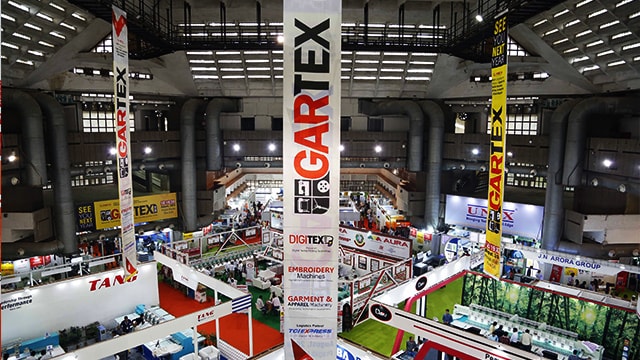
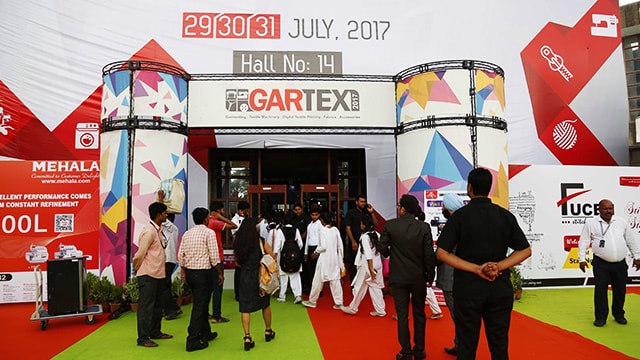
Forgetting about GST difficulties and other market complications, the Indian domestic market, including small, medium and even top-level companies, appears geared up for further growth and expansion to add new categories in their product basket. It was clearly reflected at the recently concluded Gartex 2017 at Delhi. Organized by Max Exhibitions, the second edition of the event witnessed nearly 18,000 visitors from all apparel manufacturing hubs. Apart from several value addition technology players, the event also included few big companies of stitching, cutting room, fabric and accessories. Team Apparel Online met both the optimistic exhibitors and the visitors and discussed about their future plans and strategies for business growth.
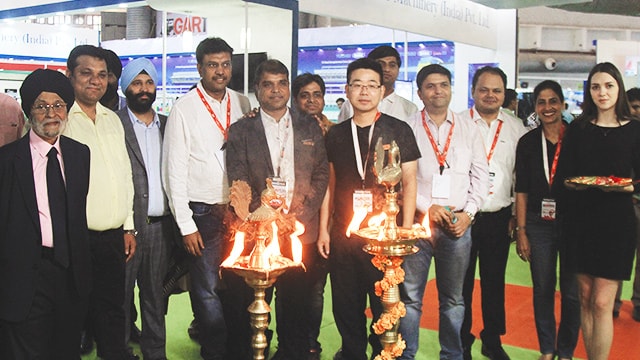
Gartex 2017 was inaugurated by various leading garment and value addition technology suppliers of India
Coming to the viewpoints of the exhibitors, they were really content with the variety and quality of visitors at Gartex 2017. Key Indian apparel manufacturers like Orient Craft (Gurgaon), Eastman Exports (Tirupur), TCNS (Noida), Blackberrys (Gurgaon), Pure Cotton (Noida), Affordable Exports (Delhi) were amongst the visitors’ list who attended the show. From the visitors’ perspective, they had expected more exhibitors in segments such as garment machinery, fabric and accessory which were less in number. However, they were still happy to see a few major accessory and fabric companies exhibiting at the fair such as Madura Coats, Gian Chand Sushil Kumar Jain (More Thread), Pashupati Overseas, Mahashakti Thread Mills, Nilesh Impex India, Neenu Plastics, Synodic Carnival Commercial etc. Chetan Agarwal, Partner, Pashupati Overseas, Delhi was quite busy with the visitors for all three days. Happy with the response, he shared that he got the advantage of being the only fabric company in the show. Importing primarily from overseas countries, the company offers wide variety of different kinds of fabrics specially those which are not being manufactured in India.
Image Courtesy: gartexindia.com
Digital printing seemed to rule the reign at Gartex 2017. Various technology companies like Mimaki India, Epson India, DCC Print Vision, Negi Sign Systems, ColorJet India and Apsom Technologies which offer digital printers for textiles, signage, home textiles, etc., presented their latest machinery in this segment under the theme ‘DigiTex’. In the digital printing category, ColorJet also launched its AuraJet II digital printer which uses less ink and has the capability of printing on a 45 GSM paper. It is one such company which manufactures digital printers within the country and promotes ‘Make in India’ concept.
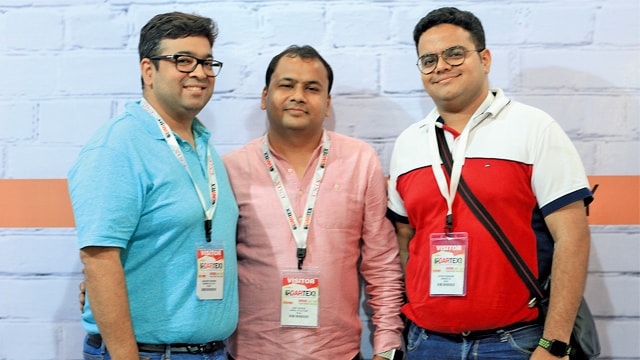
(L-R) Navdeep, Amit and Nitesh Wadhwa of Kundan Lal & CO. The company known for jackets in domestic market is focusing more on in-house production
Embroidery technology providers like Aura Technologies, Tajima, Peayush Machineries, Baba Textile Machinery India, Tang, and Unix Stitch Machines also marked their presence at the three-day fair with display of their latest embroidery machines for the industry. A key highlight of the embroidery machinery section was the multi-head embroidery machines ranging from 18 heads to 90 heads. This proved the inclination of the market towards large embroidery machines. Aura Technologies’ boring machine with multi-colour threads and multi-head embroidery machines with automatic bobbin changer also grabbed the attention at the 2017 edition of Gartex. Another company, Tajima, also showcased an 18-head embroidery machine that can simultaneously use various types of threads be it cotton, silk or woollen.
“We are very much satisfied with the event as exhibitors gave us positive feedback about the quality of visitors. The show witnessed almost 18,000 visitors from across India. Our next edition will be even bigger and will have more variety in terms of exhibitors.” – Gaurav Juneja, Director at MEX Exhibitions
Good visitation with investment agenda…
In an exclusive conversation with Apparel Online, some of the visitors discussed their multiple goals to expand in their respective businesses. Anirban Kumar Das, Director of Jinil Spinning/Ansu Meditech Gandhinagar (Gujarat) with a business of nearly 42 crore, shared about having an embroidery unit in his already existing company to boost more growth. Being a textile engineer himself with 25 years of experience in the textile industry, he knows that expansion is the mantra for further growth and therefore, he is investing Rs. 50 lakh on this unit whose production will start within a month. Process house, Color n Style (Noida), is investing in rotary printing technology; jacket suppliers for the domestic market, Kundan Lal & company (Delhi), is planning to do in-house production as it currently outsources for the stitching process. Denim process house, MS Creations (Delhi), which is planning to start kidswear manufacturing, was also seen looking for garment machinery at the fair.
The fair witnessed few visitors from buying houses too such as: Natalino Duo, Director, Pure Cotton, Noida; V. Gopal Krishnan, President, GS International, Noida; and L. Sachin of 4E International, Delhi.
Ahmedabad-based, Kalantry Textile Industries, dealing in second-hand textile machineries, is now investing in garment value addition and finishing plant and will work as a job worker and later may have its own clothing line too. Escott Apparels (Noida) is also expanding its digital printing operation and is looking for machines in the same segment. Similarly, Rohit Bhandari, Director, Strawberry Clothing, Noida, also stated, “Sequence and sublimation printing attracted me as normally we face difficulty in sourcing of sequence. Costing of sublimation printing is what interested me the most.” Doing ethnic wear for domestic market, Magnum Apparels, Delhi, is also investing in specialized machines for formal suits and shirts. “This year, marriage season is favourable, so we are expecting good growth in the current fiscal,” informed Manish Chand Mohnani, Owner of the company. The company is also strongly into embroidery segment and explored the machinery for the same in the fair.
The fair also had two booths of jobworkers. While Rajdhani Creations, Gurgaon – a renowned name in digital printing jobwork – highlighted its digital printing capabilities, Rishab Print & Laser, Delhi displayed its expertise in laser work on denims and Tees and attracted several visitors.
Gartex 2017 also unravelled some of the new companies in the apparel industry who are growing very well and having their own expansion programmes. Having started six months ago, Jodi (Yas Group), Kolkata, began its apparel business with 165 stitching machines and exported to gulf countries. It is now planning to double the capacity within one-and-a-half year. “As we are new, every technology is interesting for us and we like the fair,” shared Thakur AK Singh of the company.
Almost two years old and catering to the uniform sector, Liberty Innovative Outfits, Panipat (associated with Liberty shoes), is witnessing good demand from schools for tees, track pants and track suits which are its core products. Aditya and Saurabh Bansal of the company were impressed by the stitching, embroidery and printing machines in the fair. “We are expanding overall, so we will be investing in whatever machines are required for this purpose,” the duo shared.
The show also witnessed many visitors from embroidered fabric segment. Having stronghold on schiffli embroidery and designs, Gurgaon-based Shiv Shakti Embroidery’s Rajesh Gupta shared, “The fair is okay as I found some relevant technology at some of the booths having value addition.” He further added that despite the increased challenges, his business is growing. Mohib, MD of Surat-based Lace Manufacturers India stated, “Embroidery machines displayed here are good. Along with capacity enhancement, we are focusing more on designs as per the garment’s requirement. For this, we have enhanced our research. The company produces more than 50 lakh metres of lace per annum.”
Apart from these mentioned companies, there were few more who met Apparel Online at Gartex 2017 with their future plans which again proves the industry’s positivity and its movement in the right direction.
Netherlands-based International Apparel Federation (IAF) is organising a fashion seminar at the world’s leading apparel fair Premiere Vision, which has raised curtains today in Paris, France.
IAF is the global trade body for apparel manufacturers, their associations, and the supporting industries.
At the seminar (themed Fashion Shifters), the Federation will promote a smarter, stronger and more sustainable fashion supply chain. Matthijs Crietee will co-moderate the event at the 3-day fair.
A panel of fashion professionals will discuss and share their ideas and experiences during the seminar to bring more innovation and creativity to the fashion industry.
Additionally, the Fashion Shifters seminar will highlight ‘How Demand and Supply are Linked with Technology across the Supply Chain’.
The panellists at the seminar will also deliberate on ‘How the Fashion and Entertainment Industries together can bring Value for each other’.
Another highlight of the seminar will be ‘How a Soap Opera and Fashion Retail Chain have successfully merged fact and fiction into a successful joint campaign’.
Jurian van der Meer, Director of Endemol Shine, a Dutch-based media company that produces and distributes multiplatform entertainment content, will be the keynote speaker at the event.
The IAF’s idea behind organising this seminar is to encourage the apparel industry by sharing the inspirational examples of the fashion players at this global platform, Premier Vision.
The State Government of Maharashtra (India) has announced to set up nine textile parks in the northern part of the state.
The announcement was made by Subhash Rajaram Desai, Industries Minister Maharashtra at the Progressive Maharashtra Summit. The Summit was organised by industry body Federation of Indian Chambers of Commerce and Industry (FICCI).
The northern region produces the maximum of cotton in the state but without any value addition. The initiation of adding the ‘value’ at every stage from ‘produce’ to ‘fibre’ to ‘fabric’ to ‘fashion’ will bring a good price of cotton to the farmers.
At the Summit, the Industries Minister also highlighted the benefits of Amravati Textile Park that features 30 operational units and stressed on replicating the same at the upcoming nine parks.
Desai said, “The textile parks provides a platform to many small and medium industries to flourish their businesses. However, in such way, we can support farming and industry.”
The idea is to enhance the farmers’ income through ‘value-added’ products. Furthermore, it will also help the Government and the farmers in proper utilisation of the cotton produced in the northern part of the state.
Over the years, the Maharashtra Government has taken several initiatives that benefited the farmers.
The loan worth Rs. 34,000 crores given to the farmers had also been waived off.
The Federation of Pakistan Chambers of Commerce and Industry (FPCCI) has called the US to extend the GSP (Generalized System of Preferences) facility until 2020. The current term will end in December 2017.
Additionally, the trade association has strongly recommended to include key textile products under the GSP scheme.
The suggestion was made by Irfan Ahmed Sarwana, FPCCI’s acting President, during his meeting with John Robinson, who headed the six-member contingent of the US consulate in Pakistan recently.
Sarwana was also vocal on having more interaction between the businessmen across Pakistan and the ‘US trade mission’ so as to promote economic relations and bilateral trade between both the nations.
Though Pakistan already has a duty-free access for various commodities in the US market, textile products are still not a part of the facility.
Sarwana added that currently, Pakistan pays somewhere between 7 per cent and 32 per cent duty on some of the textile and leather products in the US.
He opined that having a better access to US market would help Pakistan in reducing poverty and thereby bringing growth, development and economic stability in the country.
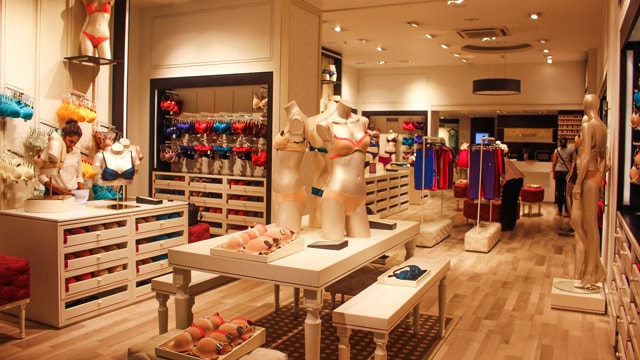
MAS Brands, a subsidiary of Sri Lankan apparel manufacturer MAS Holdings, is planning to add more of Amante stores to its India list.
The company forayed into the Indian market in the year 2007. It is eyeing to open 100 standalone stores in 15-20 cities in the next three to five years.
Amante is currently available in 1,200 multi-brand stores, 200 large format stores, 7 exclusive brand stores and leading e-commerce sites in more than 20 Indian states.
Acquisitions are also on cards for the company which targets to be the leader in the lingerie segment in the country. The retailer wants 3-4 brands in its portfolio that can contribute significantly to its growth in the Indian market.
Additionally, MAS Brands is planning to introduce Ultimo to India next month. The company owns the majority of stakes in the UK-based intimate wear label.
MAS Brands is aiming high with these strategic moves to lock Rs. 150 crores in revenue in the current fiscal year through its intimate wear business in the country.
Chinese e-commerce company JD.com Inc. has inked a deal with the Thailand-based retailer Central Group for a US $ 500 million (US $ 250 million each) joint venture.
“JD’s proven track record of successfully building out national online retail businesses made it the obvious choice to be our e-commerce partner,” reportedly said Tos Chirathivat, Chief Executive Officer of Central Group.
As per the agreement, the e-commerce giant will provide technology and logistics support to the JV, while Central Group will contribute through its merchant relationships, brand recognition, and customer insights.
JD.com aims to expand its reach in the Southeast Asia region through this e-commerce and financial technology (finetech) venture.
The retailer’s arch-rival Alibaba Group has already reached the Southeast Asian market and is quickly increasing its services in countries like Singapore. It is expected the JV will back JD.com in taking its business beyond Indonesia.
“Working with Thailand’s strongest retail conglomerate, with a massive shopping mall and department store network, gives us a huge competitive advantage as we expand further into Southeast Asia,” JD.com CEO Richard Liu said in a statement.
The partnership between the two is expected to reshape the online retailing and finance landscape in Thailand.
Partner with India's Premier Fashion Business Platform
Position your brand at the centre of the apparel industry by
partnering with Apparel Sourcing Week — where BRANDS,
MANUFACTURERS, RETAILERS and
TECHNOLOGY PROVIDERS come together to shape the future
of fashion sourcing.