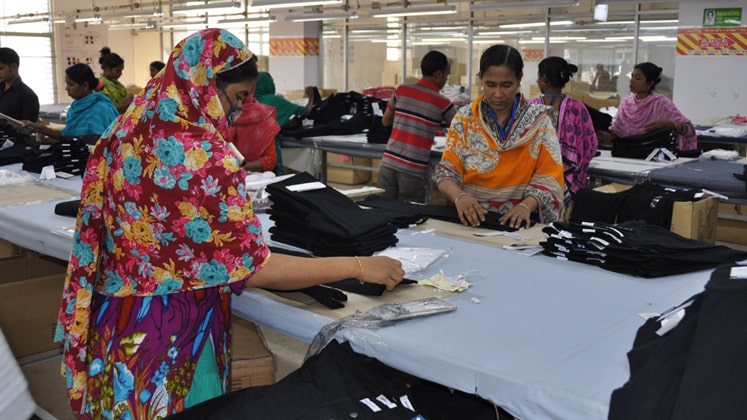
The coronavirus pandemic has come as a bolt from the blue for the garment makers in Bangladesh, especially the ones considered small and medium-sized.
It’s not that things had been looking up for these smaller players before the pandemic, as many of these units had to call it a day in face of various business challenges. On one hand, they were faced with rising overheads and faltering price points, to add to which has been the significant rise in the minimum wage for garment workers and not to mention the issue of remediation.
According to media reports, around 50,000 garment workers lost their jobs last year alone, as around 50 small and medium-sized garment factories wound up operations in 6 months since April 2019, while the apex garment makers’ body, the Bangladesh Garment Manufacturers and Exporters Association (BGMEA) maintained then that with the closures of these manufacturing units, the total number of such factories that went out of business in one year was more than 200.
However, those who lived to see another day were posed for an even bigger challenge. Unbeknown to many, COVID-19 had already started spreading its deadly tentacles in China, which in days to come would spread throughout the globe, brining devastation in its wake.
According to the BGMEA, due to coronavirus, around 300 small and medium garment factories were closed down in the country. Despite the Government bailout package, many smaller players were unable to survive and sustain owing to the stringent riders attached towards availing the loans.
“Most of those factories used to operate on a sub-contractual basis before they were closed,” BGMEA Director Md Rezwan Selim reportedly stated, adding, “Many of the factories that closed down were unable to resume operations.”
And those which did were in for more hurdles. So even as the bigger players managed to make some recovery, the small and medium and smaller players didn’t seem to have much luck in this direction. As per reports, the small and medium garment factories were yet to see a rebound in apparel shipments, as they have not received work orders at par with the bigger units.
Also Read: Businesses still sceptical on account of the pandemic: Rumana Rashid
After a drastic fall in apparel exports in April due to the pandemic, the export of apparel items started picking up from May, as international retailers and brands reopened stores and returned with work orders. However, most of such orders were meant for the bigger suppliers, it seems.
“I used to run 100 per cent overtime in the pre-pandemic period. Now, it is 40 per cent, as I am receiving a small number of orders,” explained Managing Director of Base Fashions, Ehterab Hossain, who employs around 1,000 workers in his unit. He added that in April, May and June, production at the factory was very low as orders dried up. “The situation is gradually improving, although it is not at the level of the pre-pandemic time,” quipped Ehterab, who is not alone in this, as majority of small and medium units work mainly for medium-level buyers, whose quantities are also not big. And now with market uncertainty, order volumes have gone even down.
As per reports, the COVID-19 fallout prompted a collapse in the shipment of apparel products, which contributes to around 84 per cent of Bangladesh’s total exports. The impact was so severe that overseas sales plummeted to US $ 0.37 billion in April from an average monthly export of US $ 3 billion, which was predominantly due to mass work order cancellations by retailers and brands, many of whom have since reinstated a significance of cancelled orders. However, reinstatement or not, majority small and medium players were yet to benefit much from it.
The result, an uneven recovery in the industry where bigger players seem to be making some headway towards coming back to business while small and medium players still lagging behind their bigger counterparts as far as work orders are concerned.
Further, adding to the woes, have been the deferred payment proposals from buyers and discount demands. Certain such units have not received work orders directly from the international retailers or brands due to their poor compliance with regulations. As a result, most factories which have already resumed operations were relying on bigger units for work orders on a sub-contractual basis.
One of the changes in buyers’ sourcing practice after the breakout of the pandemic which is causing problem to the suppliers is the payment term as we are being offered 60 to 120 days’ extra delayed payment, which is in sharp contrast to the regular norm, underlined Md. Fazlul Hoque, Managing Director of Plummy Fashions Limited, while speaking to Apparel Resources.
In most cases, the smaller units cannot compete with larger factories to land orders, but these units are necessary, said Ahsan H Mansur, Executive Director, Policy Research Institute of Bangladesh, while underlining that the Government should come up with some policy support like a tax waiver for the small and medium-sized units. so that they can also grow.
Meanwhile, M. Shahadat Hossain, Chairman, Bangladesh Terry Towel & Linen Manufacturers & Exporters Association, maintained that the revival in export growth would largely depend on the continuation of the ‘new normal’.
“If the second wave comes, exports could be seriously affected,” cautioned Shahadat, whose fears seem to be coming true lately.
Many buyers have dropped placing of work orders to some extent because of a possible second wave of COVID-19 and for the delay in vaccine arrival for the mass, explained Anwar-ul-Alam Chowdhury Parvez, Managing Director, Evince Group, a leading garment exporter, while adding the buyers are more cautious now compared to the pre-pandemic period.
Facing the fallouts of a second wave of infections is very important for Bangladesh, he said, adding that already some states of the US have been affected with a second wave and schools were being shut down again. So, if the stores need to be shut down for the second wave, the export of garment items from Bangladesh will be affected, said Parvez, who is also a former BGMEA President.
Mahmud Hasan Khan Babu, Managing Director, Rising Group, echoing Parvez further said if there were any issues centring the US election, garment shipments to American markets would be affected, while adding that the probable impacts of a second wave in the European and US markets would defer the recovery of garment export from the country.
“I totally agree on what ‘many exporters’ are fearing, and in fact, in recent days, almost all my statements cover the same fear of a possible resurgence of COVID-19 infection and the obvious impact on the industry,” underlined BGMEA President Dr. Rubana Huq, adding, “As winter approaches nearer, USA and European countries are witnessing new waves in infection… state of emergency has been declared in Madrid and the developments in other parts of Europe are noticeable. It’s been a tough time; we are passing through fear and anxiety. Looking at it through the lens of exports and garments, this may be horrific for us if disruptions in the west reach a magnitude of what we suffered last season.”
Going by the current situation, the uneven recovery that has plagued small and medium players does not seem to end anytime soon even when the bigger players and the industry, as a whole, are apprehending possible reversals in view of the second wave of the pandemic in the West.
So, let’s keep our fingers crossed to see how things pan out in the days to come.