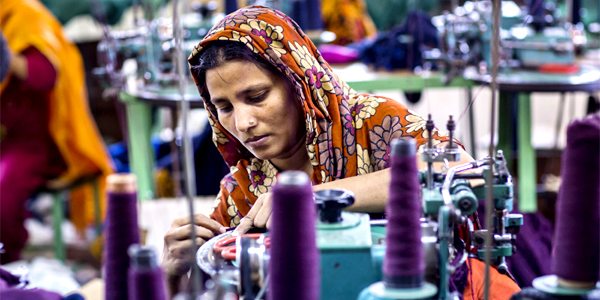
In a startling revelation, a new report of USA-based New York University’s Stern Center for Business and Human Rights has stated that millions of people working in the flourishing readymade garment industry of Bangladesh still face unsafe conditions and the country has more factories engaged in the global readymade garment business than stated by its industry.
The findings have come at a time when Accord and Alliance’s safety inspections have reportedly indicated that the percentage of readymade garment factories which are yet to make the cut according to the ‘stringent’ safety standards laid down by the western retailers’ bodies is negligible. The findings have even prompted Bangladesh’s Commerce Minster Tofail Ahmed to observe, “Initially, I was also irritated with the presence of Accord and Alliance in Bangladesh. But after the completion of the preliminary inspections I am very happy, as they found that less than 2 per cent of the factories are risky,” adding, “Now, we can say that most of our factories are compliant.”
Also Read – Bangladesh Govt. mulling action against RMG units failing to implement corrective action plan
For the New York University’s Stern Center for Business and Human Rights report, Sarah Labowitz, a co-Director of the Center, and Dorothée Baumann-Pauly, the Director of Research, parsed public data about factories and labour practices in Bangladesh.
The authors of the report is said to have determined that more than 7,000 factories in Bangladesh are producing goods for the global fashion business which is almost double the 3,600 exporting factories that Bangladesh Garment Manufacturers and Exporters Association (BGMEA) claim operates.
Also Read – Bangladesh RMG Sector ‘Unhappy’ with Delay in DEA Report Approval
The discrepancies, the study underlined were largely because the depth of subcontracting was profound, with many registered factories relying on labour and goods from informal factories which make up about half of all factories in the country.
“Though global apparel brands assert they have strict policies against subcontracting, in reality, millions of workers and thousands of smaller factories are producing their goods,” said Sarah Labowitz, in a statement, adding, “Working in these factories is often highly risky.”
However, President of BGMEA Siddiqur Rahman, while speaking to Reuters reportedly said that he did not agree with the finding that there were 7,000 factories in Bangladesh producing for the global market.
“Subcontracting factories don’t exist,” Rahman underlined adding that “Buyers don’t place orders in non-compliant factories,” in what may be termed a reference to factories that do not follow the laid down safety requirements.
Bangladesh’s US $ 25 billion apparel industry has long been in news due to safety reasons, especially the infamous Rana Plaza collapse that claimed 1,100 lives and the Tazreen fire incident.