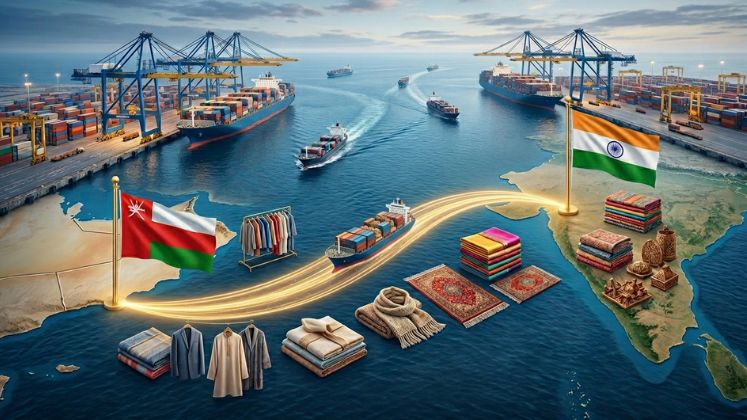
The India-Oman Comprehensive Economic Partnership Agreement (CEPA), which came into force on 1st June 2026, is expected to provide a significant boost to India’s textiles, apparel and handicrafts exports by offering comprehensive duty-free access to the Omani market.
According to the Government of India, the trade pact marks a major milestone in strengthening economic and strategic ties between the two countries and is expected to enhance bilateral trade, deepen supply chain linkages and create new opportunities for Indian exporters, artisans and micro, small and medium enterprises (MSMEs).
Under the agreement, Oman has granted immediate duty-free access on all 945 textile and apparel tariff lines, eliminating the existing 5% Most Favoured Nation (MFN) duty. The removal of tariffs is expected to improve the price competitiveness of Indian textile and apparel products in the Omani market.
India’s exports of textiles, apparel and handicrafts to Oman stood at US $95.1 million during FY 2025-26. Oman imports textiles and apparel worth approximately US $598 million annually. India currently accounts for around 11% of Oman’s textile and apparel imports and ranks as the country’s third-largest supplier.
The Ministry of Textiles stated that the agreement presents a clear opportunity for Indian exporters to increase their market share and capitalise on growing demand across key categories including apparel, made-ups, carpets and fabrics, particularly in value-added and design-oriented products.
The CEPA also introduces a modern, fully digitalised Certificate of Origin (CoO) framework, enabling electronic exchange of origin certificates between the two countries. The system is expected to reduce transaction costs, improve operational efficiency and facilitate smoother trade flows.
In addition, the agreement strengthens cooperation on intellectual property rights (IPR), reaffirming both countries’ commitments under the World Trade Organization’s Agreement on Trade-Related Aspects of Intellectual Property Rights (TRIPS). It also provides for the recognition of Geographical Indications (GIs), a move expected to enhance the visibility and marketability of India’s GI-tagged handloom and handicraft products in Oman and support the promotion of Indian heritage products in international markets.
The government noted that Oman has emerged as an increasingly important trade gateway to the Gulf Cooperation Council (GCC) region amid evolving geopolitical developments in West Asia. Ports such as Sohar offer alternative trade routes that bypass traditional maritime chokepoints, including the Strait of Hormuz.
Officials said the bilateral trade agreement is expected to strengthen India’s broader trade connectivity with GCC member nations as well as markets in East Africa, further supporting export growth across multiple sectors.
(With inputs from PTI)