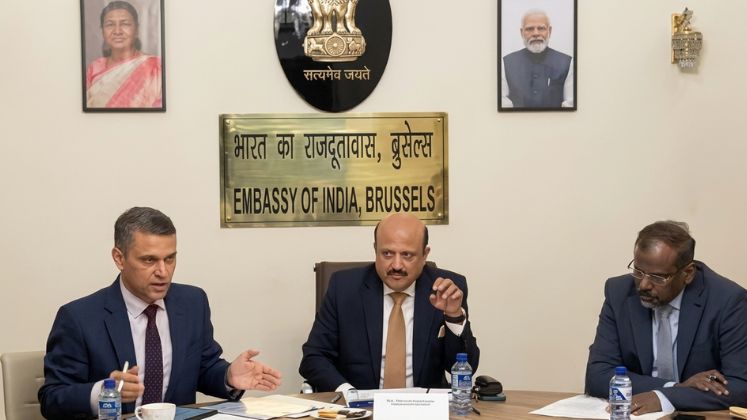
India and the European Union (EU) have discussed preparations for implementing their Free Trade Agreement (FTA), with a focus on improving market access, facilitating trade and strengthening supply chain cooperation.
Commerce Secretary Rajesh Agrawal held meetings with senior European Commission officials in Brussels, including Ditte Juul Jorgensen, Director-General of the Directorate-General for Trade and Economic Security (DG TRADE), to discuss ways to facilitate two-way trade, improve market access and strengthen supply chain resilience.
According to an official statement from the Union Ministry of Commerce and Industry, both sides reaffirmed their commitment to a fair, balanced and mutually beneficial agreement and agreed to address the remaining procedural and implementation-related issues.
Discussions also covered customs cooperation and trade facilitation, with both sides emphasising efficient, transparent and digitally enabled customs procedures to reduce transaction costs and ensure the smooth movement of goods.
India and the EU concluded FTA negotiations at the 16th India-EU Summit on January 27, 2026, in the presence of Prime Minister Narendra Modi and European Commission President Ursula von der Leyen. The agreement is currently undergoing legal verification ahead of its proposed signing in mid-December 2026, while full ratification and entry into force are targeted for mid-2027.
Under the proposed agreement, tariffs are expected to be eliminated on over 99% of Indian exports to the EU. This is expected to benefit labour-intensive sectors, including textiles, apparel, leather and jewellery, by improving their competitiveness and access to the European market.
The proposed agreement is expected to benefit India’s labour-intensive export sectors, particularly textiles and apparel.
India’s apparel exports to the European Union (EU) reached a record US$4.66 billion in FY26, up from US$4.55 billion in FY25.
Ready-made garments accounted for the largest share of India’s textile and apparel exports to the EU at 60%, followed by cotton textiles at 17% and man-made fibre textiles at 12%.
The EU, with textile and apparel imports of US$263.5 billion in 2024, remains one of India’s key export markets after the US.
The proposed India-EU Free Trade Agreement (FTA) is expected to further improve market access and support export growth.