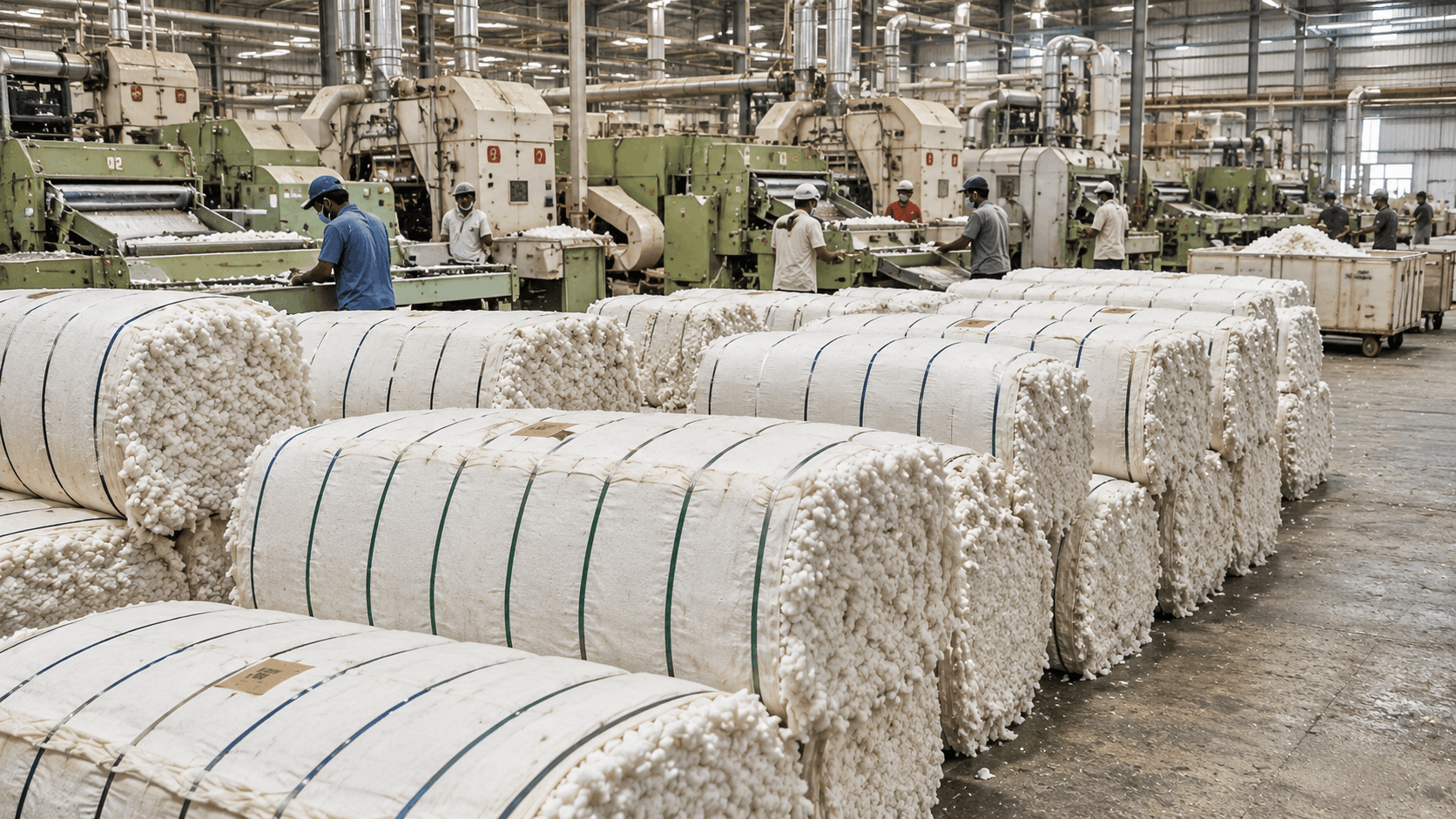
Despite the government’s decision to temporarily remove the 11% import duty on cotton, imported cotton remains only marginally cheaper than domestic cotton, offering little economic benefit to Indian textile mills, according to the latest Cotton Association of India (CAI) data.
The latest market comparison shows that Indian and international cotton prices remain almost equal. With prices remaining broadly aligned, textile manufacturers are expected to prioritise quality, supply reliability, and shipment schedules when sourcing cotton instead of focusing solely on price.
For the week ended June, Indian cotton prices remained broadly in line with global rates, making imports economically unattractive for domestic textile mills even after the removal of the import duty.
Data from the Cotton Association of India (CAI) showed that the domestic ICS 105 benchmark averaged 79.50 US cents per pound on a C&F Far East basis, including freight costs of 6.00 cents per pound. During the same period, the global Cotlook A Index stood at an average of 80.00 US cents per pound.
As a result, Indian cotton was priced only 0.50 cents per pound lower than international cotton, translating to around Rs 400 per candy or a difference of just 0.63 per cent.
The Central Government removed the cotton import duty from June 1 to October 30, 2026, with the objective of improving raw material availability for the textile sector. However, the latest market data indicates that the temporary duty exemption has not made imported cotton significantly more cost-effective than domestic supplies.
Although the import duty has been waived, buyers still have to bear expenses such as freight, insurance, port handling charges, inland logistics, financing costs, and currency fluctuations. Together, these costs are sufficient to reduce the small price difference between imported and domestically produced cotton.






 Bharat Tex Special Report 2026