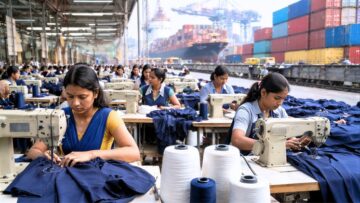
Mass order cancellations, operations coming to a standstill and liquidity crunch looming large – the Bangladesh garment industry is in the throes of severe crisis, which if not handled at the right time, can increase the chances of social upheaval, fear many.
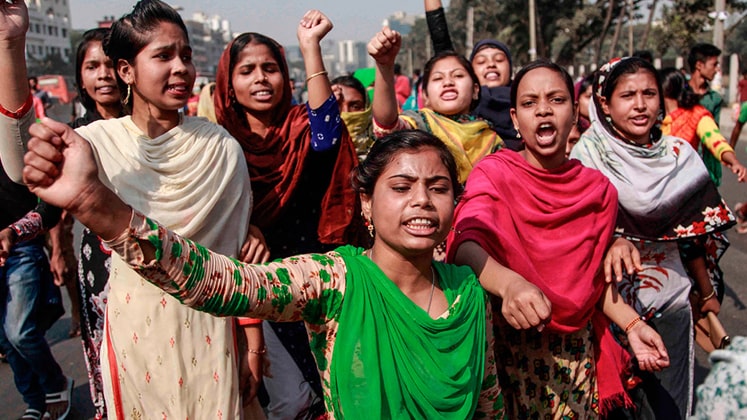
The garment workers, who are at the forefront of industry’s growth and development, are now on the streets demanding disbursement of salary and arrears, while the less fortunate ones, who are already being laid-off are staring at an uncertain future.
The global Coronavirus breakout is exacting a huge price on the industry. Even though the Government has announced a bailout package of Taka 50 billion, it’s too little to be of much help, more so considering the strings attached towards availing the same, say industry insiders.
Labour leaders are now of the opinion that if unrest is to be avoided, paying workers’ dues and reinstating them to their jobs are the only way forward. “As the businesses made profits taking services of the workers, why aren’t they paying them salaries during the Coronavirus crisis? Instead, many factory owners are preparing lists for terminating workers or declaring lay-offs unlawfully and inhumanely,” says Rajekuzzaman Ratan, a Tripartite Consultation Committee member and General Secretary of Samajtantrik Sramik Front.
Apprehensions that the labour unrest could soon take the shape of civil discontent, putting not only the industry but also the country’s future in peril, are worrying the garment exporters as well.
“The Government will have to do something to handle the current scenario, else a disaster-like situation is inevitable,” a prominent garment manufacturer shares with Apparel Resources. Many workers giving into vandalism and laying siege on roads despite getting March’s salary is but a precursor to a state of social unrest, he fears.
Even after work resumes, manufacturers may have to take a call on the volume of the workforce. If buyers cut down on order quantities substantially, there’s no way all the manufacturing units could continue working in full capacity.
“Even though it’s a very touchy and emotional issue, many companies may have to take a hard call on their workforce.” – Mohammed Monabber Ahmed, Director, Anowara Group
Sharing his thoughts with Apparel Resources, Director of Sparrow Apparels Limited, Shovon Islam (Shawn) says that 90 per cent of the industry has paid March’s salaries, but going forward, paying salaries to all the workers could be a difficult proposition for the sector.
“Discussions are continuing between the Government, labour unions and the BGMEA. Stakeholders need to understand everyone has to survive together and not in silos, or else, the industry will perish,” comments Shawn, underlining that garment makers alone cannot take onus of the existing situation. He further adds that operations will shrink and lay-offs are bound to happen, so a coordinated effort is required. The current workers’ unrest, Shawn believes, has a lot to do with lack of communication between the stakeholders. “The Government called the lockdown a general holiday in the beginning and as such the severity of the situation did not get communicated well,” he feels.
“Discussions are continuing between the Government, labour unions and the BGMEA. Stakeholders need to understand everyone has to survive together and not in silos, or else, the industry will perish.” – Shovon Islam (Shawn), Director, Sparrow Apparels Limited
Also considering that unlike the West where majority of the population can work from home, a longer lockdown is not a workable solution in Bangladesh, where a massive workforce of 4 million people is dependent on the garment manufacturing sector for their livelihoods.
The lockdown has to end, and for that, there has to be a safety mechanism in place – the do’s and don’ts of which need to be communicated well. The workers need to be educated on this and it must be ensured that safety norms are followed to the T, avers Shawn.
He gives an example of Sparrow’s manufacturing unit in Jordan, which is operating with all 1,600 workers who are staying in dormitories in and around the factory, considering the existing situation in the country due to the Coronavirus outbreak.
The Jordanian Government has reportedly allowed garment workers to stay close to their workplace, so that production is not hampered. Shawn is for replicating the same in Bangladesh as well, keeping the industry’s future in perspective.