Since the outbreak of COVID-19 in the country, Bangladesh have had to face diverse fallouts of the pandemic and, even at the time of writing this feature, media reports claimed the capital city of Dhaka has been virtually cut off from the rest of the country following the suspension of all inter-district transports (road, rail and waterway) so as to stem the surge of Coronavirus infection even as the Government has already reportedly enforced lockdown in seven districts around Dhaka again.
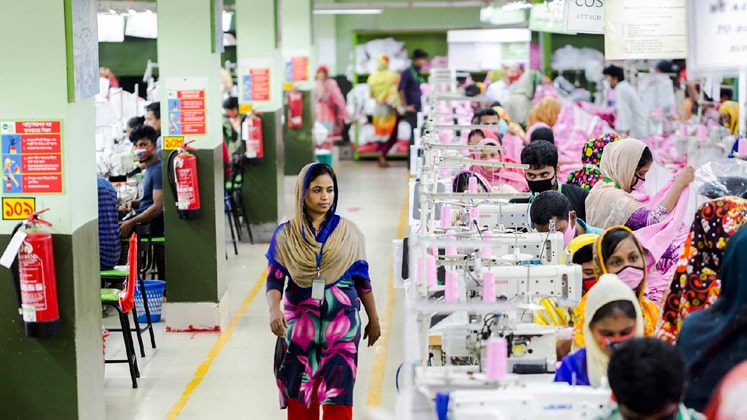
However, it might be mentioned here that despite several lockdowns since the breakout of the pandemic in Bangladesh, save for a brief period of time in March last year, RMG factories — the garment sector is responsible for more than 80 per cent of export earnings and is considered the lifeline of Bangladesh’s economy — has remained operational through multiple phases of lockdown.
After a brief period in March last year, hundreds of garment factories started operation again following strict health guidelines since they shut their doors in late March but some suppliers said they were being pushed by retailers to fulfil outstanding export orders.
“We have to accept Coronavirus as part of life. If we don’t open factories, there will be economic crisis,” underlined the Vice-President of the Bangladesh Knitwear Manufacturers and Exporters Association (BKMEA) Mohammad Hatem then.
So, despite several phases of lockdowns, the industry operated to keep the country’s economy alive and kicking even if during the holy festival of Eid-ul-Fitr recently, the Government had said garment workers will not be allowed to leave their workplaces to stop further spread of COVID-19 while also asking the garment factories to declare holidays for 3 days only, which, however, was extended by many factories later on under pressure from the garment workers, who after celebrating Eid with their near and dear ones, resumed work full fledge.
Now considering their role in keeping the wheel of the economy rolling, one would have expected these workers would be the first to get vaccinated when Bangladesh kick-started the Coronavirus vaccination campaign, but it was not.
As per a survey done jointly by South Asian Network on Economic Modeling (SANEM) and Microfinance Opportunities (MFO), a meagre 2 per cent of readymade garments workers were reportedly able to get COVID-19 vaccines even if 69 per cent of workers maintained they were willing to get vaccinated if they were eligible to get the same.
It may be mentioned here that the organisations interviewed a pool of 1,285 workers from the manufacturing hubs of Chittagong, Dhaka, Gazipur, Narayanganj, and Savar, over phone in April.
“On being asked whether they think they are eligible to get vaccinated, 36 per cent of the respondents said they were eligible, 28 per cent said they were not eligible, and 34 per cent said they did not know if they were eligible,” said the report done by SANEM and MFO while adding that three-quarter of those eligible said they want to get vaccinated, while over 60 per cent of those who were ineligible, or did not know if they were eligible, wanted to get vaccinated, but less than a quarter of them had no information on how to gain access to a vaccination shot.
The survey report further added that in order to facilitate the recovery process of RMG production, export and the economy as a whole, factory owners, Government officials, policymakers and advocacy groups will have to come together to prioritise the health and safety of workers.
It may be mentioned here that consequent to large-scale order cancellations by global buyers and in the aftermath of the pandemic when many small and medium-sized factories had to shut down operations in want of work orders, tens of thousands of garment makers have allegedly been retrenched.
Many factories had to close down with several foreign buyers cancelling work orders and renegotiating and cutting down prices even as according to Bangladesh Poshak Shramik Trade Union Federation (Bangladesh Garment Workers Trade Union Federation), around 22,000 workers lost their jobs in the port city of Chittagong alone last year either due to manpower curtailment or outright factory closures.
Meanwhile, according to another survey, during the ongoing COVID-19 pandemic, wages of the country’s readymade garment (RMG) workers have dropped by 50 per cent to 65 per cent even if around 23 per cent of workers have reportedly not yet received the minimum wage of Taka 8,000 set by the Government.
It would thus not be wrong to maintain the garment workers have perhaps been the worst affected by the pandemic and contracting the dreaded disease now in want of vaccination while putting in all their efforts to keep the industry running and consequently the economy of the country, is the last thing the garment makers would want.
And as expected, the apex garment makers’ body in Bangladesh-the Bangladesh Garment Manufacturers and Exporters Association (BGMEA) had called upon the Government to bring the apparel workers under the purview of Covid vaccination programme on priority basis considering them as frontliners as the labourers have been doing their jobs amid the pandemic to protect the economy of the country.
It may be mentioned here that as per the Government-set guidelines, only people aged above 40 years and frontline workers were entitled for the Coronavirus vaccine.
The country’s RMG workers remain out of the criteria as the age of the most of the workers is below 40 years and they are not considered as frontline workers, underlined BGMEA President Faruque Hassan who went on to add that millions of workers were working in the RMG factories amid the Covid outbreak and contributing a lot to keep the economy of the country alive.
“We have already sent a letter to the Government to bring RMG workers under the vaccination on priority basis,” further added Faruque,
Thankfully, it did not take long before the Government took note of the existing scenario and
Zahid Maleque, the Honorable Minister, Ministry of Health and Family Welfare, assured BGMEA of bringing the readymade garment workers under Covid vaccination purview on priority basis upon receipt of sufficient number of vaccines in Bangladesh.
The assurance from the Minister came after a delegation of BGMEA led by President Faruque Hassan met with the Health Minister on 16 June and made the request to him for ensuring vaccines for the RMG workers on priority basis considering them as frontliners even as the BGMEA President also requested for ensuring Covid vaccines for the officials of foreign apparel brands and buyers working in Bangladesh.
Given the proactive attitude of the BGMEA towards ensuring workers’ safety by taking up the issue of vaccinating them on priority with the Government and the subsequent assurance of the Health Minister, it is just a matter of time before the garment workers are vaccinated against the dreaded virus it seems. And this definitely would augur well for the industry in particular and Bangladesh in general.