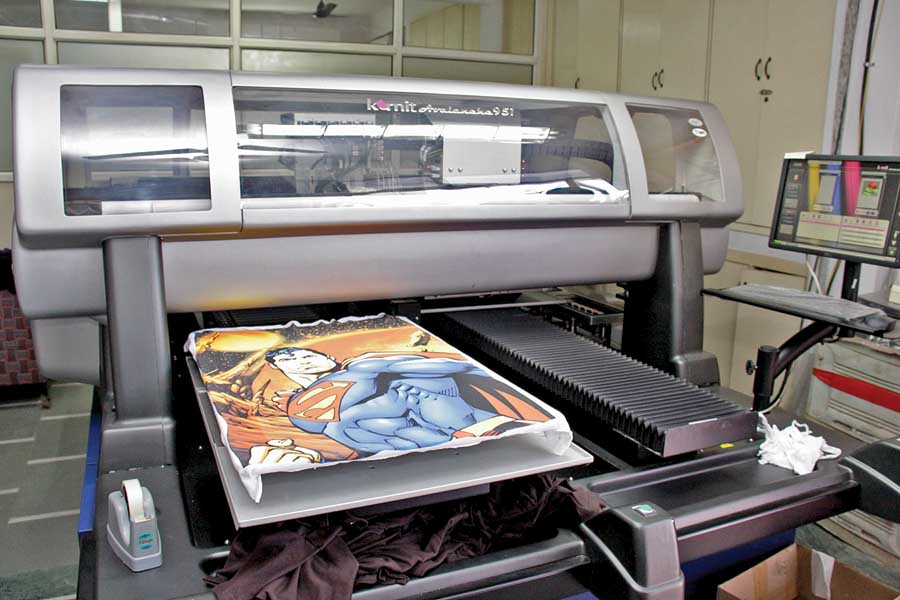
With the competition getting tighter, it has become very important for garment exporters to create niches and every company is looking to specialize in any one area that gives them an edge over the others, while also fetching a price. Gurgaon-based Vrishti Impex, a hi-fashion garment manufacturer that mainly exports to the French market, has recently invested in a digital garment printing machine from Kornit, as a strategy to grow and expand its business. In fact, digital printing is one technique which is enticing many garment manufacturers, more so as the international market is now demanding quick turnarounds, smaller runs and life-like prints, all of which are possible with digital printing.
Starting its journey as a fabricator to Maral Overseas, Vrishti Impex, which today has an export turnover of above Rs. 10 crore, saw an opportunity in digital printed garments to cross the second milestone of its journey. “I saw the innovative Kornit Avalanche printer at ITME – Barcelona and was impressed by the quality of the printing, its high productivity and low printing and operation costs. The Kornit Avalanche DC Pro is the perfect solution for vendors wanting to utilize digital printing for the high fashion market,” says Mukesh Seth, Director, Vrishti Impex.
The team of Kornit and ICC together supported Vrishti Impex in successful implementation and training of operators for achieving optimal results. “Both Kornit and ICC have been very upfront in their support; they even took one person to Hong Kong for professional training,” explains Mukesh, who has faith in the team based on past experience. Mukesh is now confident to take up orders for printed garment from existing customers who were hesitant earlier to place orders not only with him, but in India as well. Apart from increasing business in exports, Vrishti is also looking to job work for printing. “I will be utilizing only 20-25% of the capacity for in-house consumption, the rest 70-75% will be made available for job work,” avers Mukesh.
Among its many advantages, the Kornit Avalanche DC Pro is equipped with two additional print heads. A discharge chemical is applied through these print heads, which removes the dye molecules of the dark garment and the machine’s ability to add white to discharge, providing a smooth base for CMYK and creating a great hand feel for the finished product. The printer can be used for digital output with full white ink under base or full discharge under base, or with a combine under base of discharge plus white ink. Vrishti has also invested in a special high velocity hot air dryer from Adelco, used for curing and finishing post-printing on the Avalanche DC Pro.
[bleft]Stores like Primark, H&M and Zara have risen to the challenge of fast fashion turnover, offering stocks that change once a month. They appear to transfer clothes from the catwalk to the shop-floor in a matter of weeks, if not days. For such a fast turnaround, the time involved in sampling and product development is of utmost importance. With digital printing technology, a person can turn a high resolution image, into a print on the garment within few minutes.[/bleft]
With a total investment of about Rs. 2 crore, Mukesh is expecting a return on investment within 2-3 years, based on very practical estimations.“If I calculate both, the installment and the interest, I have to pay a sum of Rs. 4.5 lakh every month for the next 5 years. I am expecting to print about 45,000 pieces per month and so 12 rupees is the fixed cost which will be added to each garment. Apart from this, the ink cost is approximately 12-15 paise per square inch, so accordingly with a margin of 20% for our operations, I will be charging 35 paise per square inch for white and light based fabric,” informs Mukesh. In the case of printing on dark fabric, which requires either a double layer of white ink or discharge layer or both, the cost of process goes up to 75 paise per square inch. Mukesh further informs that printing calls for skilled labour but however, manpower required are maximum of two persons for operation of this machine.
Stores like Primark, H&M and Zara have risen to the challenge of fast fashion turnover, offering stocks that change once a month. They appear to transfer clothes from the catwalk to the shop-floor in a matter of weeks, if not days. For such a fast turnaround, the time involved in sampling and product development is of utmost importance. With digital printing technology, a person can turn a high resolution image, into a print on the garment within few minutes. With such quick turnaround, the company looks to double its orders in the next year. Predicting digital printing as the future trend, ruling most of the brands, Mukesh is concentrating aggressively on printing techniques and if required, he may also invest in continuous printing machine in the future.