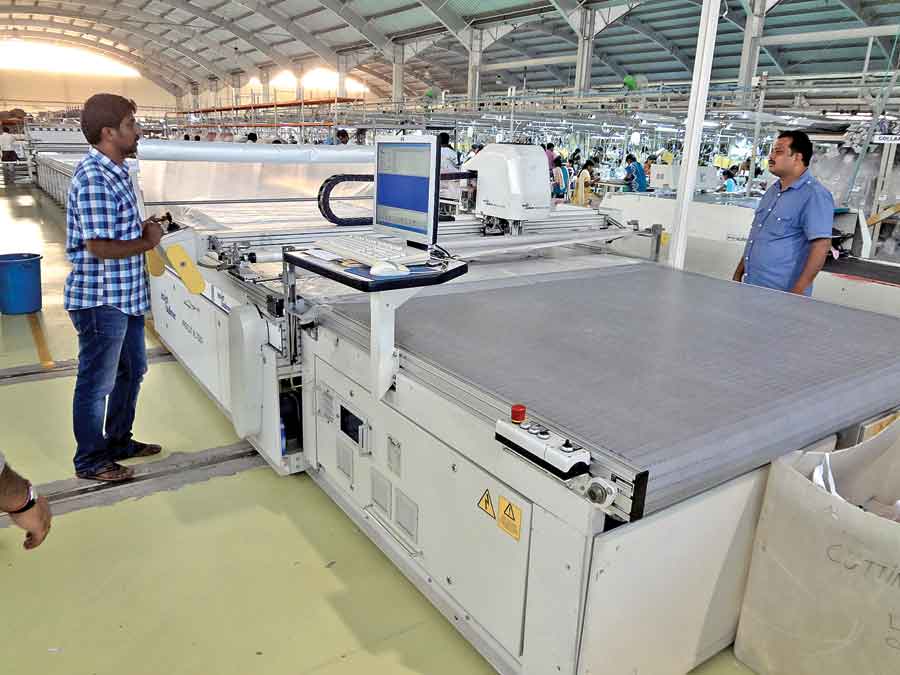
One of the major casual shirt producers of India, Bangalore-based Radhamani Exports manufactures more than one million shirts per month, while managing 70 styles in the same time period. The company with a setup of 650 sewing machines has turnover of US $ 65 million and specializes in casual shirts, embellished with embroidery, printing, appliqué work and additional sewing operations compared to basic formal shirt. The company has an in-house printing setup and 25 automatic embroidery machines.
The manufacturing system followed by the company is a ‘batch system’ which can also be called a sectional assembly line system that has different batches for part preparation and is then passed on to the final assembly line. This system ensures optimum utilization of all the three M’s – Man, Machine and Material – and also enables quality control. It is characterized with low WIP within the line but high WIP between different sections, as one part of a certain style in a particular batch are completed, new style parts are immediately fed into the line for parts preparation. This system guarantees high utilization of machine and labour, making it an ideal system for high volume manufacturing. The challenges faced in this system are longer sewing throughput time and the possibility of parts being misplaced. They, of course, go for assembly only when all the parts are completed. The only drawback of this system is that if any kind of defect is detected in the collar during the final assembly, it is a huge problem to go back to the line as by that time collars from a different style are being manufactured.
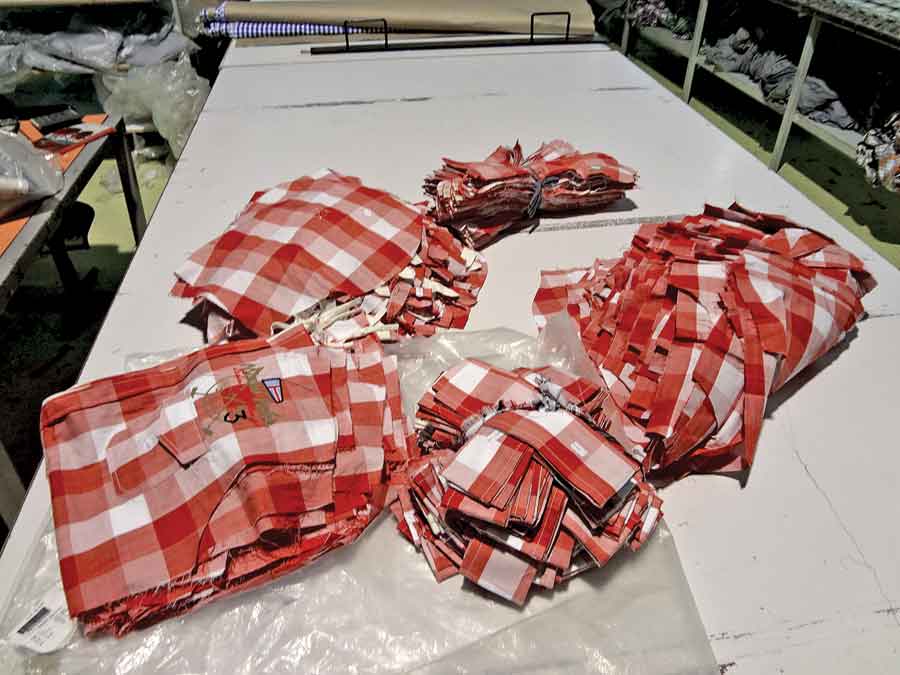
For robust bundle management, the company has adapted a system which the Italians call ‘relook’ and has been implemented in their internal order processing and production monitoring ERP system, termed as ‘Mother & Baby Model’. A single style is broken down into smaller components like pocket, collar, cuff and sleeve, and kept in Baby bags. All the Baby bags of a style are part of a bigger bag called the Mother bag, of the same style. The system being bar-code driven, there is no chance for errors. From time to time various components from the Mother bag are sent for detailing to various departments (printing, embroidery, embellishment, etc.) in Baby bags and then reunited to the Mother bag after the value addition. Only on the completion of all value addition, the Mother bag is sent to the production line for stitching. This forms an ideal example of disciplined production
[bleft] Radhamani Group has a setup of 650 sewing machines with a turnover of US $ 65 million and daily output of 10,000 casual shirts, embellished with embroidery, printing, appliqué work and additional sewing operations compared to basic formal shirt. The company has an in-house printing setup and 25 automatic embroidery machines. [/bleft]
management philosophy, Mother and Baby bag system, which ensures that all parts and materials are there before the pieces go to the assembly line.
The drawback of this system is that at times components of a style which are not planned for production in a particular month or day could still be seen on the floor. Otherwise this system brings optimum utilization of manpower of the facility at any given point of time. This high inventory production system is closely monitored by mobile bar-code scanners on the shop floor and the production status gathered is discussed and planning is done for the next day. Another big advantage of the system is that the final assembly lines are not affected with the change in shirt specifications, as all the value additions are already completed before the Mother bag is passed to the assembly line. Due to this the style changeover time has been just reduced to an hour or so.