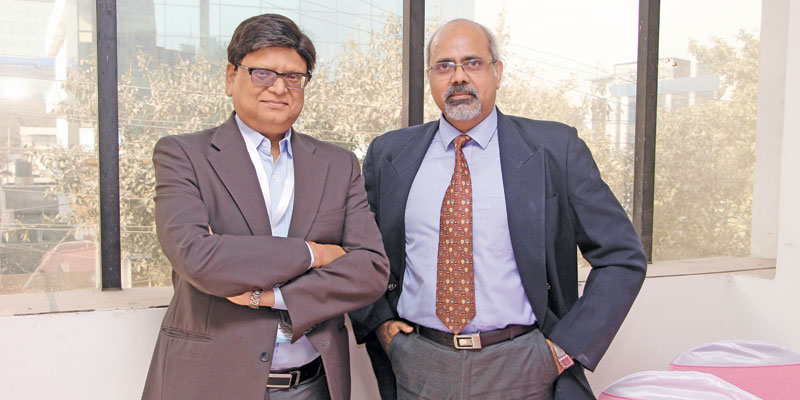
Deriving its competitive edge from integrated business models, the Pulp and Fibre business of Aditya Birla Group, Birla Cellulose has steadily grown over the past six decades to achieve global partnership with a 21 per cent market share. LIVA, the company’s new age naturally created fabric has created a stir in the domestic market for being comfortable, soft, 100 per cent natural and eco-friendly. In conversation with Apparel Online, Rajeev Gopal, Chief Marketing Officer, Birla Cellulose (Grasim) talks about the strategy of the company in respect to LIVA, LAPF and the market in general.
Although LIVA has made its name in the Indian domestic market, yet in the international scenario it is still unknown. “LIVA is really a brand for India, but we will launch it in the international market in the next couple of years,” reveals Rajeev. Meanwhile, there are plans to start a studio in New York on Seventh Street, which is going to promote LIVA accredited partners’ forum or LAPF, as it is commonly referred to. “As of now promoting LIVA as an international brand calls for a huge effort, but, we want to promote Indian exports; therefore we will promote the fabric through LAPF studios and LAPF exhibitions and whenever we participate in Premier Vision, Intertextile, or any other international event, we always take our partners (from LAPF) along with us to show their collections. This way we promote Indian exports,” continues Rajeev.
LAPF is the first-of-its-kind platform in the textile fraternity that connects and builds a network of textile professionals, to scale up the textile value chain with a joint marketing drive to increase the reach of its partners in the international markets.
Including leading players such as Shreeji, Mafatlal, Mercury, Karuna Tex, Svarn Tex, MI Industries, VSM among its 250-plus partners, the company provides them a chance to promote their products through special drives like Market Week and Mill Week that are held abroad. “We are creating an eco-system of capability in the Indian value chain to satisfy the global demand and not just domestic demand,” adds Rajeev.
The company is very bullish on the potential of LIVA in the international circuit since India has seen growth of 30 per cent CAGR in viscose-based garment exports in the last few years. “We are seeing huge growth, as there is a vacuum being created by China reducing their share due to rising labour costs and environment issues. India can more than double its present share, if we grab this opportunity,” reasons Rajeev. Although the country has the potential to do more, challenges such as market access still looms over the textile industry; and while India is still in the midst of finalization of the FTA with Europe, Rajeev stresses the need for a preferential trading agreement with the US also as both Europe and US consume 40 per cent each of India’s apparel export. “Even countries like Vietnam, Bangladesh and Pakistan have special treaties, but we don’t have anything. So how will our exporters get preferential advantage,” argues Rajeev.
Apart from issues of global market access, fibre neutrality seems to be another challenge that India faces. Although the global requirement for man-made fabrics is increasing, India still relies on cotton. “Unless we change our mindset, how will we develop and fulfil the demand. What are we doing for man-made fibres? They are saying that GST will help. But when will GST come? Even if it comes will it be a level playing field? The cost of capital is high for our exporters. Our exporters pay an interest cost of 7-8% against 2-3% which is applicable globally. Look at south they don’t get power. A lot of things need to be done by the industry and the Government. If all of it is combined together, the Indian textile industry can really boom right now,” asserts Rajeev.
Does India have the potential to double its targets? Yes, Rajeev believes so. “We are just exporting textiles worth US $ 30-40 billion in a trade worth US $ 750 billion, this is just peanuts with the kind of capability we have,” he says LAPF is an answer to India not just being known for its cotton! The company has a team which continuously visits markets every season and creates trends that are going to come in vogue in next 18 months down the line. Every season, they present these collections made from viscose fibre to brands and also display it during exhibitions. All the seasonal collections of the company will also be displayed in their LAPF studios. “The interest is generated and that’s how the growth is happening,” claims Rajeev.
Recently, the company launched their first and India’s only state-of-the-art studio exclusively for their LAPF partners in Noida. Making its presence felt in one of the largest garment clusters, Noida, where over 650 garment units are located, it will act as a one-stop customer experience centre for technical, product and marketing solutions. The studio offers more than 1,000 fabrics of Viscose, Modal & Excel on display with detailed technical specifications along with wide variety of fabrics including woven, knitted, flat-knitted, etc. Also, LIVA’s seasonal collections specially designed by their in-house designers will be on display at the studio.
The biggest challenge for the company is finding like-minded people and also the lack of people to educate and more importantly their willingness to learn. “Initially it was a challenge but the proof of the pudding is in eating it and when people see success, they don’t mind doing it,” adds Rajeev.
Going forward, the next step for the company is to get into chemical management as globally it is known for its sustainable products and increasingly wants to focus on sustainability. The company has recently collaborated with a Switzerland-based chemical management company called Total Sustainable Solutions.
Increasingly, the company also wants to associate with more institutes and the concept of LIVA Protégée is one such initiative, while having various projects with DKT, PSD college in South and NITRA research organisation. Taking a unique direction, the company is also looking at ways to support the handloom industry with their fibres and yarns.
Collaboration and innovation remain the key to the company’s business. “We would like to become a culture. The spinners we are working with, we want to promote their speciality in delivery as well. It is very difficult to fix a service standard – to define speedy delivery and quick response. It’s more of sharing information and getting it right,” concludes Rajeev. The company is doing everything right to get the industry together whether it is through the LIVA LAPF Conference or by launching speciality products such as the LIVA Crème Launch in March.





 Bharat Tex Special Report 2026