Stitching thread is perhaps the most critical input in a sewn product after the material, though it is also the most underplayed. The versatility of thread meets the diverse requirements of sewing from lightweight fabrics to hard and difficult materials in leather and PVC. They also keep pace with varied needs of structural and decorative seams on a huge product range – undergarments, lingerie, swimming costumes, shirts, blouses, T-shirts, trousers, dresses, tailored coats, waterproof and windproof jackets, snow wear, sports wear to sewn products like shoes, car seat covers, footballs and luggage.
Each of these products requires a thread with different physical properties and with a compatible needle to achieve optimum performance. Niki Tait and Team StitchWorld takes a closer look at the new varieties and developments in threads and their features in companies like A&E (Vardhman), Gunold, Gütermann, Madeira, Amann and Coats.
Sewability, loop strength, linear strength, elongation, shrinkage, abrasion resistance, colourfastness, and resistance to chemicals, heat, light, etc. are some of the critical properties in the thread for stitiching a quality garment. The thread must perform flawlessly on high speed machines without breaking and without skipping stitches. The critical factors necessary for good sewability are: thread strength, optimum twist levels, low fault levels, low and controlled elongation, tenacity, and lastly, uniform lubrication.
[bleft]The critical factors necessary for a good sewability are: thread strength, optimum twist levels, low fault levels, low and controlled elongation, tenacity, and lastly uniform lubrication[/bleft]
The type of seam, stitch type, number of stitches per inch, the type of material being sewn, the type of sewing machines and related equipment, the conditions under which the product must perform the normal life of the product and cost effectiveness also need to be added to the equation. Analyzing these factors would give one an indication of which physical properties are most important when considering threads. Nowadays, environment-friendliness is also an important issue when making the choice. Hence, selection is about choosing a thread with the most desirable properties.
American and Efird (A&E), one of the world’s foremost textile manufacturers, quite aptly pointed out: “There is no perfect thread for all applications; however, there is a perfect thread for a specific application”. However, the selection is not always straight forward which is why many thread companies provide a lot of educational literature via their websites and technical back up services which can help identify the best thread for each operation.
American & Efird provides an on-line guide “Thread Selection by End Use” which also considers sewability (process ability), seam performance (seam strength, seam durability, etc.), seam appearance (colour, colour fastness, stitch appearance, etc.), availability (Is the best product available?) and cost (including both the price and the hidden costs) to help decide which is the best thread to use.
Under seam performance, for example, items to be considered include: chemical resistance, abrasion resistance, ultra-violet resistance, short- and long-term heat resistance, stone wash resistance, minimize cut-stitch and seam elasticity. Each factor suggests a specific type of thread.
[bleft]
- Madeira has added to its range Fire Fighter threads, the first flame and heat resistant embroidery thread
- “There is no perfect thread for all applications; however, there is a perfect thread for the specific application”, observes A&E[/bleft]
A&E’s patented NTT core spun technology is used in poly/poly core spun thread for sewing at the least possible tension and thereby exerting lesser tension on the thread during the process of sewing. This thread is very popular in sewing a wide variety of garments. Stretched polyamide thread processed through NTT route is used for car, train and airplane seats, tents, sleeping bags, tarpaulins, shoes, etc. as seam elasticity and seam strength is of prime importance while putting seat cover on the seat.
Oeko-Tex Standard 100 certified Gunold claims to be the industry leader in embroidery thread, and in protecting and sustaining the environment. With Gunold’s rayon thread Sulky, for example, 100% of the viscose is processed by Enka, the producer of viscose fibre, which utilizes cellulose extracted from a unique, specialized pine tree that is grown in a protected, controlled plantation. This results in a sustainable, renewable and biodegradable resource.
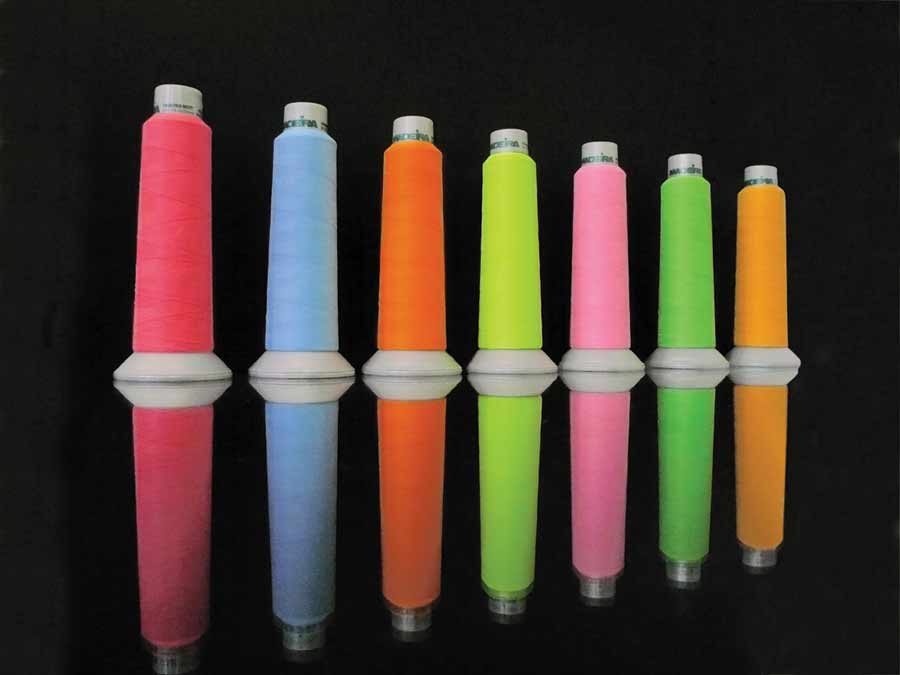
Enka insists on allowing nature to age their product for a full 30 days, after which the viscose passes rigorous inspection before being released for further production. Sulky is the only embroidery thread entitled to wear Enka’s coveted Gold Seal award. The next processing steps are to turn the viscose into thread, then to dye and twist the thread and wind them onto master cones; this is accomplished by Beerli AG, owned by Urs Isler, who also owns 50% of Gunold.
During these processes, the focus continues on preserving nature whilst maintaining high quality. Each year, Beerli invests about a million Euros in state-of-the-art ecology and quality assurance technologies in their production sites in Austria and Switzerland. For many years the investments have focused on anti-pollution measures such as waste heat recovery and steam boiler maintenance resulting in a substantial reduction in annual emissions, 3,10,000 kg less carbon dioxide emissions, 1,200 kg less sulphur dioxide emissions, and about 18 million litres of water saved. Only reusable cones are accepted in the dyeing process and for storage of unfinished goods.
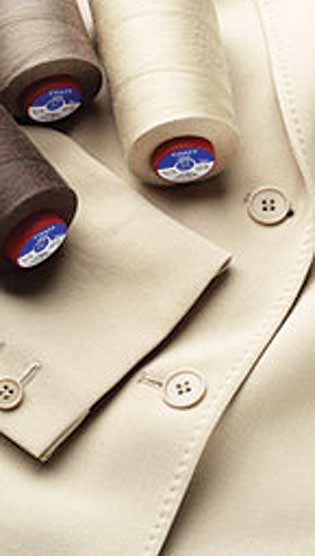
Ideal for large-scale designs in the clothing or accessory trade, Gunold has recently developed a new foil yarn called Glitter which produces, as its name implies, glittery effects. Like a hologram the cut, untwisted yarn surface refracts the light, adding brilliance to embroidery design.
Also producing the metallic look is Gütermann’s new Polar 70 which provides: “Spectacular shimmer in five shades”, from antique gold through black to three different shades of silver. Polar 70 is ideally processed using needle thicknesses 80-90/12-14. The thread is 80% viscose and 20% polyester.
The bi-fiber composition Gütermann’s Diva 20 is dual-coloured for distinctive decorative seams This special sewing thread combines a pleasant feel with a sporty style and can be used for durable, hard-wearing seams. It is soft to touch and qualified for enzyme – and industrial washing. Thread is available in Tkt/20-dtex 1500 – tex 150 and needle sizes that can be used are NM 160-180/23-24. Approximate strength is 5.300 cN and thermal shrinkage below 1%. Fastness to water, perspiration, rubbing and organic solvents is grade 4 and better.
Over the last year the Madeira Burmilana shade card has been considerably enlarged, including mélange, mouliné and astro colours, whilst X.tra provides super soft tough properties with a metallic look to compliment and provide an alternative to the real metallic threads. Fire Fighter has also been added to the range which is Madeira’s first flame and heat resistant embroidery thread.
Addressing the increasing demand for finer threads the Polyneon no.60 range has been increased from 45 to 100 colours. The new Frosted Matt, with excellent fastness to light, is claimed to be the world’s first truly matt embroidery thread. It is available in 161 colours.
To strengthen their international network of production sites and sales markets, in 2008 the Amann Group acquired Oxley whose wide range of products cover nearly all sewing thread applications in apparel and textile business. Oxley is a key supplier in the automotive sector offering a range of technical textile threads. Venus, for example, is manufactured from nylon 6.6 threads, and bonded using a unique process to provide excellent sewing performance in the production of footwear, upholstery and leather goods. Oxcel, a development of the Venus thread, is claimed to have exceptional multi-directional sewing capabilities and is used extensively in the automotive industry and production environments where high seam strength and excellent abrasion resistance are paramount.
Wardex, a lubricated thread range from Oxley, is also manufactured from highest quality nylon 6.6 threads. It offers considerably higher resistance to abrasion than polyester, making it particularly suitable for demanding areas in leather sewing. Terrier and Invincible threads made from high quality continuous filament polyester, treated with Oxley’s own blend of thread lubricant, allows excellent control of friction during sewing, making it ideal for high performance products such as harnesses, bedding and webbing. Oxella cotton covered core spun polyester processed with a glace finish offers a high quality alternative to synthetic products for leather and upholstery.
Coats have put together their global experience of manufacturing spun polyester threads to produce high tenacity Coats Epic threads. Tenacity can be explained in two ways: good tenacity means that, either for the same thickness the thread is stronger than the other, or for the same strength the thread is finer than other. For example, for the same thickness (grist) Coats Epic is 18-20% stronger than Astra. Again for the same strength Epic will be 18-20% finer (thinner) than Astra. Thread with higher tenacity also helps in sewing in other ways; for example, Coats Astra Tex 27 has a breaking strength of approximately 1050 gms.
A bobbin typically will hold between 60-65 metres of this thread. Now by replacing Coats Astra Tex 27 with Epic Tex 21 (having the same strength of 1050 gms.) the bobbin will now hold 75-80 metres of thread. Thus the bobbin will hold 20% more thread when Epic is used. Coats Eloflex, made from PBT (PolyButylene Terephthalate) is designed for highly elastic knitted fabrics, has a good tenacity, is highly elastic and could be used both as needle and under thread.