The textile industry in Ludhiana is facing mounting pressure from rising raw material costs, disrupted supply chains, and weakening demand across both domestic and international markets, according to industry stakeholders.
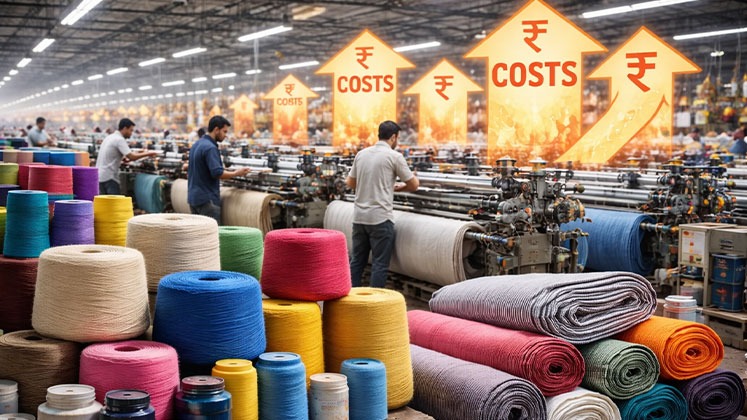
Manufacturers have reported sharp increases in the prices of fibres derived from crude oil, including polyester, nylon, and spandex, with costs rising by 20% to 30% in recent weeks. Polyester prices have increased from around Rs. 115 (US $1.23) per kg to Rs. 165 (US $1.77) to Rs. 170 (US $1.82) per kg. Price of Nylon fabric has gone up from Rs. 175 (US $1.88) per metre to about Rs. 210 (US $2.25) per metre, while spandex prices have also risen by nearly 20%, said an industry insider.
The cost pressures are not limited to synthetic materials. Natural fibres such as cotton have also become more expensive due to higher production costs and supply constraints. Cotton yarn prices, for instance, have risen from Rs. 260 (US $2.79) per kg to around Rs. 292 (US $3.13) per kg in recent weeks, reflecting a broader inflationary trend across raw materials.
Sudarshan Jain, president of Knitwear and Apparel Manufacturers Association of Ludhiana, confirmed that the rise in prices has been widespread across both synthetic and natural fibres, including cotton and rayon.
In addition, manufacturers are grappling with a sharp increase in packaging costs. Prices of polybags and other plastic-based materials used in logistics and exports have risen by as much as 40%, further adding to operational expenses. The price of a single polybag has increased from Rs. 2 (US $0.021) to around Rs. 3.15 (US $0.034) to Rs. 3.5 (US $0.038). All PVC-based packing materials have become significantly costlier.
Industry players have attributed the surge in input costs to disruptions linked to crude oil markets as well as higher shipping and freight charges. Ongoing geopolitical tensions have impacted global logistics, significantly increasing transportation costs for raw materials.
At the same time, demand has weakened, with buyers placing smaller orders or delaying purchases amid rising prices and economic uncertainty. Amit Jain, chairman of Confederation of Indian Industry (CII), Punjab, stated that the industry is confronting a dual challenge of escalating costs and declining demand, adding that continued pressure could have broader economic implications, including the risk of a global slowdown.
The cost of raw materials, including fibres, has increased by 20% to 30%, while chemicals and dyes have gone up by nearly 30%. At the same time, customers are either delaying or reducing orders due to uncertainty in global markets.
Labour shortages have further compounded the situation. Manufacturers estimate that around 20% of workers have not returned following the festive season, citing uncertainty and operational disruptions, including shortages of industrial fuel such as gas cylinders. Jain noted that the usual post-festival return of workers has been slower this year.
With rising costs, shrinking orders, and workforce constraints converging, Ludhiana’s textile sector is bracing for a prolonged period of stress. Industry stakeholders have warned that unless geopolitical tensions ease and supply chains stabilise, conditions may deteriorate further in the coming months.