India’s textile industry is poised for a long-term growth phase, driven by the global China+1 sourcing strategy, diversification of supply chains and improving market access through trade agreements. However, the sector’s ability to translate these opportunities into sustained export growth and higher global market share will largely depend on execution, productivity and manufacturing competitiveness, according to a research report by 360 One Capital.
The domestic brokerage firm said that textile companies with scalable garment manufacturing operations, integrated production facilities, strong customer relationships and consistent execution are expected to benefit the most from the evolving global sourcing landscape.
As international brands look to reduce dependence on China amid geopolitical shifts and the need for more resilient supply chains, India stands to gain from rising sourcing opportunities.
At the same time, the report cautioned that favourable trade agreements alone will not guarantee long-term growth, highlighting that India has previously struggled to fully leverage similar opportunities.
“The central question is therefore no longer whether the opportunity exists. It is whether Indian manufacturers can build sufficient scale, productivity, technical capability, compliance and delivery reliability to capture the incremental sourcing volumes becoming available,” the report said.
According to the report, India’s share of global apparel exports has remained at nearly 3% over the past two decades, while Bangladesh has increased its share to around 9-10% and Vietnam to about 6-7%.
It noted that India’s competitive edge is no longer determined primarily by labour costs. Global buyers are increasingly assessing suppliers on factors such as manufacturing scale, product capabilities, turnaround times, logistics, regulatory compliance, sustainability and overall supply-chain resilience.
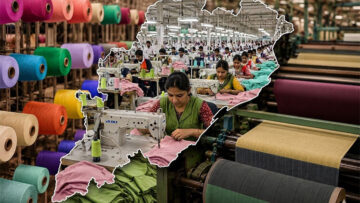
The report identified garment manufacturing as India’s biggest structural weakness and its largest growth opportunity, with fragmented production and limited scale restricting the country’s ability to service large international orders.
It added that future competitiveness will be shaped more by labour productivity, operational efficiency, automation and timely deliveries than by low wage costs.
The report also stressed the need for India to diversify beyond cotton, as global demand continues to shift towards man-made fibres, performance apparel and technical textiles.
To remain competitive, India must strengthen its capabilities in advanced fibres and yarns while also improving cotton productivity, fibre quality and traceability.
Trade agreements such as the recently implemented India-UK Free Trade Agreement could enhance India’s sourcing attractiveness, but the report emphasised that the industry’s operational readiness will determine whether tariff advantages translate into long-term business.
“The industry therefore needs multiple trade agreements alongside meaningful expansion in garmenting capacity, technical capabilities, compliance and new labour-rich manufacturing clusters,” it said.
Looking ahead, the report expects automation, sustainability and traceability to emerge as key competitive differentiators.