‘Opportunity’ is the word that defines the market for umbrellas in India, impacting a population of more than 850 million residing in coastal areas, receiving an average annual rainfall of over 1,500 mm per year. Even when we take a meagre requirement of one umbrella per family of four people, still the requirement of umbrellas in the country goes up to 210 million umbrellas. Assuming an umbrella costs a minimal of US $ 2, the market demand amounts to a little more than US $ 420 million. But the Indian domestic market, according to the 4,000-odd umbrella manufacturers of the country, is just US $ 100 million and is growing at a rate of 7% to 10% as projected by the Ministry of Small and Medium Enterprises. Who is making good the shortfalls…, of course it is China, with a total manufacturing capacity of 3 billion umbrellas; but with China getting expensive, the scope for growth of domestic players is huge.
Kolkata has its share of umbrella brands like Garden, Mohendra Lal Dutta, Citizen Umbrellas and Hindustan, and Kerala’s umbrella market is even more vibrant with well known players like John’s and Popy’s, along with a number of others including Sun, Stag, Colombo and Lunar. In Mumbai, there are companies like Sagar Group (parent company of Happy Umbrellas, Fuma Umbrellas, Sagar Sons, Mahaveer Exports), Anchor Umbrellas, and Natural Umbrellas, and in Delhi there are companies like Capital Chhata Udyog, Bamotra Industries, T. K. National Umbrella, Swastik Enterprises and Avon Umbrellas. “With approximately 4,000 umbrella manufacturers, India has a potential to make around 72 million umbrellas per season but ends up making only 60 million umbrellas,” claims Jayesh Chopra, Owner of the Mumbai based Happy Umbrellas. ‘Happy’ brand of umbrellas is manufactured by Sagar Sons Pvt. Ltd., which is a subsidiary of Sagar Group with four umbrellas manufacturing verticals namely, Mahavir Exports, Fuma Umbrella, Nice Umbrella and Sagar Sons. Established in Falna, Rajasthan in 1937, the company is among the few vertically integrated umbrella manufacturers.
Today, the industry is hopeful that the Chinese supremacy may not last for long as the rising wages in China have opened up the opportunities in the Indian markets as not only the price of umbrella is rising but also the quality of the imported Chinese umbrellas has gone down.
Despite the industry’s long existence of six decades, the Indian manufacturers are still majorly dependent on the Chinese and Taiwanese imports of fabrics, ribs and shafts. The reason being, China also makes specialized yarn and hence the fabric is available at a cheaper rate, and same is the case with ribs and shafts. “We make four lakh dozen umbrellas a year, which are mostly retailed at less than US $ 1.5 but still we are not able to match up with the Chinese pricing,” says Naresh Bhatia, Managing Director of Mumbai-based ‘Citizen’ brand of umbrellas. Established in 1882, Citizen is the oldest umbrella manufacturer in India and claims to be the largest producer of umbrellas. With an ISO 9001:2008 certification and sales turnover of US $ 16 million, the company has a woven umbrella fabric manufacturing and processing unit in Surat, Gujarat, along with backward linkages for ribs and shafts manufacturing.
For manufacturing frame and stick, there are two factories in India, established as joint ventures – Fulex Steel Printab, located in Falna in Rajasthan and Fuma Umbrella Works, located in Thana in Maharashtra.
What further fuels the competitiveness of the Chinese umbrellas is the 28% duty levied at the Indian ports on import of fabrics for umbrellas and 15% to 20% on the import of shafts and ribs. Ironically, a mere 5% duty is levied on a finished umbrella imported into the country. Joseph Thayyil, Director, John’s Umbrella shares an alternate solution by which companies can avoid paying hefty duties. “We get the fabrics into Sri Lanka where it is cut to umbrella-panel size, and then imported by paying only 5% duty. But the logistic costs and the involvement, take away the benefits,” says Joseph. John’s Umbrella is arguably the largest domestic umbrella player in the country with a turnover of more than US $ 5 million. The closest competitor to John’s Umbrella is Popy’s Umbrella, which receives fabrics from Taiwan in its factory in Dubai, where the panels are cut and stitched as a canopy. For manufacturing frame and stick, there are two factories in India, established as joint ventures – Fulex Steel Printab, located at Falna in Rajasthan and Fuma Umbrella Works, located at Thana in Maharashtra.
Today, the industry is hopeful that the Chinese supremacy may not last for long as the rising wages in China have opened up the opportunities in the Indian markets as not only the price of umbrella is rising but also the quality of the imported Chinese umbrellas has gone down. “Companies in Umbergaon, Gujarat and Falna, Rajasthan have been providing steel and metal ribs and shafts, but now they have developed capabilities for manufacturing fibreglass ribs and shafts,” shares KN Marsook, Chairman, Colombo Group of umbrellas, happy with the current situation. The shaft is a hollow pole made of wood, steel, aluminium or fibreglass forming the axis of the umbrella. It houses the tension springs that assist the opening and closing of umbrellas. Ribs made of steel or fibreglass run underneath the canopy of the umbrella. These ribs are connected to the shaft of the umbrella by the means of multiple hinged thin steel segments called stretchers.
Majorly polyester, canvas, dupione, nylon and taffeta fabrics are used in making umbrella canopies which are available with the manufacturers and suppliers in Gujarat and Maharashtra. One has to ensure that the fabric is processed using special colours along with the fixation agents for colour fastness to sunlight and water. The capabilities are yet to be developed for plastic-material based canopies for umbrellas. Fabrics with better finishes can be sourced from Taiwanese manufacturers such as Formosa. Use of PVC and microfiber fabrics with UV protective finishes are also popular. However, when umbrellas serve as the fashion quotient, the fabric can range from silk and lace to leather and canvas.
With the complete supply chain in place, it is now the manufacturers who are upgrading their products to tap a greater share in the market by attracting non-umbrella users. “We have licences from Disney, Warner, Marvel and Green Gold of Chota Bheem fame for using their cartoon characters on umbrella clothes,” continues Joseph. The company has also launched an umbrella with a built-in MP3 player. “Earlier people would not use an umbrella under a blazing sun but now they do not mind paying extra for an umbrella with Teflon coating that offers protection from ultraviolet rays,” he adds. Similar is the thinking of, Davis Thayil, CEO, Popy’s Umbrella Mart, manufacturing nearly 4.8 million umbrellas annually and a close competitor of John’s Umbrella, together the companies hold 70% of the Indian domestic market share. Popy’s has developed an umbrella, which when folded shrinks to 16 cm and another umbrella equipped with a torch, thermometer, compass, lens, mirror and whistle. “Product innovation is the key in our business, it has to appeal to everyone, irrespective of age or gender,” explains Davis, who claims that India can certainly win the game by focussing on the quality and longevity of the product.
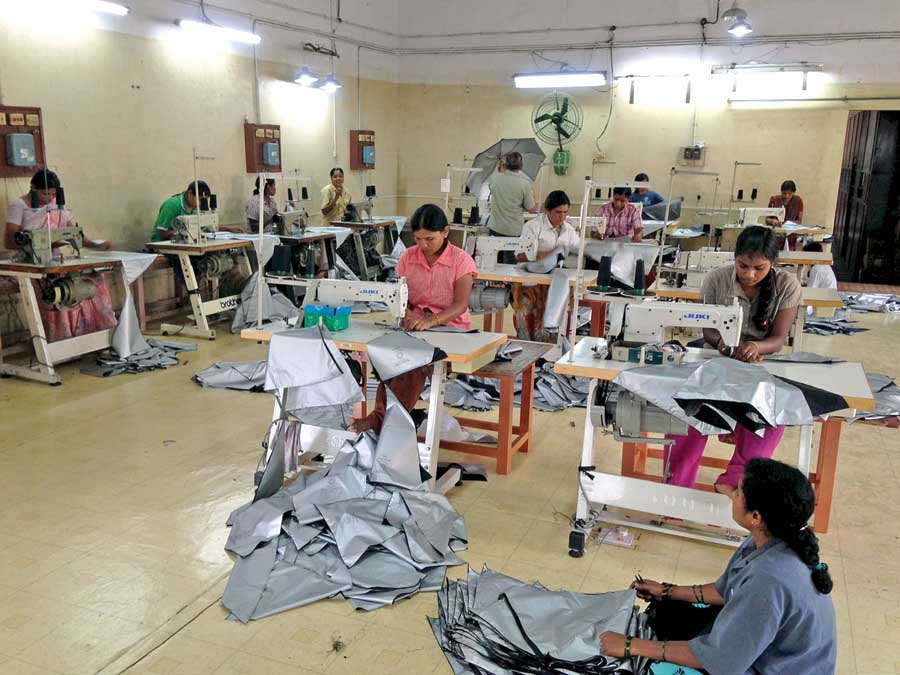
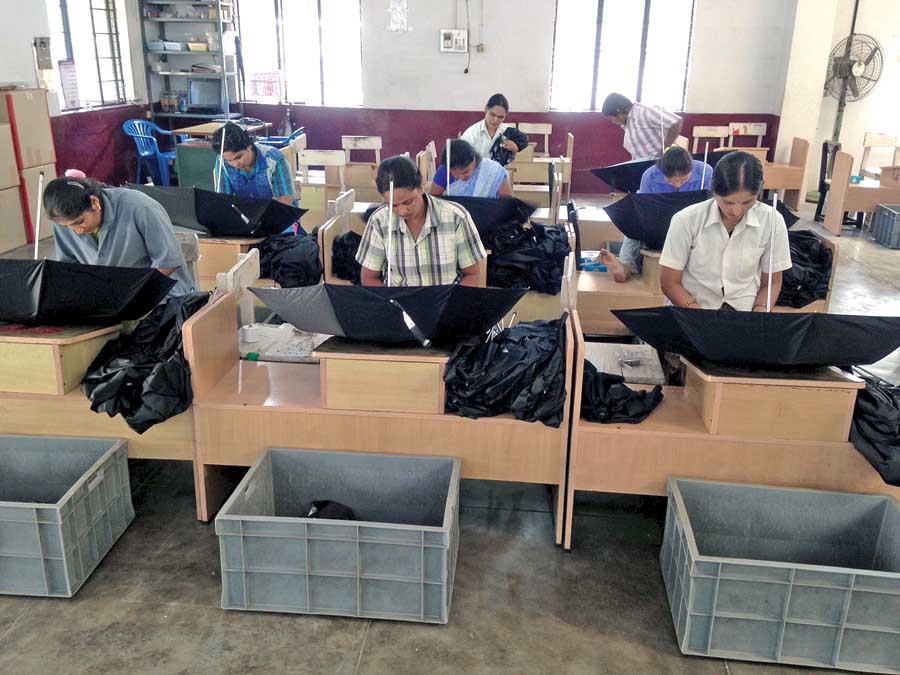
Requirements of manufacturing an umbrella are essentially identical to those of garments – right from cutting to printing to stitching to assembly to packaging. Umbrella manufacturing as seen at the production floor of Sun Umbrellas in the pictures below, testifies the same.
Opportunity in the Export Market
Despite being the world’s second largest umbrella manufacturer after China, according to the International Trade Centre calculations based on UN Comtrade Statistics for 2012-13, India exported umbrellas worth only US $ 0.6 million, while China exported umbrellas worth US $ 2.7 billion (70 per cent of world’s demand). The same old reasons are given for China’s growth, its strong indigenous backward linkages, large production capacities and export incentives. “Absence of such blanket measures discourage the Indian umbrella manufacturers,” advocates Jayesh, who also was unhappy that his company is not being allowed to cater to the domestic market from its facilities located in the free trade zones, while the same is allowed in China. The company is exporting over 720,000 umbrellas per annum for almost a year now.
However, as the Chinese labour wages rise and its labour pool shrinks, India is gradually increasing its market share in exports. India’s umbrella exports for FY 2013-14 increased to US $ 2.11 million (according to the Ministry of Commerce, Government of India), a 250 per cent Y-O-Y rise, which looks good on paper but is still 1% of the total Chinese exports. Sadly, this growth can only be attributed to less than 10 umbrella exporters from India, including names like Happy Umbrellas and Sun Umbrellas, along with few other domestic players who are exporting to gulf countries and Africa. Mumbai based Happy Umbrellas anticipates a growth of 20 per cent on Y-O-Y basis in its export orders over the next five years. “The cost of manufacturing a basic umbrella will be US $ 2.5 for domestic market while the same umbrella will cost US $ 2 for exports due to the Advance License provision by the Government of India,” explains Manoj Mehta, Owner, Sun Umbrella who exports 1,00,000 umbrellas annually, highlighting the opportunities in the export market for the already established domestic manufacturers.
| Operation breakdown and sewing process flow chart of a basic 8-panel umbrella | |||||||
| Description of Operation | Machine Type | Work Aid | Juki | Typical | Siruba | OPE.TIME (min.) | |
| Umbrella loop | |||||||
| 1 | Fold & both side topstitch | Flat Bed (Lockstitch) | Edge guide | DDL-810eB | GC-6150 | DL918/L918/L818D | 0.65 |
| 2 | Attach metal fastner (male & female) | Post bed (snap button attach) | N.A. | Metal Fastener Pressing Machine | 0.35 | ||
| Umbrella canopy | |||||||
| 3 | Join delta cloth (8 pcs.) | Flatbed (Lockstitch or Chainstitch) | Edge guide | MH-481U | GK-0056 | L918/L381 | 4.80 |
| 4 | Sew center hole | Cylindrical bed | N.A. | LK-1900A-SS/JAO58 OR AMS-210EN1306S5000Z | PK533-C | 0.33 | |
| 5 | Attach loop to umbrella cloth | Cylindrical bed | N.A. | LK-1900B | GT690 | PK-02 | 0.26 |
| 6 | Topping ring attach | Post bed | N.A. | ||||
| 7 | Attach end tips (optional) | Cylindrical bed | Modified clamp with a horizontal spoke | MB-1377 | GT660/GT661 | PK-01 | |
| 8 | Set umbrella cloth to bone (24 pcs.) | Done manually | Modified L shaped clamp | Hand work | GT660/GT661 | PK-01 | 14.40 |
| Total (in min) | 20.79 | ||||||
“Apart from large capacities, exports require the manufacturers to have proper systems to manage quality, develop and practice Standard Operating Procedures (SOPs),” says Nafisur Rahman, Group Leader, Home Division, Triburg, working in close cooperation with Kerala based John’s Umbrellas for Tchibo, a German buyer. Initiated five months ago, the project is focused at developing John’s Umbrella as a compliant and competent factory, using the principle of ‘work not recorded is work not done’, which includes training on topics ranging from documentation of RFT, reworks and production planning systems. Placing special emphasis on quality systems, John’s has already been trained on AQL 1.0, 4 point inspection for fabric and cut panel inspection. “Being a major domestic umbrella manufacturer, John’s competency lies in manufacturing while our expertise lies in standardization and documentation of procedures in a manner that it becomes integrated with the process. Bringing the two competencies together will put John’s operations at par with the export requirements,” explains Nafisur.
Market-wise, an umbrella exporter is more likely to receive huge business volumes from Europe due to its unpredictable weather conditions as compared to the US. Australia is another emerging important market as it recorded a growth of over 66 per cent in umbrella last year (Trade Map, International Trade Centre). Leading exporters such as Sun Umbrellas from Mysore and Mumbai based Happy Umbrellas have been catering to the UAE and African countries. Closer home, lucrative markets for exports include Bangladesh and Pakistan as they are prone to daily weather fluctuations. However, Sri Lanka has imposed anti-dumping duties on umbrellas to guard the interest of its local manufacturers.
India’s gradually increasing export market share can only be attributed to less than 10 umbrella exporters from India, including names like Happy Umbrellas and Sun Umbrellas, along with few other domestic players who are exporting to gulf countries and Africa.
Manufacturing
Requirements of manufacturing an umbrella are essentially identical to that of garments-right from cutting to printing to stitching to assembly to packaging. The sewing operations involve both machine stitching and hand stitching operations. Sewing operations are generally done in groups, where each group comprises of a certain number of operators performing a particular operation and the operator is responsible for checking threads while stitching. The permeation of technology in umbrella manufacturing is restricted to the use of 3D modelling software at product development stage.
The three main components of an umbrella are the canopy, ribs and the shaft. Canopy refers to the triangular fabric panels sewn together. The canopy cannot be cut in one piece since the panels are needed to be shaped to the curve of the ribs. Attached to the canopy is the loop that holds the folded canopy of umbrella together. Based on the requirement of the product, 6-12 identical triangular panels of fabric are cut. A variety of options for cutting machines are available ranging from Gerber’s Paragon, GGT, GTxL, XLc7000 and Z7 to Eastman’s manually operated cutter. Generally, umbrellas have eight panels, although umbrellas with six panels such as children’s umbrellas and as many as 12 panels can be found occasionally.
An umbrella has two sewn components – the canopy and the loop. The loop is sewn by folding a rectangular piece of fabric and top stitching along the length followed by attaching snap fasteners. Meanwhile, the sewing of canopy begins with hemming the bottom of the triangular pieces of fabric (delta cloth) and is followed by sewing together the eight panels of delta cloth for a complete canopy leaving a quarter of an inch unstitched from the top. The hole thus formed is reinforced using a circular bar tack. At this stage, the loop is attached to the canopy. The optional operation of sewing the end tips on the wrong side of the canopy fabric can also be carried out. Subsequently, the shaft is passed through the canopy and topping ring is attached.
The last operation of attaching the ribs to the canopy proves to be a bottleneck if performed manually. Each rib is attached to the fabric at three points. However, a chainstitch button attaches machine with a modified clamp that holds the rib and fabric together, can automate the operation and reduce the SAM by 92 per cent (i.e. from 14.40 minutes to 1.16 minutes). A similar work aid can be developed for sewing the end tips, reducing the SAM to 0.55 minutes for 8 end tips. The modifications required to be made to the chainstitch button attach machine include replacement of clamps that hold button with a horizontal metallic spoke (approximately 1½ inch long). No modifications are made on the throat plate though. The end tip is loaded on to the spoke from the side which is to be inserted in the ribs and tacked to the canopy fabric just like a button. Another work-aid is required for attaching fabric to ribs. The clamp needed for this operation is L-shaped with a single groove parallel to the breadth of the L on the underside. Similarly, the throat plate is altered and a groove is created by splitting it in two parts right under the groove of L. This groove houses the rib and fabric which is tacked together with the chainstitch.