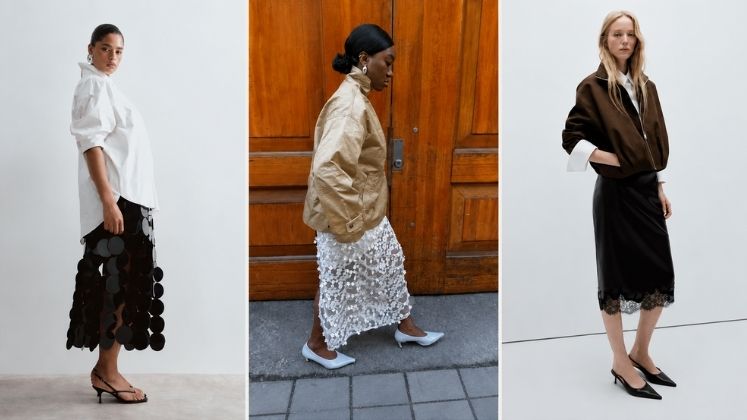
As autumn edges toward the party season, the styling formula dominates both international runways and street style is a study in contrast: take the most ornate, embellished piece in the wardrobe, the sequin skirt, the beaded midi, the sheer statement layer — and ground it with something deliberately casual. Bomber jackets, waterproofs, knitwear and plain shirting are replacing the expected cami or fitted blouse, turning eveningwear into something that can be worn well before December’s party calendar kicks in.
The formula translates easily: pair a sequin or sheer skirt with a plain knit or shirt rather than another embellished piece, add a utilitarian outer layer; a bomber, a trench or even a waterproof and keep accessories minimal so the skirt remains the focal point. As with the international examples, the goal isn’t to tone down the skirt itself, but to let a casual counterpart do the work of making it wearable well ahead of the actual festive season.
This season’s fashion month runways made the case for “dressed-down drama” repeatedly. At Chanel, delicately beaded skirt suits were shown with simple white T-shirts, stripping away the formality usually associated with beading and tweed. Celine paired a fully sequin-covered dress with a plain trench coat, using the coat to mute the sparkle into something wearable by day. Marc Jacobs took a similar approach from another angle, styling solid-coloured skirts with sequinned tops in contrasting colours, while Erdem grounded a hand-embroidered silk top with plain denim. The common thread across these shows is restraint: one ornate piece, one deliberately plain one, so the eye has somewhere to rest.
This “statement skirt, simple shirt” formula, which first surfaced on the spring 2026 runways, has since evolved into a broader movement toward mixing evening pieces into everyday wardrobes, part of what’s being called “wardrobe dressing” this season, where directional pieces are expected to integrate into a real closet rather than exist only for one-off events.
No designer has built a career on this exact formula longer than Ashish Gupta, the Delhi-born, London-based designer nicknamed “the king of sequins.” For two decades on the London Fashion Week schedule, Gupta has paired his hand-sequinned skirts sourced through workshops in India, with rugby shirts, sportswear, denim and plain T-shirts, a signature juxtaposition of high-glamour embellishment against deliberately low-key basics. His archive includes sequin bomber jackets and sequinned knitwear alongside his statement skirts, effectively pre-empting by years the exact styling formula now showing up on international runways. For Indian fashion audiences, Gupta’s work is a reminder that the “dressed-down sparkle” trend has deep roots in Indian craft traditions of hand-embellishment, reframed for a Western, streetwear-adjacent context.
Closer to home, several Indian design houses work regularly in embellished and sequinned skirt silhouettes as part of their pret and occasion lines. Designers such as Amit Aggarwal and Nikhil Thampi, both known for structured, statement-making silhouettes, include skirts and midi separates within their bridal-adjacent pret collections, pieces designed to be broken up and restyled rather than worn only as part of a full look. Rocky Star, under his label Rivaar, has similarly built a reputation around sequin and embellishment-heavy occasionwear that lends itself to separates dressing. These labels illustrate how Indian couture is increasingly designing skirts as standalone wardrobe pieces rather than fixed lehenga or gown components; a shift that aligns closely with the international trend toward breaking up eveningwear.
At the more accessible end, both Zara and H&M have leaned into sequin skirts as a seasonal category, styling them explicitly for day-to-night wear, a white T-shirt and sneakers by day, a strappy top and heels by night. This mirrors the international It-girl formula referenced on the runways, and signals that the “dressed-down party skirt” is filtering down from runway and designer collections into mass-market seasonal ranges.