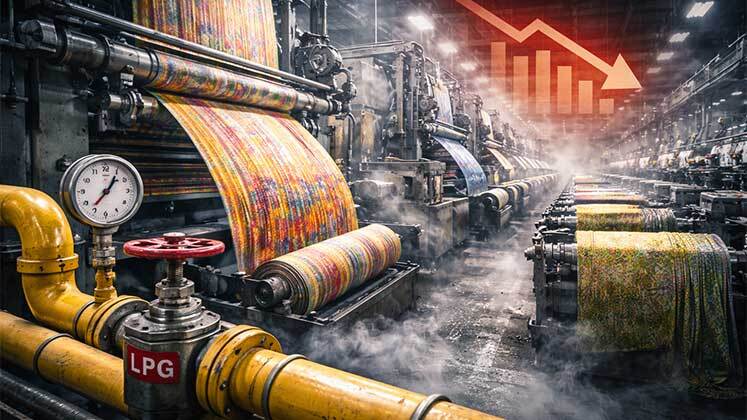
The textile dyeing and printing industry in Sanganer, is facing the prospect of a production shutdown amid a severe shortage of liquefied petroleum gas (LPG) cylinders, a key fuel used to operate flat-belt printing machines in the region’s textile units.
Industry representatives indicated that around 2,000 dyeing and printing units in Sanganer depend on LPG supply, collectively requiring approximately 3,000 cylinders each day to sustain operations. However, current inventories are estimated to be sufficient for only two to three days, raising concerns that production across the cluster may soon come to a halt.
The shortage is linked to a broader disruption in LPG supplies across Rajasthan. Reports from around 11th March 2026 indicate that fresh bookings for commercial LPG cylinders have effectively been halted, leaving industrial users, hotels and restaurants unable to replenish their stocks.
The supply constraints form part of a wider energy disruption affecting India following escalating tensions in West Asia involving Israel, Iran and the United States. The conflict has disrupted maritime traffic through the Strait of Hormuz, one of the world’s most important shipping routes for energy supplies. Restrictions in the area have delayed shipments of LPG, a commodity for which India depends heavily on imports.
India currently imports around 60 per cent of its LPG requirements, making domestic supplies particularly vulnerable to disruptions in international shipping routes.
In response to the tightening supply situation, the Ministry of Petroleum and Natural Gas has directed refineries and oil marketing companies to prioritise LPG supply for household consumers. As a result, bookings for commercial cylinders used by industries and service establishments have effectively been paused in several regions.
Representatives from the Federation of Rajasthan Trade and Industry have warned that textile printing operations in Sanganer could cease entirely if LPG allocations are not restored immediately. The industry body noted that a prolonged disruption would have serious economic consequences, particularly for workers dependent on the cluster for daily wages.
The potential halt follows similar operational disruptions reported at manufacturing facilities in Jaipur, including at the Borosil plant, where production has also been affected by the shortage of industrial gas supplies.
Authorities have introduced several measures to manage the LPG shortfall. A committee comprising three executive directors from oil marketing companies (OMCs) has been established to examine requests from industrial users seeking access to commercial LPG supplies. Industrial units requiring cylinders must now submit applications online, which will be evaluated based on operational necessity and available supply.
In addition, state governments, including that of Rajasthan, have been advised to monitor LPG distribution on a daily basis to prevent hoarding and black marketing during the supply crunch.
The central government has also imposed a mandatory 25-day interval between bookings for domestic LPG refills in an effort to discourage stockpiling and ensure equitable distribution among consumers.
Industry observers warn that unless supply routes stabilise and commercial allocations resume soon, one of India’s key textile printing hubs could face a significant disruption, placing thousands of jobs and export-linked production at risk.