High versatility, flexibility, productivity, and quality are the critical considerations when it comes to the pressing and finishing of any garment. Style runs are becoming shorter, design and styling more varied and today’s fibres, fabrics, special dyes and finishes are becoming more specialized and often necessitate very tightly controlled pressing and finishing parameters to ensure a quality finish. Eco-friendliness is also increasingly becoming a key priority in terms of ease of use, ergonomic design, low power consumption, low noise emissions, etc. Niki Tait takes a look at what is new from the pressing and finishing technology.
One of the most important developments in recent years, for example, has been the technology to extrude extremely fine man-made filaments, less than 1.0 denier. These ‘microfibres’ not only provide unique physical and mechanical performance in specialist outdoor wear for example, they also provide easy shaping characteristics, superb drapability, wrinkle resistance and silk like feel and are used in diverse ranges of apparel from tailored jackets and trousers, blouses, dresses, sportswear, outerwear and rainwear to swimwear.
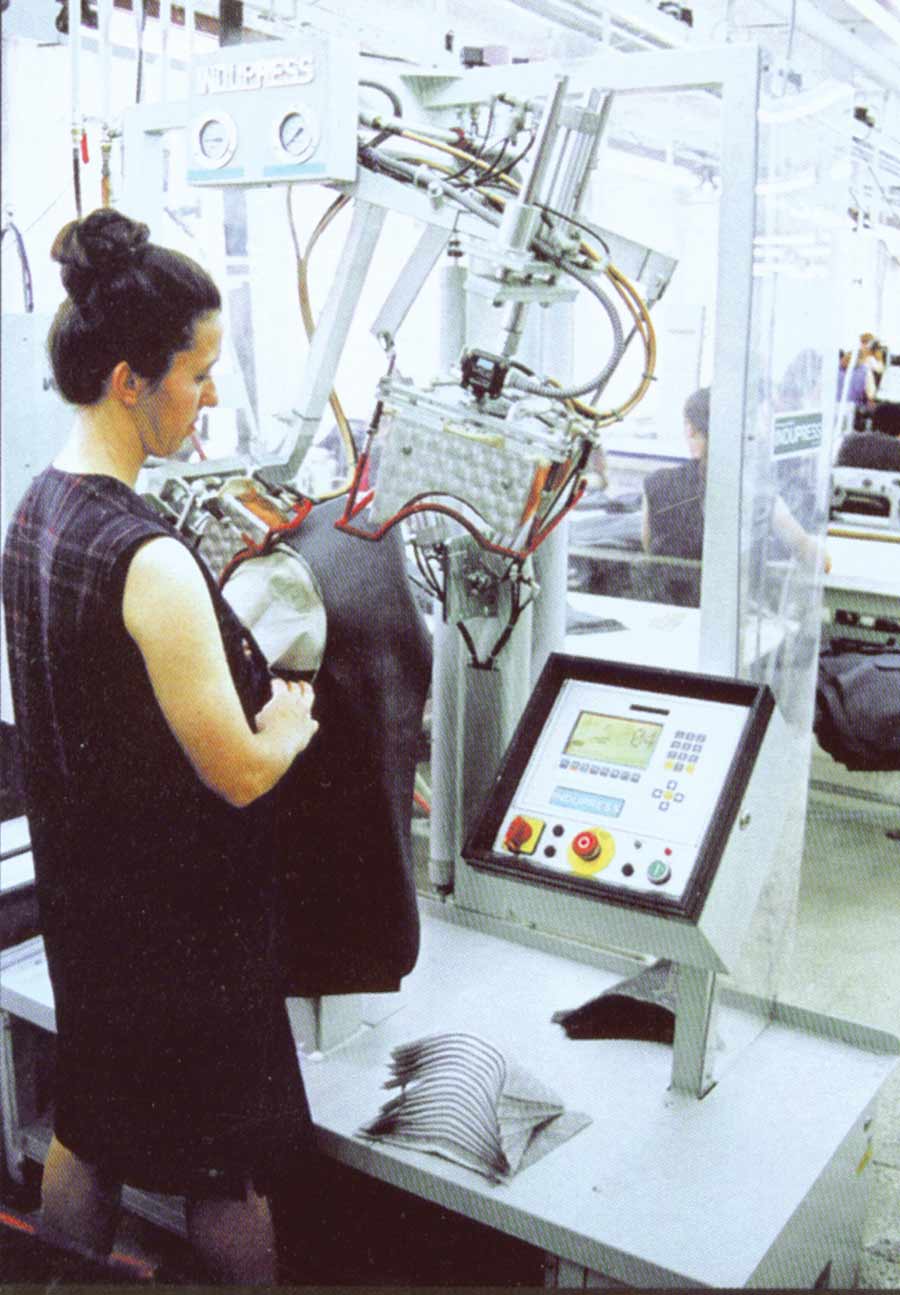
However, due to the very nature of the microfibres, as with many of today’s special finishes and treatments, extra care must be taken when pressing and finishing these garments to avoid shines, marks or glazes. Pressing and finishing calls for low temperature and low pressure and dry steam.
The manufacture of ladies dresses and blouses necessitates the need for more flexibility and versatility than probably any other product. Fashion dictated hem lengths may be long, short, mid length, wide or narrow. Shoulders and sleeve heads may be padded, dropped, puffed, gathered, set in, raglan, magyar, etc. Sleeves may be present or not, they can be long, short, hemmed, cuffed, gathered, puffed, bound, gusseted. Collars and necklines are almost infinite.
Fabrics may range from very fine cottons, silks, georgettes, micro fibres, crepes, to wools, velvets, corduroy and denims. Waists may be set high, low, seamed, draped or darted. Stitching may be decorative, functional, or both at the same time, as may the threads that are used. Additional ornamentation such as embroidery, beads and ruffles may be present. 3-D or form finishing again is often the most appropriate method of pressing and finishing these garments.
Indeed, this method of 3-D finishing is also especially useful for any type of structured or cut thread fabric, such as corduroy, velvet, cashmere, fleeces, and knitwear, where outside pressure can destroy the natural look of the fabric whilst sewing problems such as puckering can be minimized. Forms, or 3-D finishers, are getting more sophisticated to cater for these special needs.
[bleft]Pressing can be defined as compression of two surfaces with fabric within. When the two surfaces are flat, it is called flat pressing, while buck pressing uses 3-D shaped heads. While form finisher involves blowing steam and hot air at high pressure, thus stretching to de-wrinkle the garments[/bleft]
Digital programming helps in achieving consistent quality levels for different materials providing control on all aspects such as temperature, steam time, steamair time, air time, steam and air volumes and directional flow. Specialized fans can help with speedy drying of the fabric. Vacuum areas can help hold specific parts of the garment in place whilst loading the form. Programmable and adjustable seam tensioning devices can help minimize any puckering.
Anti stretch mechanisms can help to hold the garments in shape without applying any additional stretch, a feature particularly useful for garments that are blended with Lycra or Spandex. Pneumatic sleeve clamps which hold the sleeves from inside, at different angles, can help in better finishing of the arm holes and sleeves. Drive mechanisms can control waistband and leg tensioners to ensure the precise tension on the trouser waistband and the legs thereby achieving the required measurements. The actual measurements may be recorded and stored automatically on an external PC for further quality control analysis. If slightly out of tolerance, a restretching function can help in the size correction by the use
of additional steam. Adjustable height functionality makes loading and finishing of varying dress and shirt lengths simple.
Garments made out of microfibres are recommended to be pressed from inside or when it is pressed from the “right-side” of the fabric the temperature has to be very low around 130º C to avoid shine marks on the garments due to the increase in surface area of the fabric. The steam has to be perfectly dry since the man-made fibres cannot take any moisture. The difficulty in pressing the garments made out of microfibres calls for the use of form finishers that can steam and finish inside-out.
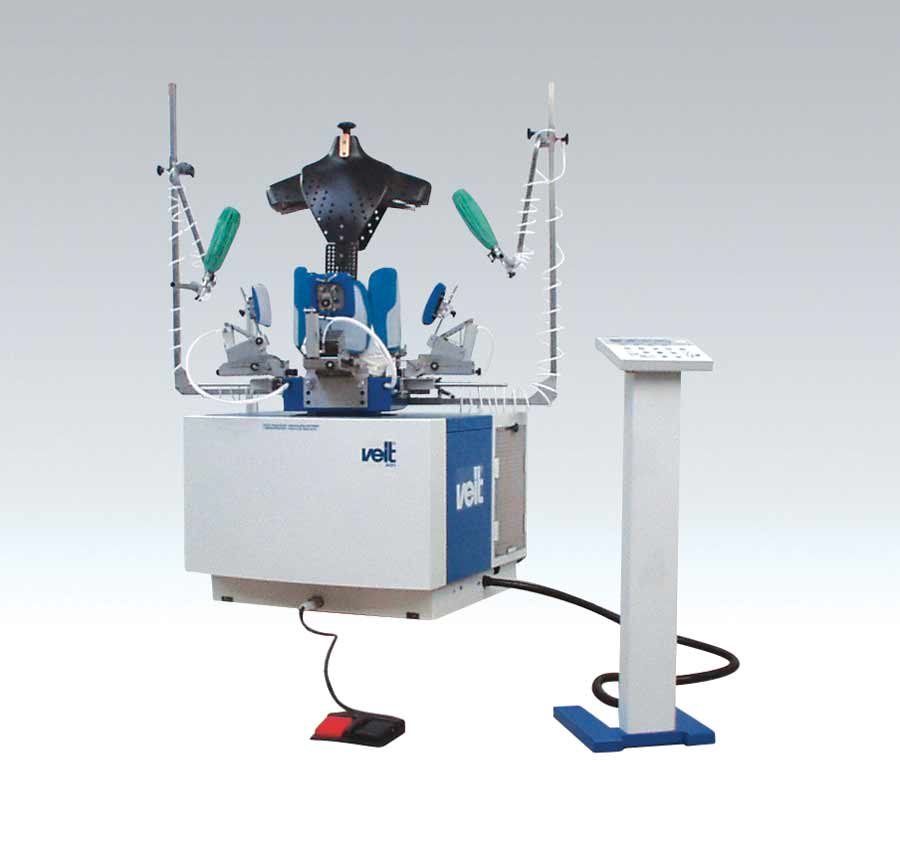
VEIT 8371, with its standard form, can finish any garments (tops) of shoulder size ranging between 34 cm and 52 cm. The strong inbuilt motor, with its second programmable fan, helps in drying the garments faster resulting in better productivity. VEIT’s digital programmer also helps in achieving consistent quality levels for different materials by the use of 10 programmable memories to store steam time, air time and air volume. Garments are finished with hangers which reduce lot of material handling after finishing. That not only improves quality but also reduces the post finishing operations.
The VEIT 8371 is also equipped with the adjustable seam tensioning device that helps to finish with minimal puckering on the seams. Garments that are blended with lycra/spandex can also be finished better without any undue stretch with the help of the anti-stretch mechanism. The built-in anti-stretch mechanism helps to hold the garments in its shape without applying any additional stretch than what is required during the finishing operations. The machine is also offered with the Pneumatic sleeve clamps that hold the sleeves from inside, at different angles, helping in better finishing of the arm holes and sleeves.
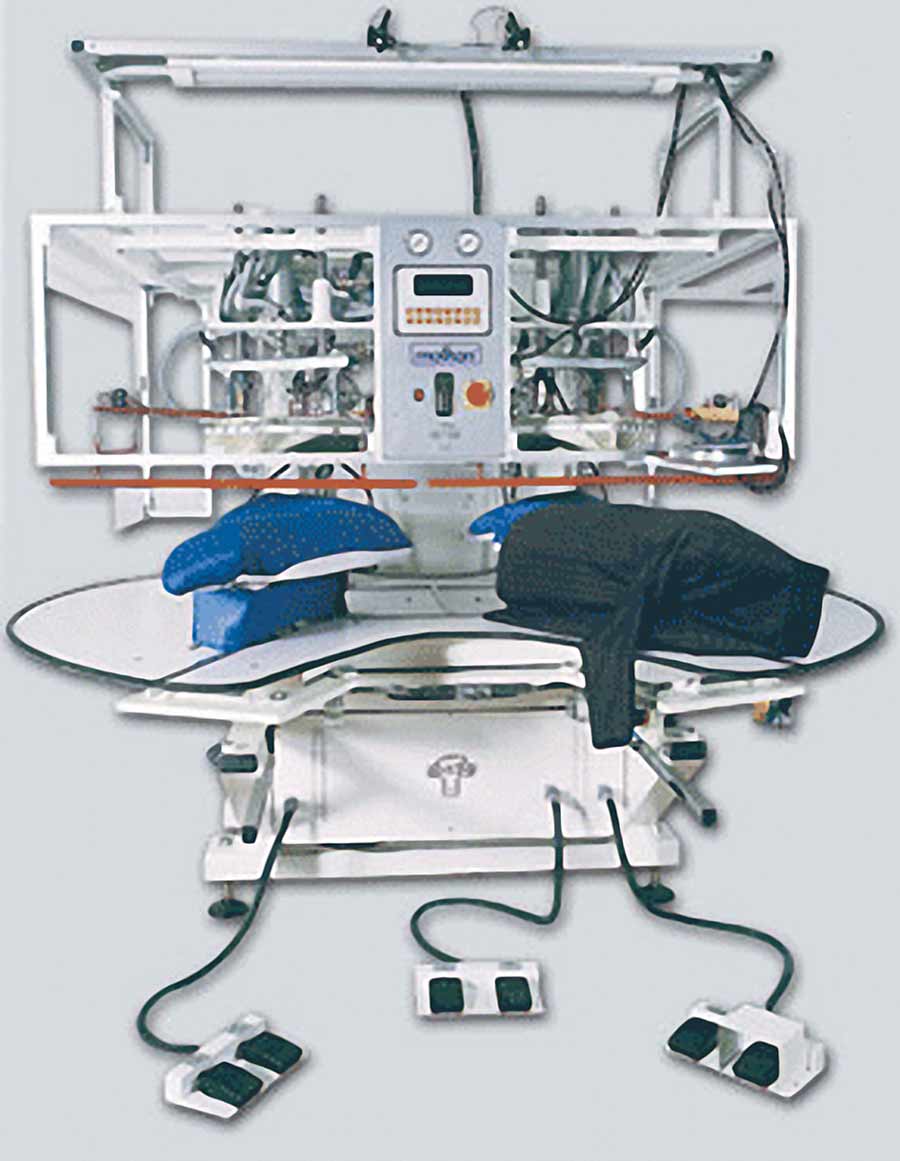
In general, a pressing machine, whether vertical or horizontal, consists of both upper and lower bucks that come in contact with each other to press the garment with steam and air, thereby shaping and finishing the garment. Raised areas such as seams are the most vulnerable to pressure damage, hence finishing machines may also use special padding and head covering to maintain even pressure over the different thicknesses of the garment. Microprocessor controls enable total control of top and bottom heat, steam and pressure, whilst enhanced vacuum chambers may be incorporated to promote efficient drying and cooling of the garment.
Air blowing allows the garment to float on a cushion of air during the finishing process. Auxiliary bucks may be used for difficult areas of the garment. As the shape, style and fit of tailored garments keep changing according to the needs of the end customer, the shape of the buck and heads must be able to accommodate the respective changes in styles, shapes and fit.
[bleft]Extra care must be taken when pressing and finishing garments made with micro fibre to avoid shines, marks or glazes. Typically, they call for low temperature, low pressure, dry steam and are often best ‘pressed’ from inside using form finishers[/bleft]
Thus easily interchangeable heads and bucks with modular format ensure the flexibility of product and fabric types. Even specially designed ladies bucks with an inflatable bust are now available. As the bust is inflated the chest point moves tangentially giving smooth, ‘perfect shaping’. Subsequent steaming from inside helps to set the shape. Forms are shaped in such a way that there are no gaps between the shoulder and the torso, yielding a stable support to the loaded garment, and thus avoiding unwanted distortion as they are easily adjustable.
Malkan’s KAR1011 ergonomically designed vertical right and left front press pressing carousel with 120 or 180 degree turntable, for example, provides a double or quadruple lower mould option for pressing the upper left and right pockets of the jacket. Features include more efficient and faster performance by the use of a single operator, energy saving using aluminum moulds with serpentine, high quality pressing with delicate mould design and one hundred different programmes to control the vacuum, buck and head temperature and pressure, steam temperature and pressure, etc. all controlled with a digital micro processor. There is a photocell controlled safety system for operator’s safety.
Imported garments, after shipping, often have to be ‘reconditioned’ to freshen the garment. This is normally done through a steam tunnel where precise control of all the inside parameters; air (quantity, flow, temperature, direction and speed both for heating and cooling), steam (quantity and quality, degree of humidity), and time, renders the best quality. Some tunnels enable continuous movement of garments as they are conveyor fed through the tunnel. Others operate in a closed or batch processing method.
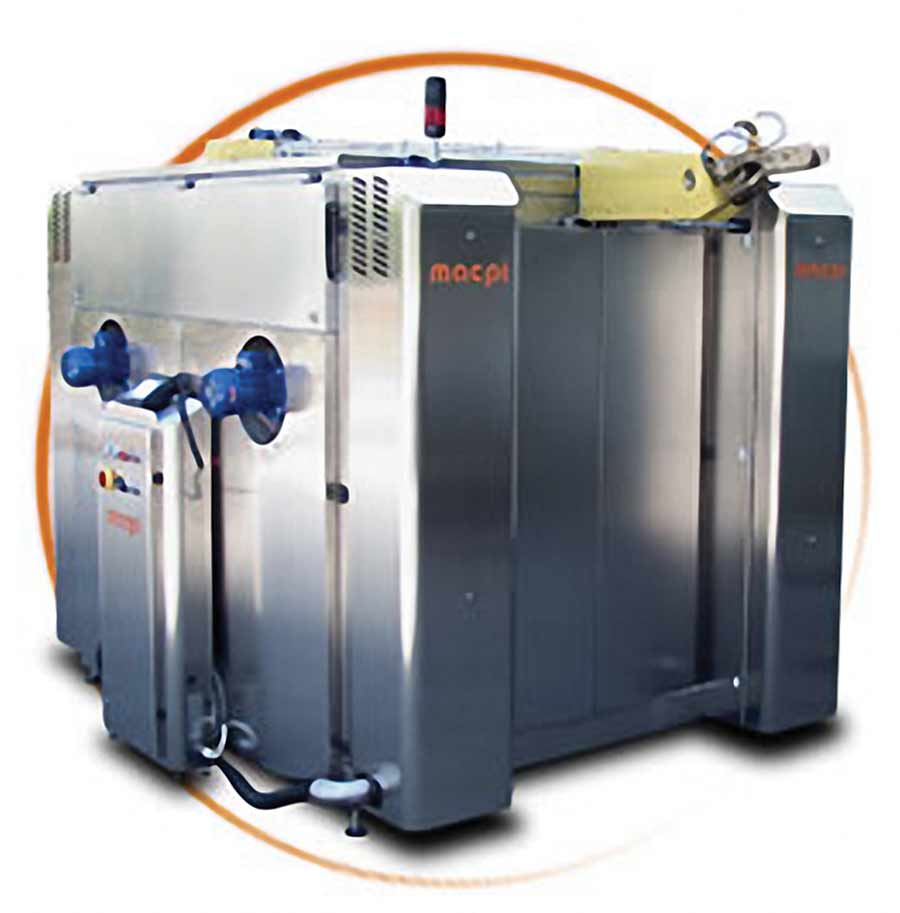
The Macpi steam tunnel, for example, for garments pressing, refurbishing and finishing comes in various models. The construction is in stainless steel, the walls are made by insulating material and the loader/conveyor/unloader is compatible with most common transport systems. The working cycle takes place within a closed unit. The fluids, steam and overheated air, are put into forced circulation both clockwise and anticlockwise. Steaming time, steam pressure and temperature, clockwise and anti-clockwise ventilation (time, capacity, temperature, blowing for pins cooling (time) and the distance of pins loading can all be pre-specified using a palm PLC with a graphic touch screen display into 20 available programmes.