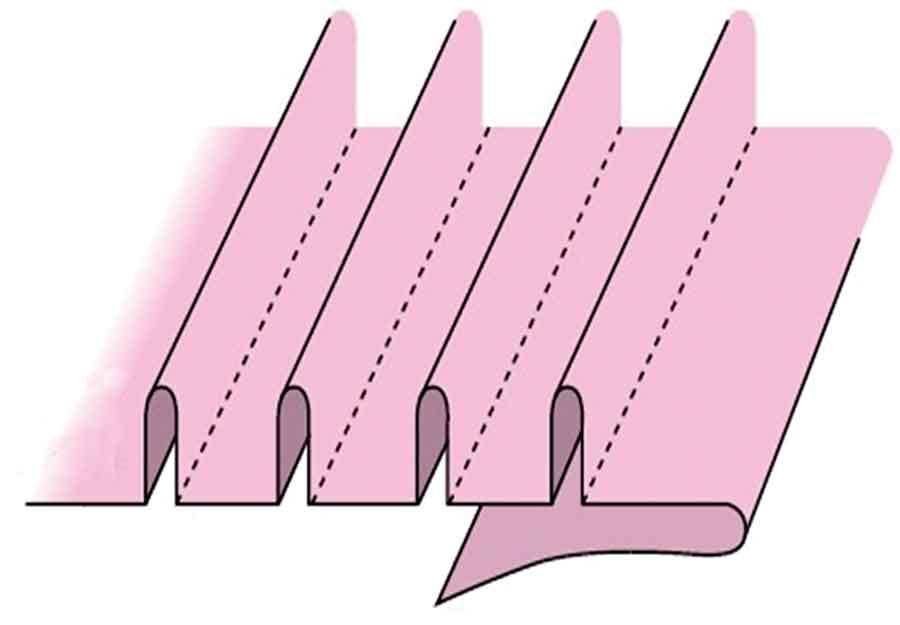
While the individual tucking height is called crest, the distance between two pintucks is called root width (as seen in Picture 1). Pintucks can be sewn with multi needle chainstitch machine, where stitch-line appears as top stitch and often visible on the face of the garment. There is clear difference between seam diagram of chainstitch pintuck and lockstitch pintuck. While lockstitch pintuck stands straight, chainstitch pintuck is generally flattened in one side due to the difference in seam type. If the crest height is more than the root width, then the flattened stitch-line gets hidden under the crest and is therefore called invisible pintuck. But in case the crest height is lesser than root width, then stitch-line is visible even when flattened, and called visible pintuck. While stitch-line is visible at both face and back side of chainstitch pintuck, no stitch is visible at the back side of lockstitch pintuck.
Although multineedle chainstitch pintucking machines, with 12 to 33 needles and pintucking attachments were available with prominent sewing machine brands like Kansai Special, Siruba, and Golden Wheel Variomatic for a long time, yet in Southeast Asian region these are rarely in use.The prime reason behind non-use of such pintucking machine is difficulty in sewing dimensionally unstable fabric and equally delicate setting of attachment. A dimensionally unstable fabric may create variable tension between crests and thus creating variable crest height, thereby the stitch-line misses the flattened crest. Another bottleneck in the chainstitch pintucking is that the needle would run from end-to-end of the fabric and cannot be stopped halfway. Finishing chainstitch pintuck halfway through will require pintuck ends to be secured by additional separate bartack to avoid stitch unravelling. Also as multiple rows of pintucks are created simultaneously by multi-needle sewing, variable lengths of pintucks are not possible by chainstitch machine.
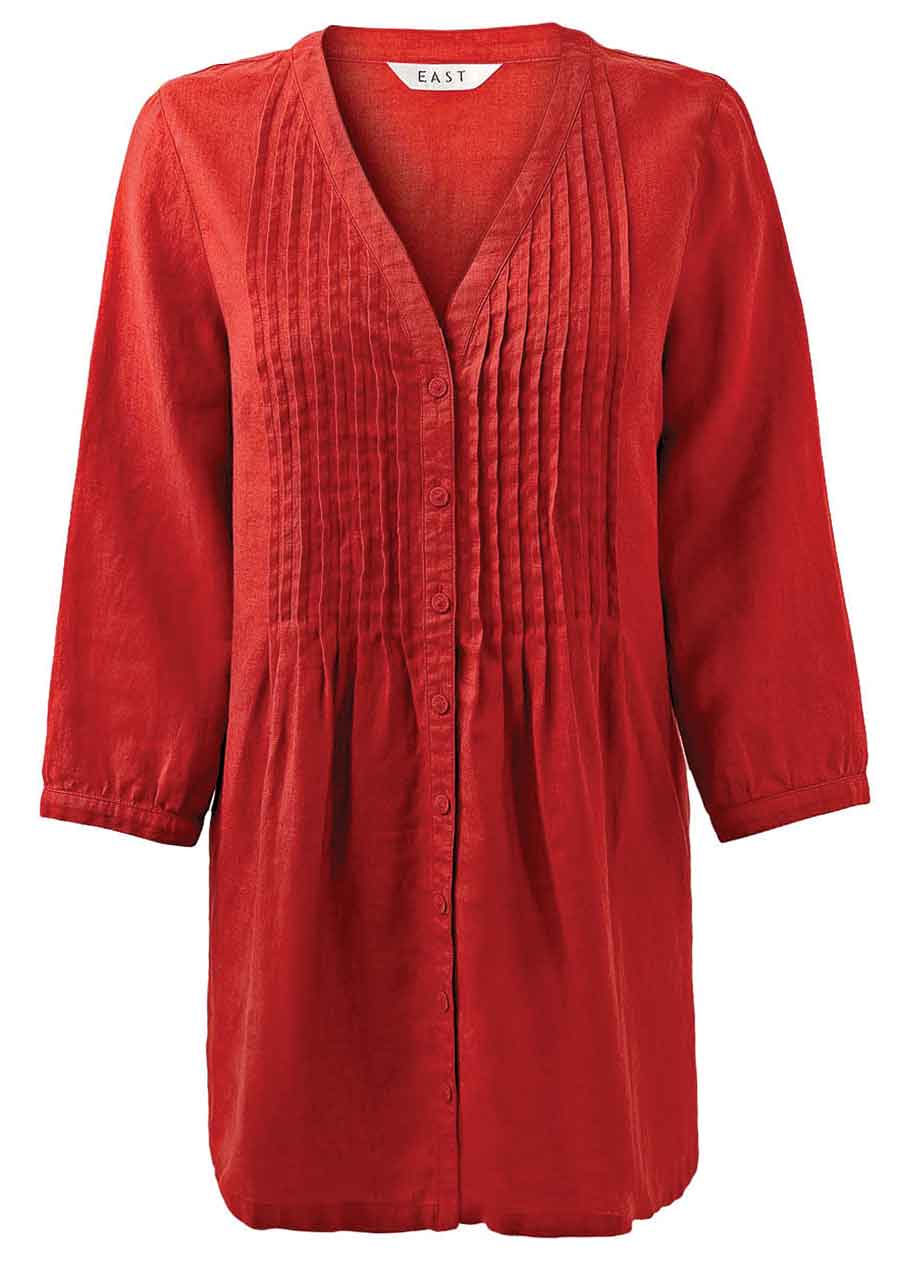
Style features often demand pintucks to end halfway through in the garment and also vary in length. Therefore, factories have no other option than to use lockstitch pintucking, where machinists sew pintucks one by one using lockstitch machine. In that case the notches or tracing marks are made on the fabrics and the operator creates crease mark by nail press following the tracing marks and then sew using edge guide.
There are pintuck attachments available for use with lockstitch machine, using which pintuck width and distance between two pintucks can be changed. Juki has a special lockstitch machine AE-200 ALD to use with pintucking attachment, configured with a unique sensor and manipulator control mechanisms allowing even the inexperienced operators to handle difficult curves smoothly. It divides the sewing length into 10 different sections and with the use of sensors, fabric edges are detected, and the machine actually pulls the fabric inside the sewing area in case it goes out of it. The pintuck device is able to achieve a crest height of 30 mm and can maintain a root width of 25 mm. The similar pintucking attachment can also be used with Jin Gong brand of sewing machine.
Principally these machines and attachments work fine for dimensionally stable fabric, but again work non-uniformly for fine dimensionally unstable fabrics and therefore have not found acceptability levels among many factories.
What used to be the most difficult handling problem of pintucking a dimensionally unstable fabric has now been taken care of with the latest machine offering from Simanco.
The recently concluded CISMA 2013 displayed an automatic lockstitch pintucking workstation where total length of pintucking was formed by a long plate and held by a pincer before the sewing head sews the entire length of pintuck. The advantage is that it works very well even for dimensionally unstable fabrics. Presented by Simanco, the JG-3000 is an automatic tucking machine, applicable for both elastic knitted fabric and other woven fabrics. Producing tucks from 3 mm to 25 mm width and tucking length of 3 mm to 1300 mm, with the ability to program every tucking width and length while sewing, JG-3000 has the entire processes controlled by PLC, where one worker can operate 2-4 machines at one time, thus saving labour cost.