Ultrasonic and high frequency welding, bonding and gluing are technologies suitable for a large number of high-tech fabrics used in apparel as well as technical applications. Both the exhibitions, Texprocess and Techtextil, held concurrently in May 2011 in Frankfurt am Main, Germany, were platform for specialist machine builders. StitchWorld Correspondent Claudia Ollenhauer-Ries gives an overview on the latest developments.
However advance ‘fabric joining’ techniques may get, one thing is for sure – traditional sewing with needle and thread won’t disappear – for the simple reason that it is the basic technology for joining two or more pieces of fabric. But a growing range of fabrics and applications require other joining technologies. The main requirements are for waterproof seams, seams without additional components and delicate fabric structures.
Obviously, welding will only work with fabrics and non-wovens made of man-made thermoplastic fibres, which will tightly fuse at the moment and at the spot of welding. The most common technology are hot air welding, wedge welding and ultrasonic welding, and an impressing range of machines is now on offer by many technology providers, especially the ultrasonic welding technology, which is on the forward march.
Welding with Heat, Pressure and Taping
The more traditional technologies work with additives: Glues, thermoplastic films and sealing tapes. Bonding and gluing works with adhesive supplements, which firmly link the sheets of material – either natural fibres, man-made fibres or both of them as a mix. Classic applications of bonding are the interlining with spots of glue on the interlining fabric/non-woven and the reinforcement of seams and edges with narrow interlining tapes or pre-cut formed interlining. Other applications are the taping of sewn seams in order to acquire waterproof qualities for outdoor clothing or joining fabrics edge to edge for apparently “seamless” swimwear and underwear. The disadvantage is, that one more material is involved which could make the recycling difficult. The advantage is that fabrics made of 100% natural fibres could also be joined.
One of the most cutting edge suppliers for this technology is Framis Italia S.p.A., leader in high quality polyurethane films and tapes for sewn and heat-welded applications. They supply both machines and tapes (NoSo heat-welding polyurethane tapes with double-sided adhesion). Both products, Framilon and NoSo were given Oeko-Tex Standard 100 class I and class II, respectively. The range of machines covers models with combined welding and cutting, welding and folding or simply folding, joining or taping machines. A compact welding machine NS 500 is designed for prototyping and small series. The machines are conceived for apparel, swimwear and underwear.
German Pfaff Industrial has mobile hot-wedge heat-sealing machines (Pfaff 8362) and programmable hot-air or hot-wedge sealing machines (Pfaff 8320 and 8390 series) for large size applications. The model Pfaff 8323 would be used for hot-air tape welding of large items, while Pfaff 8303, 8330 would seal garment, shoes and extra wide tapes.
Italian Macpi, known for its pressing machines, also offers bonding machines for seams of bodywear and swimwear. The hot-air system applies a thermoplastic tape and trims the edge of the fabric in one step. Other types of machines with hot wedges allow the fixing of a tape to both sides of the fabric, thus provide a hemming. British Ardmel also offers a range of heat sealing machines for any purposes.
Latest Revolution – Ultrasonic Technology

A phenomenon in the evolution of the market for joining fabrics is the emergence of ultrasonic technology, with the number of suppliers providing the technology growing significantly since its inception. Companies with core competence in ultrasonic welding and cutting also entered the markets of textiles, while traditional sewing machines manufacturers bought in the competence from the specialists, thus enlarging their portfolio.
A wide field of application of ultrasonic welding and cutting are technical applications. These reach from diapers to filters, from truck tarpaulins to textile roofs, from medical to military uses. Often, special automatic or semi-automatic devices are being developed in order to optimize reproducible quality in mass production. For instance, mobile ultrasonic welding machines run on floor-based rails, welding some 10 or more metres of tent roofs.
A comparatively new field of application of ultrasonic is the manufacture of apparel. The challenges here are the curves and the often changing and possibly highly stretchable materials. Automation plays a smaller role; manually controlled movements, stop and go, has to be supported by the programming of the machine. Christoph Manager, Product Manager of Branson Ultrasonics Europe says, “We still have more applications of ultrasonic sealing in technical textiles than in apparel.” Marc Tshech, Junior Managing Director and Software Development Manager of Nucleus, reports that technical textiles and sporting apparel have an equal level of application.
Main Criteria of Ultrasonic Welding
From the view of the user, the following criteria would be of high importance:
- Speed,
- Width of seam (in mm),
- Diameter of anvil and ultrasonic wheel (the smaller, the narrower the curves can be),
- Material puller (lift, right, mechanically or electronically on/off),
- Controlling unit/programming (several user levels, easy to use touch screen, off-line or online connection with LAN and/or external support), and
- Cutting, sealing and welding in one operation step. Other requirements would be:
- Energy consumption,
- Air consumption,
- Ultrasonic frequency (one fixed or variable frequencies),
- Performance of the generator (one for several machines),
- Type of converter, and
- Easy change of program and parts.
Some Key Players
Branson, an international leading specialist in welding, is a member of the US-based Emerson Electric Group. Branson started its business in 1946 in Danbury, Connecticut, US and today, the branches are spread worldwide; the Indian branch is located in Mumbai. Application laboratories are located in Germany, in US, Shanghai and Tokyo. The modular system 2000x can be configured according to the customer requests and is then a ready-to-use standalone system. Ready to use is also the hand-held 2000LPe; while the assembly module RMX 30 has to be integrated into a production machine. The width of the sonotrode varies between 5 and 200 mm. The maximum width is reached by using two converters for one up to 200 mm wide sonotrode, thus being able to transfer more power.
KSL, member of the Keilmann Group, is a German machine manufacturer focussed on sewing and welding technical textiles. A specialty is the CNC-steered and 3D-robotic devices. They use Branson ultrasonic technology and combine it with own software programmes and own machines with respective robots. In 2011, Keilmann was awarded the JEC 2011 Innovation award.

An example is the KL 213 for continuous welding with a 30 kHz generator. The machine is available in flatbed-, long arm-, free arm-, post- and arm down-design. According to the requirement, the machine also could be integrated into customer specific manufacture lines. The speed of material transport varies between 0.5 and 17m/minute. A clearly structured screen design which helps the users to program the machine according to the individual task.
Belsonic, a brand of Belgian Verus, is specialized in the distribution and assembly of ultrasonic cutting and welding machines, hot air welding machines and high frequency welding machines, used in textile, plastics and non-ferrous industries. The machines would be integrated in automated production lines. Special applications in the apparel industry are hemming with hot air machines using an adhesive film on the edge of the fabric or in-between two layers of fabric. Another application is welding elastic around fabric edges of slips and bra or cutting and sealing of shoulder straps (Belsonic SeamStar). An interesting point is the idea of placing the wheel into the top surface of the working table (Type SeamStar BS 150). According to Vincent Verbeke, Managing Director of Belsonic, this would allow easier access during precise hand guided operations. The latest development is a continuous high frequency welding machine specially developed for welding long seams of PVX banners, tarps, tents, solos, side curtains, pool membranes or awnings. The speed of the HF Welder is up to 6m per minute.
Forsstrom, a Swedish specialist in welding plastics with high frequency, launched the “weldolution”. Mikael Wallin, Vice-President Marketing & Sales at Forsstrom, explains “with high frequency, we make it easy to join PVC- and PU-coated fabrics with metal. The patented clue is coating the metal with a primer first.” The new method ForFlexx would allow air-, gas- and liquid-tight seals between the fabrics and metal or metal and metal.
French Texti Sonic focuses on seam sealing and material slitting for technical textiles, non-wovens and other supple materials. The company promises “beautiful and strong edges”. The machine Ultra-Star 400-35 combines sonotrode (for welding the seams) and rotary wheel (for cutting in-between the welded sectors) in one.
Sonotronic from Germany works on ultrasonic systems for making-up (welding, embossing, punching, cutting and slitting) and finishing (thermofixing and washing). The systems could provide sealing speeds up to 80m/minute. They launched the “Green Sonics” campaign, which consists of textiles and automotive of joining materials in the sector made from renewable raw materials to plastics by ultrasonic riveting and welding coated materials made from renewable raw materials, so that all materials could be recycled more easily at the end of their lifecycle. As Markus Hecht, Application Engineering at Sonotronic explains, the Greensonics concept could also work on the finishing application. At the washing process of narrow textiles, it would allow to use cold instead of warm bathes and only four instead of eight bathes. In consequence, the consumption of chemicals, water and energy would be cut down significantly.
Zemat Technology Group, a Polish company, is a specialist for high frequency welding technology. Some of the application fields of the machines built is awnings, advertising, tarpaulins and other technical textiles. The maximal length is 25m for welding with travelling head Tarpa Pro.
Sinclair, based in US, proposes a large range of heat sealing machines. The flagship series, Triad Wedge Welding System, is used for thermoplastic fabrics such as tents, tarpaulins, awnings, banners, curtains, tubes, etc. The machine can be as fast as 6m per minute, is noiseless and will not produce hazardous smoke. It runs on tracks and could be operated by a single person.
Weldmaster, US offers solution for really large scale heat sealing applications up to 30m long. A speciality of the company is building customised automatic machines, also for heat sealing geomembranes, tents and billboards. A new device for smaller sign, banner and awning productions is the T3 Hot Wedge Welder, compact enough to fit on a table or travelling on a track for welding larger banners and awnings. T3 would weld PVC mesh, PE and other industrial fabrics with a speed of up to 10m per minute.
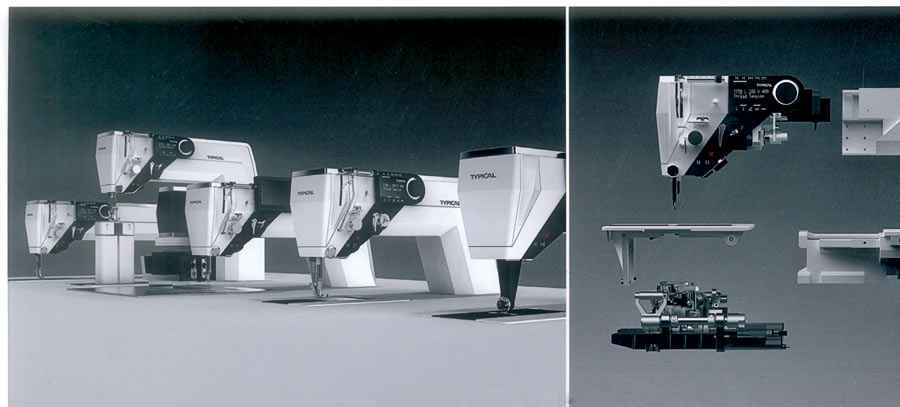
Typical, a brand of Chinese Xi’an Typical Industries, has its R&D centre in Kaiserslautern, Germany, and the production site in PR China. With its new Vetron range of machines, Typical was awarded the Texprocess Innovation Award 2011. The clue of the Vetron range is the exchangeable machine head: depending on the work to be done, the machine head is removed from the machine frame and the other one inserted. The process just takes a few minutes. Among the exchangeable heads, an ultrasonic welding machine is proposed, which is developed with MS Spaichingen of Germany, a specialist in ultrasonic technology. The machine will be marketed from 2012 on. Holger Labes, General Manager of Typical Europe, points out that the 25mm-diameter of the anvil would allow small curves.
Germany-based Pfaff Industrial has further enlarged their welding machine portfolio: The 8320 machine is now equipped with programming software and an exchangeable device for alternative hot-air and hot-wedge sealing technology. Double features also on the 8312 CS and the 8310 CS Dual; both machines can cut and seal in one operation step. The 8310 CS dual features a new patented double wheel, which allows a constant distance between the welded seam and the cut and secured edge. The basic 8301 ultrasonic sealing series has now three different types of arms with working widths of 500 to 1000 mm.
Queenlight, Japan, is a supplier of heat sealing and sewing machines and also has a high frequency welding machines. They focus on apparel and technical textiles production.
Nucleus, Germany, focuses on ultrasonic welding with rotating sonotrodes, combined with computer engineering including the access by remote services through the internet. Marc Tschech, Software Development Manager of Nucleus emphasises, “Our software allows the learning machine. With material tests, the best practice parameters for a new production lot can be found out and stored. So, the production quality will be reproducible.” The new series Rotosonic V4E I is available as flatbed, pillar and down-arm version. Both anvil and sonotrode are executed as wheel with separate motors. A large range of special machines for individual products and applications for fully automated productions is offered as well.
UK-based Ardmel offers a wide range of basic machines for all kind of applications.