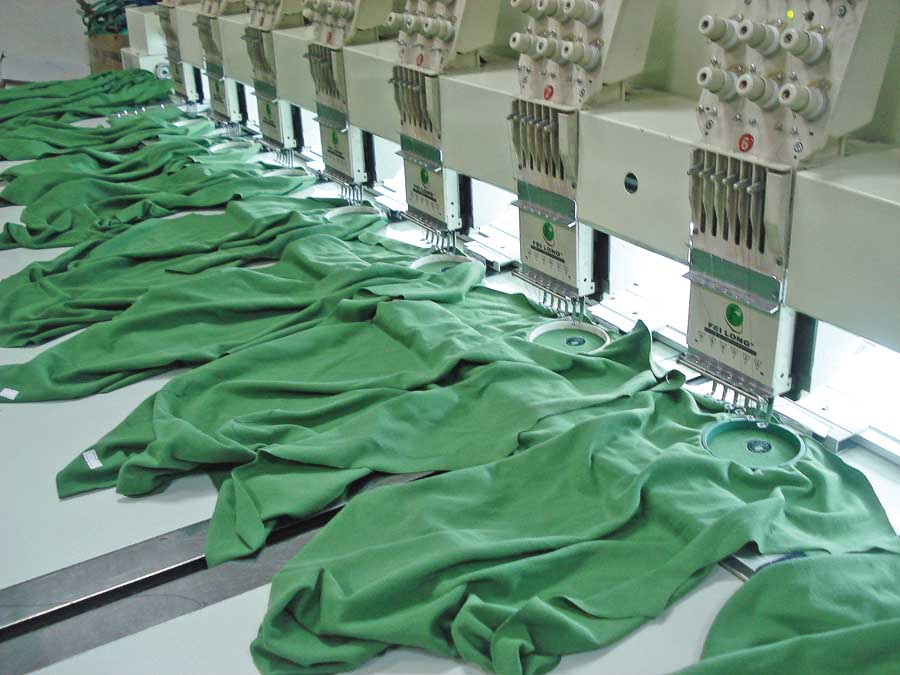
Embroidery is a value-added process in textile/apparel industry with low value-added ratio, due to considerably high feeding or changeover time. Even though the speed of the embroidery machines has been increased considerably by the manufacturers in an effort to increase productivity, the industry has struggled to find solutions to improve performance while maintaining the quality of design. Industry Consultant and an expat from Sri Lanka, Chandrajith Wickramasinghe, with many years of exposure to the Indian industry, has designed a kaizen/lean technique that doubles productivity of embroidery units and improves the appearance of the design.
Embroidery machines are considered to be high capital intensive machines, but the focus given on improving productivity and quality standards is below satisfactory. Challenges faced in conventional automatic embroidery are many. In the case of small designs, machine utilization is generally below 50%, adding to the cost and also bringing down productivity leading to issues of lead time/speed. Further, only one design can be stitched at a time, which affects flexibility. Many quality issues like puckering around the stitch due to tension in framing and shine mark around the design due to framing are common problems. There is also requirement of skill manpower to do framing. Besides, there is also a need for block cutting or additional panel attaching to fix the desired panel to frame, and embroidered panels have to be re-arranged as per serial numbers by employing additional manpower.

As a result of “Out of the box thinking” with industrial engineering and lean principles as the backbone to overcome challenges that the industry faces in conventional way of embroidery, an innovative approach – a kaizen – which is a combination of method improvement in work place and the way we carry out embroidery work and design software has helped to achieve significant results.
In a traditional embroidery machine the frame on which the fabric is mounted can only run in a single batch. On completion, the machine has to be stopped and the fabric panels taken off the frames and the threads beneath the embroidery cut or finished; during this whole process the embroidery machine is out of operation and it doesn’t matter which machine is being used or at what speed it embroiders.
[bleft]The results summarized
Increased machine utilization by 100% from current state for small design.
No shine mark around the design.
Higher productivity of approximately 6800 pieces in 20 hours in 1500-1800 stitches design in proper working condition.
Few designs can be produced simultaneously at one cycle of production run.
Reduce dependency of skill manpower.
No block cutting or additional panel attaching to fix the desired panel to frame.
No puckering around the stitch.[/bleft]
The innovation enables attaching of an additional set of embroidery frames on to the X-Y direction motor’s shaft, i.e. in place of a single row of frames, now two rows of embroidery frames are fixed at the same place. The simple intervention doubles the productivity by allowing the operator to make ready one set while the other set is in process. “The rectangular frame moves two and fro after embroidering every set, and after doing the first lot, the frame moves forward and starts embroidery on the next lot,” explains Chandrajith Wickramasinghe.
What more is possible apart from the non-stop embroidery is that a design with two or more colour embroideries or patterns is possible. With the improvement in the embroidery machine software the design can be done in a single go, with the machine performing the first design on the production set and then changing to the second design and doing the same upon the first production batch.
The same innovation was successfully experimented at the KOC Industries Ltd. (TJ Apparel) in Ludhiana. The target was a minimum 25% increase in production without compromising on quality standard. At the factory the cut panels were being put into a frame and then frame was fixed into the machine to do the embroidery. Before the kaizen, the total cycle time was 5.35 minutes for one round of production for 1700 stitches design in 12 head machine with a production of 135 pieces per hour. After the kaizen, the total cycle time increased to 6.09 min. for one round of production for 3250 stitches design in 12 head machine with increased production of 240 pieces which translate to a production increase of 77%.