Availability of inexpensive skilled manpower, favourable industrial policy and low energy cost have made China, Bangladesh and India favoured sourcing destinations. However, with a view on emerging low-cost manufacturing destination from Southeast Asia and Africa, the industry needs to enhance its capabilities on key performance indicators such as cost, productivity, quality and delivery.
Garment manufacturers, especially those who are catering to standard bulk products, are observed to work with high level of in-process inventory. Finishing and sewing inventory in jeans manufacturing factories often run into hundred thousand pieces. Frantic search for garments in stock piles of finishing inventory is a common site in a jeans factory. The problem is further compounded for styles with wash programme where tracking inventory at vendor‘s factory becomes critical. Manufacturers tend to use high inventory and Work in Progress (WIP) as buffer against contingencies such as machine breakdown, erratic supplies, unbalanced production capacities and absenteeism.
However, high inventory brings high ‘inventory carrying’ cost putting a strain on working capital, storage cost and in some cases chances of loss or damage to the stock. High inventory levels also hide inefficiencies in production, quality, maintenance, set-up time, supplier reliability, work flow management and planning. Reducing inventory becomes even more significant for CMT manufacturers, who are constantly reeling under pricing pressures. ERP system can be effectively used to synergize processes, reduce waste and manage inventory. However, it should be remembered that ERP does not substitute operational control but compliments it. It is observed that factories in their zeal to bring substantive improvements in operations go overboard in customization, which may not fetch satisfactory results.
Implementing ERP not only helps the factories deprive of strong operational controls (by streamlining and standardizing processes), but also help in organizing factories by streamlining and standardizing the processes as per international standards.
Unlike other garments, jeans manufacturing plants have additional inventories due to additional processes post-sewing, hence there is all the more reason to control the inventory in jeans manufacturing. On an average, a jeans manufacturer sewing 10,000 jeans per day would have 70,000 to 1.5 lakh pieces of sewn jeans as dry/wet processing inventory with an additional capital blocked to the tune of US $ 0.175 million per day. ERP as an inventory visibility tool can help an organization focus their attention on the right places at the right time for an effective control.
ERP systems in Apparel Industry
IT-enabled services like Enterprise Resource Planning (ERP) provides an effective control over supply chain functions. ERP integrates processes and activities and provides real time information which helps to synergize resources towards organizational efficiency. Modern ERP systems customized for textile and apparel industry can fully cater to the complex requirements of fashion trade. Different ERP modules such as Material Management, Manufacturing, Finance, Marketing, Product Development, and Planning can be installed as standalone units or as integrated systems creating a seamless interface. Best of the breed capability can be developed by interfacing the customized modules with generic ERP system which allows integrating the best system in its referenced niche or category. ERP systems can be further interfaced with work stations (CAM cutting, programmable machines), material handling systems (Unit Production System), and other planning and scheduling systems (cut planning, planning board) for real time data sharing and tracking. Modern ERP systems also provide options of cloud based installations eliminating the need of client based installation. They are consumed on a subscription basis with all aspects of the offering provided by the ERP supplier. They also do not require major upfront investments in software, licenses or hardware and hence reduce capital outlay.
ERP, an Inventory Management Tool
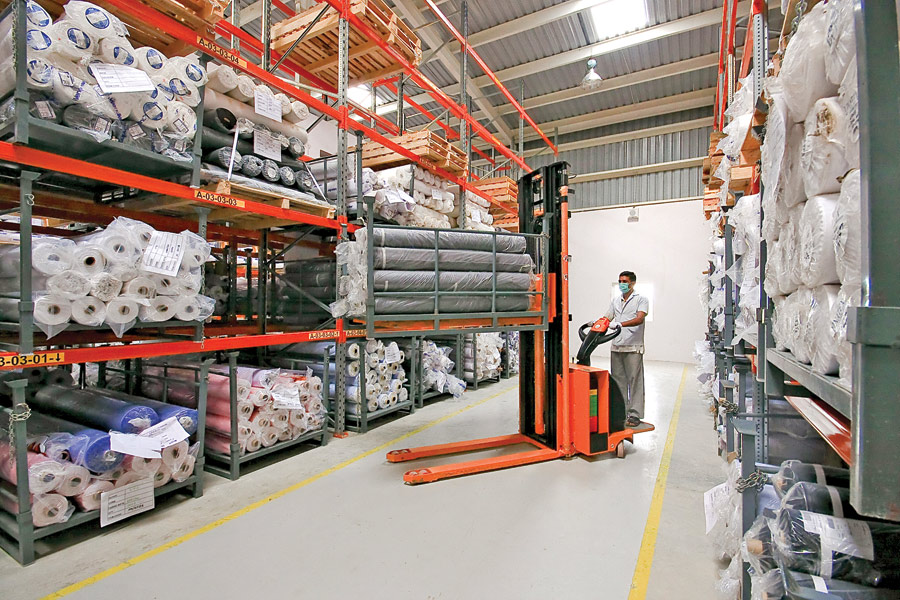
ERP can be configured to use tools such as alerts, blocks, rules in planning boards, production progress (booking), stock transactions, allocation to exercise control over inventory. The system can be configured from the product development stage to track submissions, iterations, approvals for samples, patterns, trims, accessories to order dispatch (dispatch receipts). Such tracking can generate alerts and/or automated emails, thereby augmenting visibility in planning and sourcing function and hence help avert stock out and stock pile situations. The system can be configured to automatically generate and release purchase order for nominated vendors, thereby reducing order placing time, sourcing lead time and hence stock out situations. Since the system allocates warehouse stock to respective (purchase) order, it eliminates possibility of errors in stock issue (wrong stock) and pilferage. In operations, ERP can be interfaced with shop floor machines and material handling systems (automatic CAM cutter, programmable work stations, UPS system, cut planning system, CAD marker) for real time data and production tracking. The planning and scheduling board of the ERP package can help balance production capacities between departments and thus help manage WIP. It predicts order completion dates on real time basis, helping the planner to break/reallocate job to different lines/sub-contractors to ensure conformance to shipment dates. The planning board takes into account the inventory in warehouse and on floor for each work order and in case excess/low inventory is detected, it generates alerts and/or blocks issue of new cut panels/trims/bundles/fabric to the production floor. The nesting function identifies free stock in stores and allocates it to new orders before calculating new orders’ requirement.