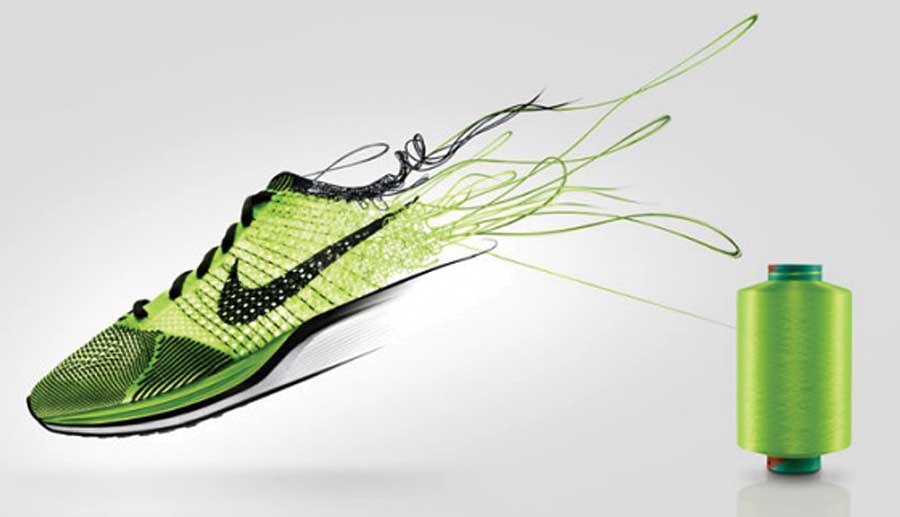
Sportswear and sports shoe giant Nike Inc. has launched a revolutionary new running shoe which uses state-of-the-art integral knitting techniques to create a one piece upper which is virtually seamless. The Nike Flyknit upper is engineered for precision fit and aims to create the feeling of a second skin for runners.
Yarns and fabric used in the shoe are precisely engineered only where they are needed for a featherweight, formfitting and virtually seamless upper that weight only 34 grams (1.2 ounces). In fact the whole shoe weighs a mere 160 grams (5.6 ounces) for a size 9, 19% lighter than the Nike Zoom Streak 3, a shoe worn by winners of the men’s marathon at the 2011 World Championships.
A final product of the sock-shoe project which started 4 years ago, Nike hired a team of computer programmers and engineers to take a machine used to knit sweaters and socks and re-engineer it to weave the upper part of a sneaker. Spools of coloured polyester yarn are fed into the 15-foot (4.5m) long machine, which weaves together the top of the shoe and creates a “second skin” with tiny synthetic cables knitted into the weave around the mid-foot for support.
A final product of the sock-shoe project which started 4 years ago, Nike hired a team of computer programmers and engineers to take a machine used to knit sweaters and socks and re-engineer it to weave the upper part of a sneaker
In a process the company calls “micro-level precision engineering”, in-house software instructs the machine to minutely alter a shoe’s stability and aesthetics. If the toe needs more stretch, the design can be digitally altered instantly to add Lycra-infused thread. For added strength in the heel, the computer can use multiple layers of yarn of varying thickness. Nike plans to patent the process.
The process of shoemaking hasn’t changed much since its commencement, it’s still about cutting and sewing. However in the manufacturing of Flyknit, both the aspect of cutting and sewing have been eliminated, as the upper is made in one piece and then fastened to the sole – making the process cheaper and faster.
This development in footwear manufacturing would not only empower Nike to manufacturer shoes in the US, which currently are manufactured in China, Indonesia and Vietnam, but also allowed people to just walk into a store, scan their feet and order a customised shoe. The same aspect of minimising the whole process of ‘knitting a shoes’ is the next step for Nike.
Nike holds a number of patents which cover the knitting of one piece trainer uppers using both warp and weft knitting (flat and circular knitting technologies). In the case of warp and circular knitting, two dimensionally knitted shoe upper panels are knitted side by side and are later cut from the fabric and seamed before being attached to other shoe components.