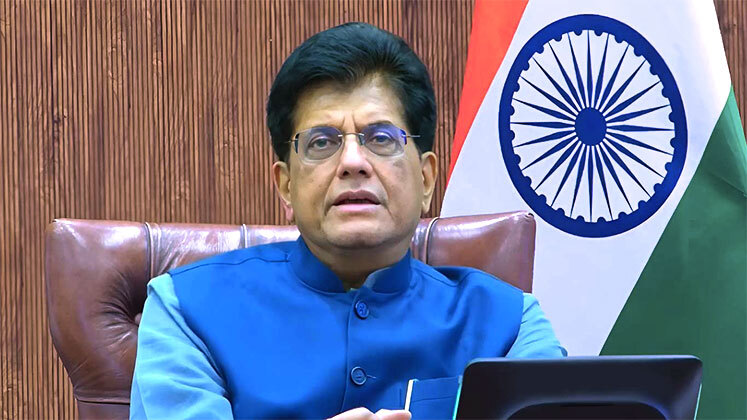
Union Commerce and Industry Minister Piyush Goyal has called on exporters and industry bodies to fully leverage India’s recently concluded Free Trade Agreements (FTAs) with developed nations to drive job creation and expand exports of goods and services.
Goyal met representatives of 35 Export Promotion Councils (EPCs) and leading industry associations representing India’s principal export sectors. During the interaction, industry leaders expressed appreciation for the government’s trade-promotion initiatives and recent diplomatic engagements.
Addressing the gathering, Goyal stated that the government had signed FTAs with developed countries to enable India’s farmers, workers, professionals, artisans and micro, small and medium enterprises (MSMEs) to access global markets on preferential terms. He emphasised that these agreements would open international opportunities for India’s traditional medicine systems and yoga, while safeguarding the interests of the agriculture and dairy sectors.
He asserted that industry must intensify efforts to enter new markets, enhance quality standards and strengthen competitiveness to derive maximum benefit from the trade agreements. He further observed that India had held a prominent position in international trade since ancient times and that the new trade deals would accelerate the country’s ‘Viksit Bharat’ mission while advancing the Prime Minister’s vision of ‘Vikas bhi, Virasat bhi’.
Industry representatives conveyed their gratitude to the Prime Minister and the Minister of Commerce and Industry for what they described as decisive leadership in concluding recent trade agreements with the United Kingdom, the European Union and the United States.
Particular appreciation was expressed for the removal of the additional 25% tariff on Indian imports to the United States, terminated through a United States Executive Order dated 6th February 2026. Industry representatives noted that the decision was expected to restore competitive market access for Indian exports to one of the country’s largest export destinations, providing stability and renewed competitiveness to exporters.
Associations representing sectors previously affected by US tariff measures — including textiles and apparel, carpets, leather and footwear and more— stated that the rollback had restored business confidence and safeguarded employment in labour-intensive industries.
Among the participating bodies were the Federation of Indian Export Organisations (FIEO); Apparel Export Promotion Council (AEPC); Council for Leather Exports (CLE); Basic Chemicals, Cosmetics & Dyes Export Promotion Council (CHEMEXCIL); Cotton Textiles Export Promotion Council (TEXPROCIL); Manmade and Technical Textiles Export Promotion Council (MATEXIL); Carpet Export Promotion Council (CEPC); Export Promotion Council for Handicrafts (EPCH) and more. Also present were the India SME Forum, the Sourcing Consultants Association (BAA) and apex chambers such as FICCI, ASSOCHAM, NASSCOM and PHDCCI, among others.
The Ministry of Commerce and Industry delivered presentations on the recently concluded trade engagement with the United States, detailing market access opportunities, compliance requirements and export expansion strategies. Industry participants welcomed the clarity provided and reiterated their commitment to scaling exports in priority sectors.
Discussions also reviewed progress under the Export Promotion Mission (EPM), the government’s flagship framework aimed at supporting exporters. Industry welcomed interventions already implemented, including enhanced access to trade finance through interest subvention support for export credit loans, collateral guarantees for export credit extended to MSMEs and targeted market access assistance.
Officials indicated that additional measures relating to trade finance, export logistics, compliance, branding and market diversification would be introduced in phases to further strengthen India’s export ecosystem.
Goyal reaffirmed the government’s commitment to accelerating export growth, deepening global economic integration and leveraging new trade agreements to position India as a trusted global supply partner.