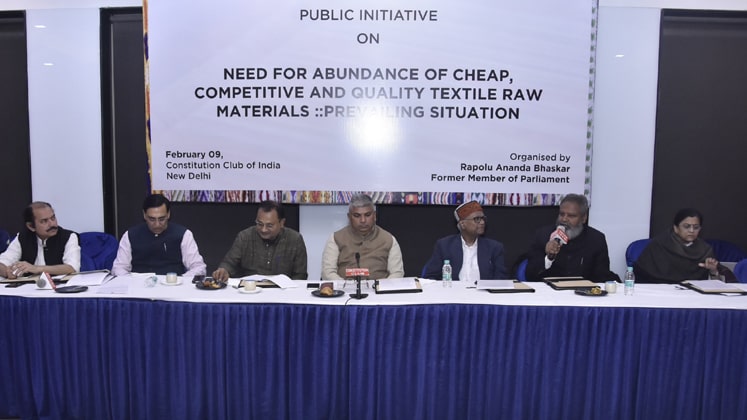
A roundtable was organised at the Constitution Club of India, New Delhi, recently, by Ananda Bhaskar Rapolu, Ex-MP, to discuss and deliberate on the scarcity of the various man-made and natural fibres in the country. Parliamentarians from BJP, INC, DMK, SO and others, along with industry representatives from different parts of the country were among the dignitaries present. They shared their perspectives on the consequences of the scarcity of raw materials and the impact of potential duty impositions, such as the Anti-Dumping Duty, on the sector.
There is a need to ensure abundant availability of raw materials like fibre in the country, seeing the increase of the market share of India in the global textile industry. There is a large supply-demand deficit, especially in viscose, despite India being the 2nd largest producer of man-made fibre/yarns and polyester. The key drivers for man-made fibre adoption are dwindling cotton supply, low cost, and versatility in design/application.
The domestic Viscose Staple Fibre (VSF) demand in FY 2021-2022 was 7 lakh tonnes, with the availability being only 5.4 lakh tonnes, which is a gap of 1,60,000 tonnes/year. India’s entire value chain depends on a single manufacturer, since there is only one major viscose supplier contributing to over 90 per cent of the supply, which creates a big risk for users. As a result, many small spinners cannot access Viscose as the supply is limited to select spinners only.
The above-mentioned challenges were highlighted by the dignitaries in the current situation of India’s weaving sector. Further deliberations were done on the solutions to ensure access to abundant and high-quality raw materials for the downstream community at cheap rates. Suggestions included building mechanisms to ensure no pricing policies exist which puts Indian weavers and spinners at a disadvantage and the non-imposition of duties (like anti-dumping duty) on raw materials such as polyester and viscose.
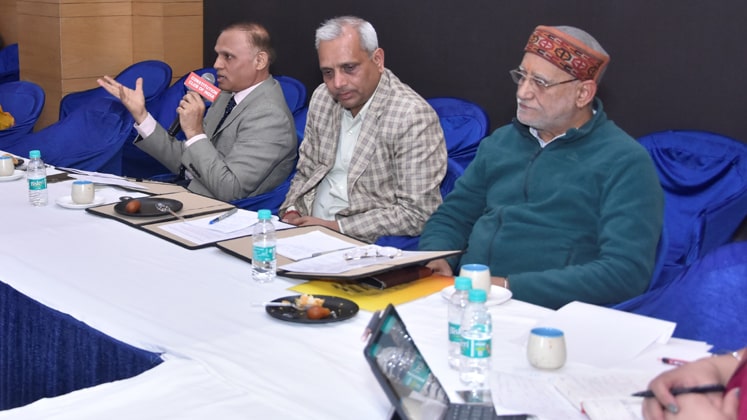
Ananda Bhaskar Rapolu, reflecting on and summarising the discussion, highlighted that there is a need for an encouraging ecosystem to enlarge the capacities of fibre to fabric. Critical for the labour-intensive textile value chain, which generates over 45 million in employment, mostly for rural poor and women is ensuring sufficient fibre/yarn availability. He further emphasised that viscose is poor people’s silk, and viscose blended cotton is the future.
Inconsistent policy decisions on raw materials will only ruin the chance of participation for the small-scale spinning and weaving industries. Hence, to ensure an ecosystem that safeguards healthy and fair competition in the market, concentrated efforts are needed which will enable the availability of quality raw materials for value addition. A consensus was reached by the parliamentarians and industry representatives that this discussion will be taken forward to the concerned offices.