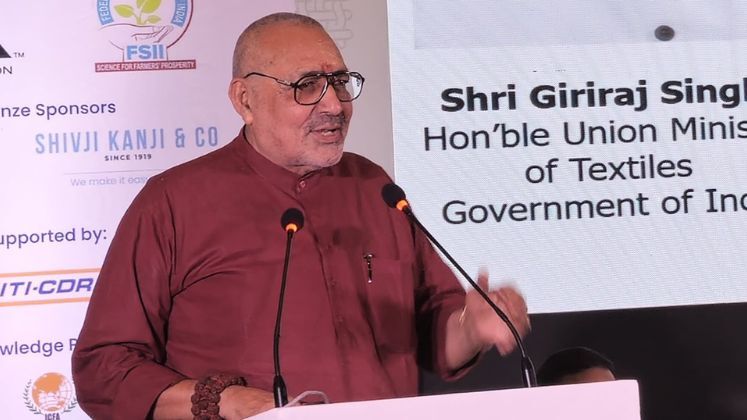
The Government of India is working towards achieving a US $ 350 billion textiles sector by 2030 — including US $ 100 billion in exports — while simultaneously advancing towards carbon neutrality, Union Textiles Minister Giriraj Singh said.
Speaking at an event jointly organised by the Ministry of Textiles and the Confederation of Indian Textile Industry (CITI) on World Cotton Day, the Minister underscored the importance of cotton to India’s agricultural identity. He remarked that cotton was not merely a crop but “the very soul of Indian agriculture, a reflection of the farmer’s sweat, resilience, and hope.”
Extending his greetings to cotton farmers, he said each thread of cotton carried the story of farmers — of their labour under the scorching sun, their prayers for rain, and their unwavering faith in the soil.
Singh observed that climate change and environmental sustainability posed major challenges to the textiles industry, stressing the need for judicious use of water and electricity and collective efforts to protect nature. He stated that efficient water use, soil conservation, and the adoption of renewable energy were vital to safeguard India’s predominantly rain-fed cotton regions and to ensure prosperity for future generations.
The Minister added that meaningful transformation could only occur when all stakeholders — from farmers to textile exporters — worked as one family.
Despite India accounting for 40 per cent of the world’s cotton-growing area, productivity remains about 450 kg per hectare — significantly lower than the 2,000 kg per hectare recorded in many other countries. The proposed Mission for Cotton Productivity aims to address this gap, Singh said.
He also highlighted the Government’s consistent support for farmers through steady increases in Minimum Support Prices (MSP) over the past decade, reflecting its commitment to rural welfare.
Looking ahead, Singh said natural fibres such as milkweed, ramie, and flax held significant potential, noting that India’s farmers had both the strength and wisdom to lead global efforts in sustainable fibre production. He added that as the world moved towards eco-friendly products, Indian farmers were well-positioned to show the way forward.
Minister of State for Textiles, Pabitra Margherita, said India must aim to secure global leadership in quality, sustainability, and ethical production. He emphasised that the Kasturi Cotton initiative could play a major role in advancing the Government’s ‘5F’ vision — farm, fibre, factory, fashion, and foreign. Margherita also noted that India and Russia had the potential to deepen cooperation in the textiles and apparel sector.