![Dr. Mike Fralix, President & CEO, [TC]2](https://www.apparelresources.com/wp-content/uploads/2014/08/Mike-Fralix-President-and-CEO-TC2-1-copy-copy.jpg)
On one hand companies like Henderson, Baxter and Softwear Automation displayed technologies to replace human operators in garment manufacturing, while Apparel Made 4 You (AM4U) showed a concept called Purchase Activated Manufacturing (PAM) through an integrated mini factory based on the principle of postponement of conversion in managing supply chain and both aiming to revive onshore US manufacturing of garments. Technologies like Styku and iStyling are taking the 3D scanning application to mass use through low cost made to measure concept. Companies like Gerber and A&E are already world leaders in their category for innovations and their presence at Cool Zone only reiterated the fact. “A lot of research is going on around the world to make the process of sewing more simple and automated. At the end of the day it all comes down to cost and only that technology can be cool which has the right combination of performance and practicality,” reasoned Dr. Fralix.
Some of the path breaking technologies
Styku – The Alpha of body scanning devices
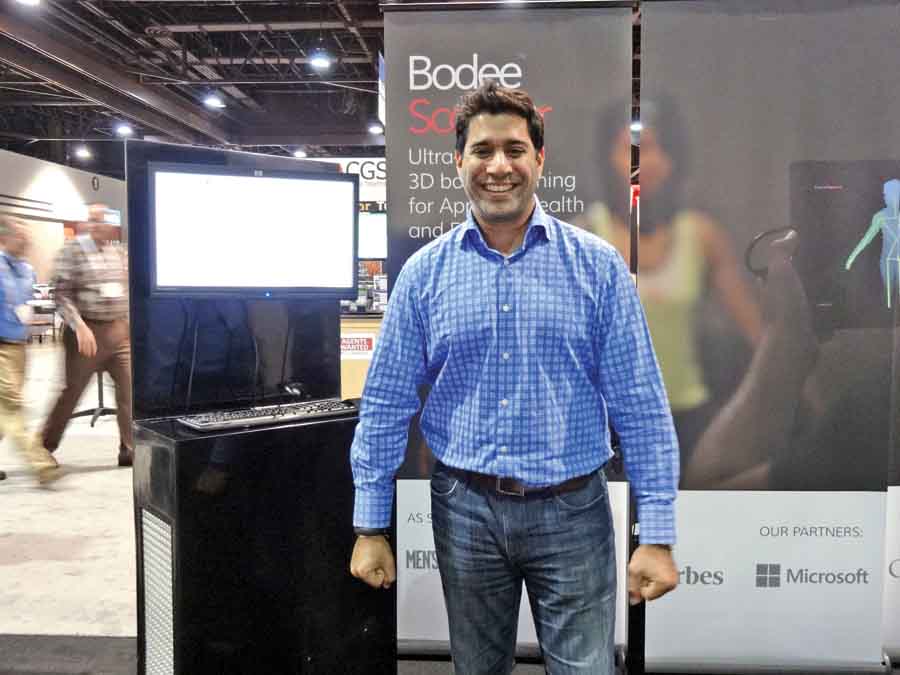
Stirring up what can aptly be labelled as a revolution in the avenue of fit, the California based Styku launched a new version of MyBodee, the ultra-portable body scanning technology, MyBodee, developed under the collaboration of Styku with Microsoft Kinect, that brings to the fore the Alpha of innovations for MTM. A simple, inexpensive and portable body scanning technology, it comes with an automated turntable, Microsoft Kinect and a stand. Styku has developed a complete end to end solution that resolves fit issues throughout the apparel value chain that will eventually imbibe innovations at the level of mobile phones.
Innovations and applications in the field of body scanning have been around for 15 years, but Styku has given new dimension to the concept with solutions that are portable, simple, inexpensive, quick, accurate, intuitive, powerful and scalable to any proportion. “At Styku we wanted to build something that was cost-effective and a lot more portable for an average company. Something that can be put up at stores and even in people’s homes,” avers Raj Sareen, CEO and Co-founder, Styku. Styku’s MyBodee scanner takes 40 seconds to scan a person on a turntable and takes over a million different measurements, 50 times more data than a traditional scanner would take. Traditional scanners only scan for a few seconds and capture only a moment of time. However, a scan over only a few seconds means a customer’s recorded shape may be biased by the amount of air in their lungs (imagine taking a deep breath or exhaling) or their posture, which bias measurements. Styku found that by scanning over 40 seconds, they could take 50 times more data and average the data across your body’s natural sway, inhaling and exhaling, and posture.
Another distinguishing point of this tool is that not only does it extract 150 precise measurements of a body but converts those measurements and shape information into a pattern that would perfectly fit the customer by the virtue of the software’s integration with TukaCAD and therefore doing away with the need of training workforce for customized pattern making. “Precision of such applications is increasing and therefore there are lesser re-fittings. Several young men from middle-class in India are going out there, spending US $ 300-400 on a custom suit. They want a fit. Then there is a cool factor on being associated with a retailer who is using the latest tools. Nobody wants to get a custom suit in two weeks or a month,” says Raj hinting at the adoption of quick response fashion at the MTM level. Giants like Nordstrom have partnered with Styku for their online stores in order to tackle the issue of returned apparel goods sold due to poor fit. Meanwhile, in India Arvind is testing the Beta version for an upcoming concept store.
Raj believes that the adoption of MyBodee and other products will provide feedback on the true shape of people, enabling brands, retailers, and manufacturers to make better product development decisions and build more personalized products.”
Integrating garment production with AM4U
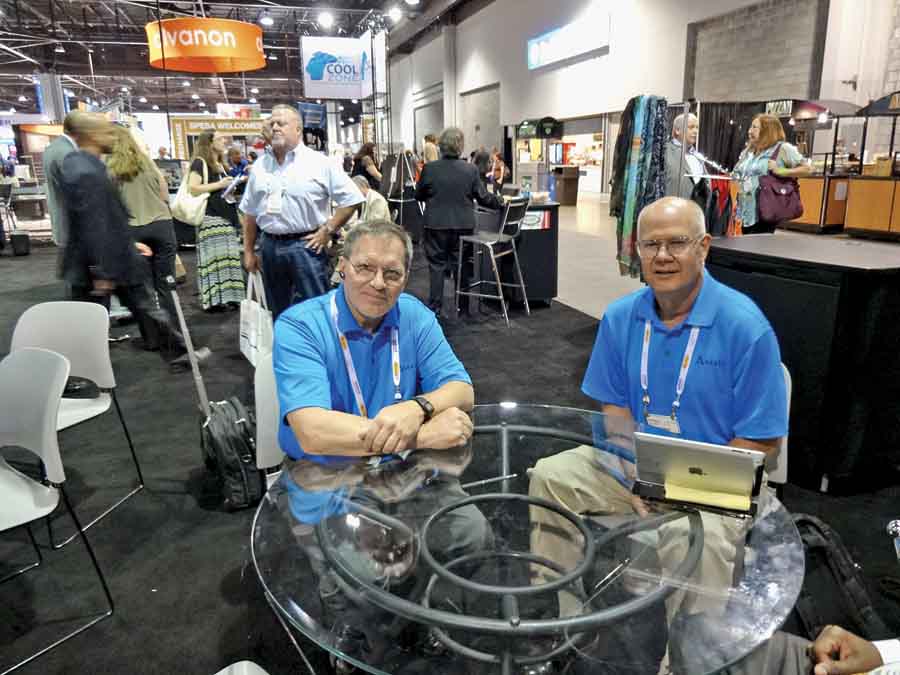
Apparel Made 4 You (AM4U) is a revolutionary “Purchase Activated Manufacturing” (PAM) concept that is contributing to the paradigm of re-shoring the production to USA. The concept is fundamentally a business model that lowers cost and removes markdowns of inventories finished apparel through implementation of dyeing, printing, digital cutting and sewing operations in a very small footprint under one roof. The integrated mini factory’s sewing floor will feed bar-coded bundles to an automated RFID system for moving each unit to a specific line and on to shipping even. “We are supporting the re-shoring movement with our integrated ‘mini-factory’ concept which can customize clothing from pattern making to value addition and sewing for local production,” said Bill Grier, President and Inventor of AM4U.
Robotic sewing solutions from SoftWear Automation
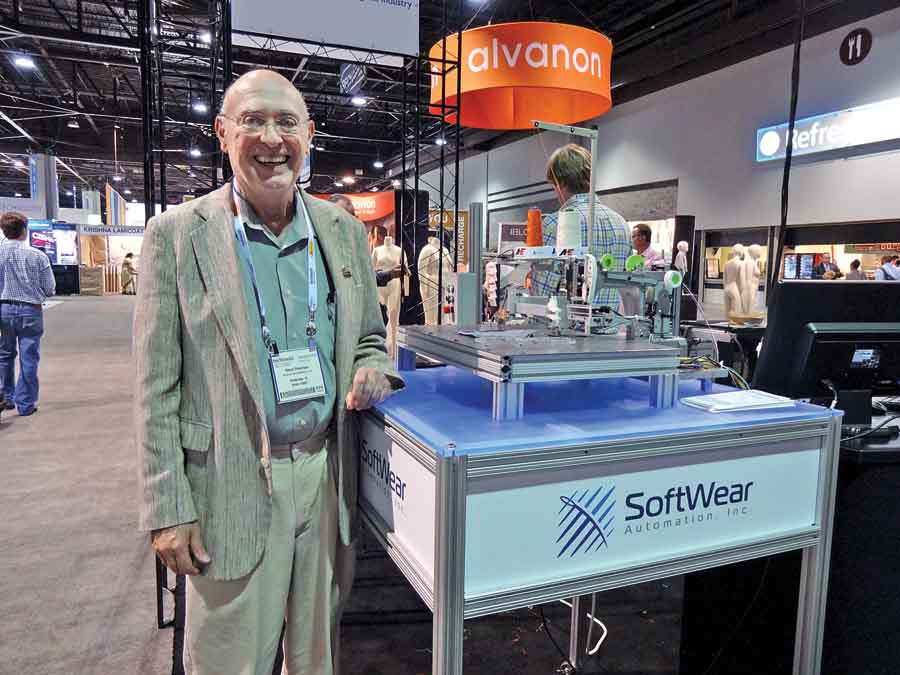
Atlanta based SoftWear Automation, which aims to be a supplier of fully automated production lines for robotic cutting and sewing of garments demonstrated a robotic sewing machine that is capable of stitching together two independent pieces of fabric. The company claims that its robotic solutions would lead the transformation of the labour intensive sewn products industry to one that is high-tech and capital intensive. The technologies work on two patented mechanisms, one on counting threads with accurate machine vision and second based on feed mechanism that advances the fabric towards the sewing head. In the first product DARPA, the machine vision measures the thread count at 1000 frames per second and corrects the fabric positions at the needle head to allow accurate stitching. The movement of the bottom and top fabrics are automatically controlled and coordinated during sewing. No dedicated sewing operator is needed for sewing. LOWRY, the second product for the work cell, is a low cost lightweight fabric transport robot that works based on a feed mechanism called ‘sewing dog’ that transports the fabric and garment part to and from sewing head. “While DARPA will hit the market by the end of 2015, deliveries for LOWRY will begin in the second half of 2014, informed William T. Lockhart, CEO SoftWear Automation.
Baxter from Rethink Robotics

Baxter is the world’s first interactive production robot designed to safely and intelligently operate directly next to people, without safety caging. It is manually trainable by the line workers to perform simple, repetitive production tasks and can switch between tasks and production lines quickly and easily. Among the interesting features is that it can be setup and integrated in a fraction of time of typical robots.
Manufactured by Rethink Robotics, USA, Baxter is an entirely new type of robot that is redefining the way robots can be used in manufacturing environments. Baxter exhibits behaviour-based ‘common sense’, capable of sensing and adapting to its task and its environment. Additionally, Baxter requires no complex programming or costly integration and the makers claim that with its uniquely low price point, Baxter provides a compelling alternative to low-cost offshoring for manufacturers of all sizes.