Steiger Textil launches ‘Stitch Lab’

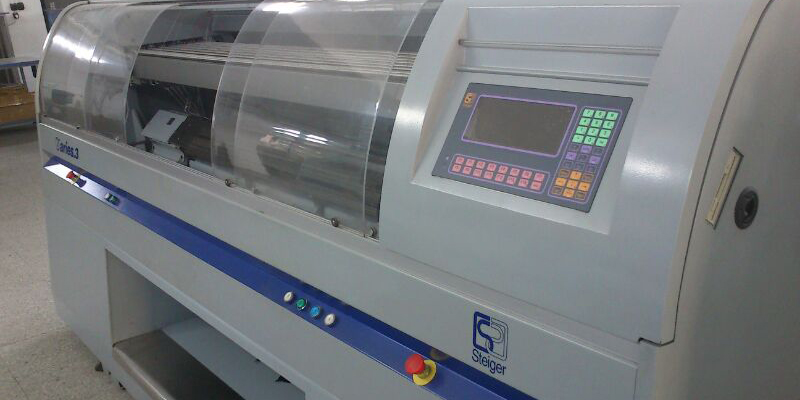
Steiger Knitting Machines
Image Courtesy: exapro.com

Switzerland-based flat knitting machine manufacturer, Steiger textil, has launched a new facility called ‘Stitch Lab’, for experts in knitting and programming to work together with clients on developing their future applications.

Using the Stitch Lab, Steiger technicians and their partners will be able to work together via the machine’s 3D simulation software Model Plus (M+). The software will simulate the creation of the stitches, row by row with the use of the virtual knitting machine function. The programmer can then detect any potential knitting problems early in the creation of the garment and, using the appropriate Wizard, will be able to navigate into the product to inspect the sample in closer detail.

Also ReadAustralia debuts in carbon fibre production

Explaining the features of Stitch Lab, Pierre-Yves Bonvin, CEO of Steiger, commented, “The Stitch Lab is a very powerful tool to develop the future applications using which Steiger will develop 3D articles for knitwear, for medical applications and for the composite material.”

According to Steiger, Stitch Lab can be used on all the latest and major knitting machines of the company such as: Libra 3.130, New Aries 3.130, C2.185 SCP, Taurus 2.170 XP and Antares 3.130.

“We will use all our expertise and innovation capability to create new patterns and 3D parts using any kind of yarns. In the Stitch Lab we have put together the best experts, the best machines and the best framework to boost the innovation,” concluded Bonvin.

Business keyboard_arrow_right Sourcing keyboard_arrow_right News

Oliberté & South African textile firm to launch Women’s Collection

Oliberté Footwear
Oliberte collaborates with Boabab Batik Kinsha to make this lace-up sneakers

Oliberté Footwear, the first show company to make premium shoes in Africa using materials from those countries and creating jobs there, and well-known for its Ethiopian-produced line of shoes for men, women and children, will be launching a new Women’s collection, in collaboration with Boabab Batik, a Swaziland-based enterprise doing business in locally sourced printed fabrics.

The collection will come out in two styles — Kinsha, a lace-up retailing for $100, and the Mbozi, a slip-on at $90; both of which will be available in two colour ways. The collection will be available online from March 28 at Oliberte. This will also the first ever for women. Earlier, Oliberté, which was founded by Canadian entrepreneur Tal Dehtiar as a sustainable brand supporting workers’ rights in sub-Saharan Africa in 2009, had partnered with designer Mark McNairy for a men’s line.

According to a statement issued by Oliberté, the collaboration was “a natural one”, given that both companies aim on promoting social enterprise. With its over 20 years experience in handcrafting uniquely dyed fabrics for scarves, pillows and dolls, its collaboration with Oliberté was definitely a natural one. The Canadian footwear firm now owns its own factory in Addis Ababa, where its entire collection is produced. For this collection, Oliberté has worked closely with Baobab to produce the fabrics, with the help of local workers. Both companies are also Fair Trade Certified, which signifies they are made with respect to people and planet.


bluesign publishes annual revision of the BSSL

Image Courtesy: keepon.com.tw
                 Image Courtesy: keepon.com.tw

bluesign technologies regularly revises limits and usage bans for chemical substances that are published in the bluesign® system substances list (BSSL) Consumer safety limits. The 2015 revision considers new scientific knowledge on toxicological profile of substances, ECHA Candidate List of Substances of Very High Concern, revised risk assessments as well as new analytical standards. The main focus of this year’s revision has been set on the analytical test methods. In the testing methods column both the information on sample preparation and on the measuring method are now listed. Furthermore, a chapter on testing methods provides technical details of the recommended sample preparation methods.


Business keyboard_arrow_right Sourcing keyboard_arrow_right News

Swaziland’s textile sector to create 800 jobs

Image Courtesy: gdb.voanews.com
                        Image Courtesy: gdb.voanews.com

Phumelele Dlamini, CEO, Swaziland Investments Promotions Authority (SIPA) has said that two textiles firms in Swaziland are expected to create around 800 jobs in the country soon. She informed, “We are expecting that these factory shells (situated in Nhlangano and Matsanjeni) will provide job opportunities that will amount to 800. We expect 400 job opportunities from each of the factory shells. Government initially pumped US $ 8.3 million into the factory shells projects, and then pumped in US $ 1.4 million afterward. “We implore workers to work hard and cooperate with their employees so that they can establish a mutually beneficial working relationship with their employers,” Dlamini added.


Business keyboard_arrow_right Sourcing keyboard_arrow_right News

Sukano expands fibre & textiles division

Image courtesy: plasticsrecycling.org
                Image courtesy: plasticsrecycling.org

Sukano, a Switzerland based manufacturer of masterbatches and compounds, has expanded the team which handles its fibres division. Roberto Parenzan as product development leader (Textiles & Fibres) will take care of the technical management of fibre projects and new product developments. Michael de Braaf, CEO of Sukano AG said, “The new Sukano fibres team is part of our mission towards even more customer focus and service.” The Sukano portfolio for fibre applications has a masterbatch range to improve functionality and look of fibre products, like high performance UV masterbatches and ultra durable antimicrobial masterbatches.


Swaziland’s duty free exports through AGOA to US under scanner

Image courtesy: photos-a.ak.fbcdn.net
             Image courtesy: photos-a.ak.fbcdn.net

Swaziland’s duty-free export market to the United States through the Africa Growth and Opportunity Act (AGOA) won’t get the benefits from late December, this year, if it fails to meet the benchmarks.The textile and apparel industry of the country have requested to the United States President Barak Obama, to give Swaziland a few months to sort the benchmark issues that could result in its expulsion from the act.AGOA is the US non-reciprocal trade preference program that caters duty-free treatment to the US imports of approximately 6,000 products from eligible sub-Saharan African countries.


ESPRITECH – Makes entry into folding machines for home textile segment – towels, sheets, curtains

Samuel Gerber, CEO, Espritech shows a packaging with towel folded by the specialized machines from the company

We are catering to the folding needs of global retailers both in the US and EU and our products assure perfect fold with least manual involvement,” says Samuel Gerber, CEO, Espritech.

Some of the interesting machines with the company include folding systems for towels, sheets, curtains with or without cardboard inserting device. The White Diamond folding system is for the folding and stacking of flat sheets, fitted sheets, duvet covers, curtains, blankets and other flat product – woven, non-woven, non-elastic pieces. This installation is a stand-alone unit that is able to work up various material types including cotton, sateen, mixture fabric, polyester/cotton, and flannel. The feeding edges of the pieces are shown as outside fold or hidden as inside fold. The system is equipped with a cardboard inserting device for standard and book fold folding.

Another machine specific to towels is the White Opal Folding machine for the folding and stacking of Towels – woven, non-elastic flat pieces. This installation too is a stand-alone unit that is able to work up various material types including terry, cotton, sateen, mixture fabric, polyester/cotton and flannel. In this machine the feeding edges of the pieces are shown as outside folding. A more versatile machine is the Black Opal folding machine for the folding and stacking of towels and other flat products – woven, non-woven, non-elastic flat pieces in various material types including terry, cotton, sateen, mixture fabric, polyester/cotton and flannel. The feeding edges of the pieces are shown as outside fold or hidden as inside fold.

The technology is being marketed in India by MSB Consulting. Manjeet Singh Bakshi, CEO, MSBC was very happy at the interest shown in the technology at the event, though there are already some installations in India, it was for the first time that the company was showcasing at an industry forum.


TexPrint v.2008 from ErgoSoft Targets Digital Textile Printing Industry

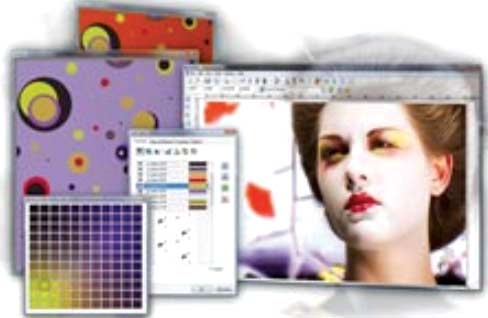
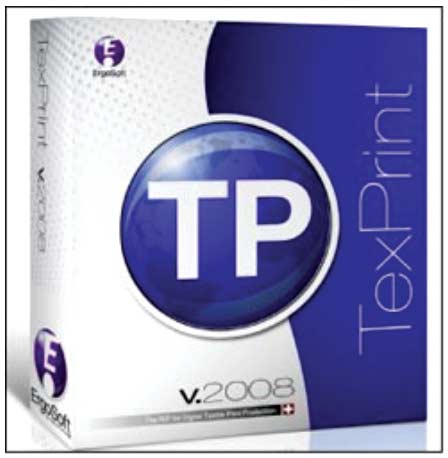
The ErgoSoft RIP software TexPrint v.2008
         The ErgoSoft RIP software TexPrint v.2008

The ErgoSoft RIP software TexPrint  v.2008 is a new RIP software specially developed for digital textile printing. The well-known qualities of the TexPrint software, such as the sensitive user interface and usability, have been enhanced and enlarged with new functions to increase its productivity and flexibility. With the integration of the multi core CPU technology, it is up to 30% faster.

The known production tool JobQueueViewer that gives the user a summary of the current print information, is now faster than before. Status reports for jobs such as the state of the ripping process, the other print jobs lined up in the printer, and the status of the finished jobs by the cutter, can be viewed in detail and information recalled in the future.

The ErgoSoft RIP software TexPrint v.2008
          The ErgoSoft RIP software TexPrint v.2008

The new developed PrintClient allows immediate changes in print parameters to optimise the printer settings like the number of passes, unidirectional or bi-directional printing and changing the temperature at the printer heating. It is also possible to print white ink and spot colours. With the introduction of a new feature to estimate the cost, the user has detailed information about the price of the job at hand and therefore can use this information for further price quotes. Furthermore, the Postscript support is enhanced.

With the optional additions, the modularly developed ErgoSoft TexPrint v.2008 can be customised to the user’s needs and grow with the user’s business success. Therefore optional functions such as ‘Variable Data’ are also available. This function can be used to print apparel, e.g. sport-shirts all having the same pattern but with different numbers or names.