Cambodia’s exports to US down 7%

Exports
Image Courtesy: fureurope.eu

The uncertainties in the US presidential race, rising exports from Vietnam and emergence of new market Myanmar resulted in 7 per cent decline in Cambodia’s total exports to the United States to US $ 2.8 billion in 2016 compared to more than US $ 3 billion in 2015.

Seung Sophary, Spokesperson, Ministry of Commerce said, “The American people were tightening their belts to brace for the worse in the race between the two candidates. There was high uncertainty and this affected their desire to buy imported goods. Now that the election is over, things hopefully will return to normal. The American people have got a new president.”

Also ReadBrexit to impact Cambodian apparel export sector

Cambodian’s garment exports to the US are also facing stiff competition from Vietnam and Myanmar. The wage levels are on par with Cambodia which makes it difficult for the Cambodian exporters to compete in terms of cost, as per Kaing Monika, Deputy Director General, Garment Manufacturers Association of Cambodia (GMAC).

It may be mentioned here that the new minimum monthly wage for Cambodian garment workers this year is US $ 153, up from US $ 140 last year. However, the US’ withdrawal from TPP has given a ray of hope to Cambodia. The TPP would have eliminated most tariffs in the garment sector and the country would have lost to Vietnam. Myanmar is the “dark horse” in garment trade as it has come out strong with an aggressive and concrete master plan.

Also ReadMyanmar garment industry is out with its 10-year Plan

According to the Myanmar Garment Manufacturers Association (MGMA), the Myanmar apparel industry operating under the cut-make-pack system exported more than US $ 1 billion worth of clothing last year as against US $ 408 million in 2015, noting a massive increase of 145 per cent.
 

Cambodian garment workers stage protest for non-payment of wages

Cambodian Garment Workers Strike
Image Courtesy: VOA Cambodia

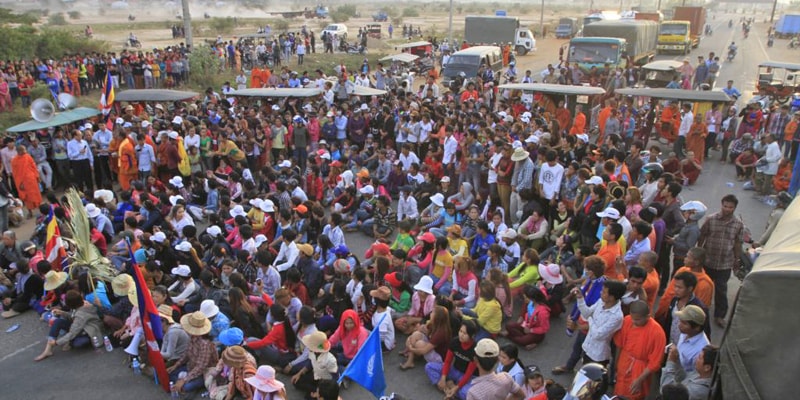
Around 200 garment workers staged protest in Phnom Penh, the capital city of Cambodia, seeking payment of their due wages from the owners of Top World Garment and Kbal Koah Garment of Hong Kong. Around 600 workers have been on strike since January 10. “The workers really need their wages because they are facing livelihood difficulties,” reportedly informed an official.

The informal cordon ended when local authorities and Labour Ministry officials negotiated a meeting with workers’ representatives. However, it is still not clear whether the garment factory owners have paid the dues or not.  

Also ReadTruck carrying garment workers crashes; injuring 25

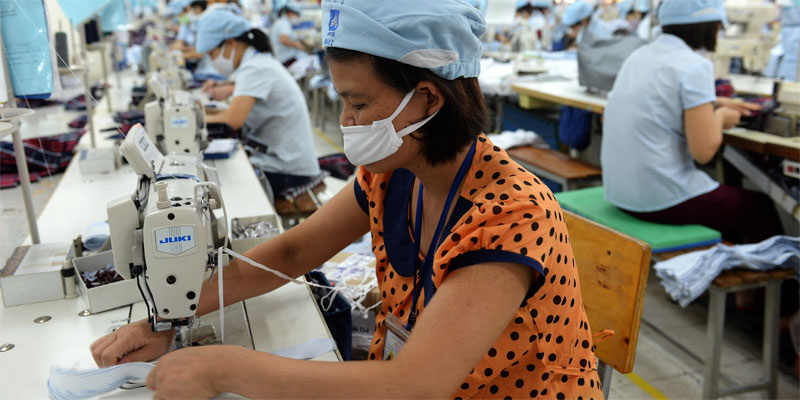
It is pertinent to mention here that Cambodian garment industry is worth US $ 6.9 billion and employs 690,000 workers, mostly women in approximately 1,000 factories.


26 workers faint in Cambodian factory

Cambodia Garment Industry
Image Courtesy: khmertimeskh.com

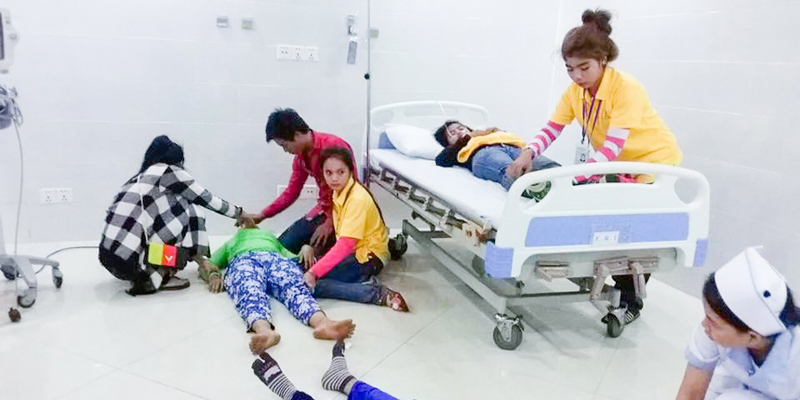
More than 20 workers fainted at Romantic Leather (Cambodia) Co. Ltd. in Sihanoukville Province. Yov Khemara, Director, Provincial Labour Department said, “There was a worker who fainted and then the other workers who saw her felt shock, fear and hysteria and then fainted continuously until there were 26 of them.”

The workers were sent to a private clinic for medical assistance. As per Yov, the first worker fainted because she was tired. She had been taking care of her sick husband at the hospital all night and had to come straight to work after having little sleep while the others were suffering from malnutrition. The doctors concluded that they lack glucose and calcium and that caused them to easily faint when they were shocked.

“They were sent to the hospital immediately. They were allowed to rest for a day, and if they feel better, they can come back to work,” added Yov.

Also ReadCambodian garment workers’ accidents death rate drops; but still a concern

It may be mentioned here that last year, 1,160 workers fainted at factories across the country, as per the statistics released earlier in the current month by the National Social Security Fund.  

The Cambodian Government has found seven reasons for these mass fainting after speaking to factory workers. The two most common reasons were related to their mental state (34 per cent) and nutrition (22 per cent). Long hours and physical injuries were also cited as reasons for mass faintings.

Cambodian garment workers seek PM’s support

Cambodian Garment Factory
Image Courtesy: cloudfront.net

In Phnom Penh (Cambodia), around 500 garment workers from three factories marched to Prime Minister Hun Sen’s house with a petition urging the premier help to claim their dues. The garment workers said their employer, a Chinese national, had fled the country without paying their December wages.

“There are 1,146 workers who are now employed as the three factories owned by a Chinese national had fled the country without paying their wages. We want the PM to help us find the owner and solve our problems by paying us our salary and if the factories end up closing, the owner must pay us all our benefits and seniority bonuses as stipulated in the Labour Law,” a worker said.

Also ReadUK garment workers get half the legal minimum wage

Workers approached the PM after their meetings with the Labour Ministry and Council of Ministers failed to draw any fruitful results. Chhin Thea, Legal Official, Coalition of Cambodian Apparel Workers Democratic Union stated that meeting with Labour Ministry was pointless as one of the union negotiators did not agree to the proposed terms. “The company was ready to sell their equipment to pay their debts but they did not agreed, they want to settle this issue out of the court,” Thea revealed.

It has been observed lately that factory owners in the country are absconding from the country without paying their workers, with at least half a dozen such cases last year alone involving hundreds of garment workers. In September last year, the Ministry said it was preparing to enact regulations that would provide some amount of monetary relief to workers left in the lurch by factory owners who flee the country without giving workers advance notice or compensation.


Truck carrying garment workers crashes; injuring 25

Cambodia Garment workers
Image Courtesy: s.yimg.com

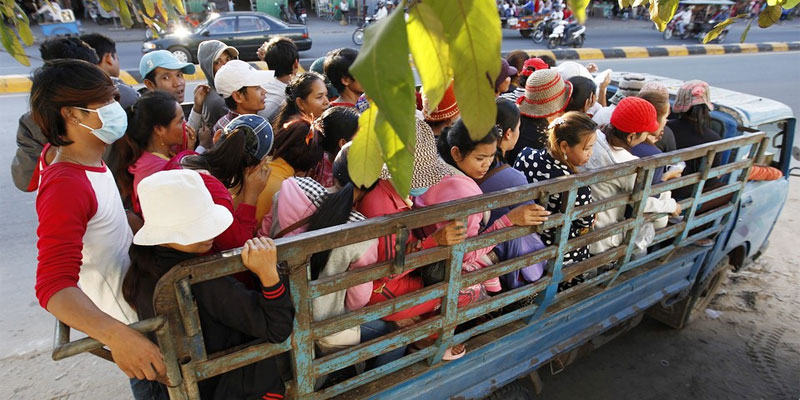
Twenty-five garment factory workers recently got injured after the truck carrying them flipped onto its side in western Cambodia’s Kampong Speu province.The injured were rushed to hospitals for treatment and the National Social Security Fund would cover for their medical expenses.

Confirming to the incident, statement from Cambodia Labour Ministry read, “The speedy truck carrying workers to their factory overturned when the driver attempted to overtake another car in a dangerous situation. Six workers were seriously injured and 19 others sustained minor injuries in the crash.”

Also ReadCambodian garment workers’ accidents death rate drops; but still a concern

It may be noted that transporting factory workers in open trucks to and from factories is a common scenario in Southeast Asian country. Late last month, one garment factory worker was killed and 13 others got wounded when their truck collided with a lorry in southwestern Preah Sihanouk province. Furthermore, more than 100 garment workers died in traffic accidents last year

Cambodia garment industry is worth US $ 6.9 billion and employs 690,000 workers, mostly women in approximately 1,000 factories.


Brexit to impact Cambodian apparel export sector

Cambodian Garment Sector
Image Courtesy: bloomberg.com

Brexit, a short expression for Britain’s Exit from European Union, was the referendum of the United Kingdom on its continuity as a member of EU, where 48.1 per cent voting to remain and 51.9 per cent winning the leave. And, according to the ILO (International Labour Organization) this is going to hurt the garment export sector of Cambodia as Europe has been its No. 1 garment export market since 2014, with the UK, in particular, topping the list.

Garments currently make up roughly 80 per cent of Cambodia’s total exports and have been its most reliable growth engine for the past several years. Exports continued their strong growth over the first half of fiscal 2016, up 10.8 per cent year-over-year to US $3.5 billion. ILO said that the UK could maintain preferential access for Cambodia and other so-called Least Developed Countries, or revert to World Trade Organization rules. In the latter case, Cambodia would lose its special access unless the Government arranges a new free-trade agreement with the UK.

Also ReadIndian handicraft exports note 8.3% growth: EPCH

Kaing Monika, Deputy Secretary General of Garment Manufacturers Association in Cambodia (GMAC) said, “Let’s just hope that the EU can keep moving forward and any negative effect would be minimal. For us, it’s an external factor which is out of our control. Cambodia should just do its best to make sure our investment climate remains conducive,” adding, “Brexit is a very complicated matter and it is too early for us to exactly predict the consequences. Many don’t really know what is going to happen next.”


Cambodian garment workers’ accidents death rate drops; but still a concern

Cambodian Garment Workers
Image Courtesy: wsj.net

More than 100 garment workers died in traffic accidents last year, with 21 per cent drop in number compared to 2015, as per the reports by the National Social Security Fund (NSSF).

NSSF informed that garment workers were involved in 5,609 traffic accidents last year. Of these cases, 103 workers died and 7,446 were injured, and 970 were seriously injured. The figures of injured workers declined nine percent, but light injuries surged three percent. However, traffic accidents decreased by 882 or 14 per cent in 2016 as against 2015, but the total number of victims increased by 89 workers or 1 per cent.

Cheav Bunrith, Director –Policy Division, NSSF revealed that the factors causing traffic accidents were speeding, drunk driving, overtaking and not giving way when driving. He informed that 47 per cent of traffic accidents were caused by trucks carrying workers.

Also ReadBangladesh RMG factory owners urged to solve workers’ housing issues

“I want to appeal to the workers and truck drivers to respect and implement the road traffic law in all situations while traveling and be good citizens. They must not drive over the speed limit, while drunk or when they are sleepy. They have to wear helmets, wear seatbelts, drive on the right side, check vehicles technically and be careful at all times while driving,” urged Ouk Samvithya, Director, NSSF.


TÜV SÜD, GMAC to sign an MoU

Memorandum of Understanding
Image Courtesy: news.lk

TÜV SÜD, one of the world‘s leading services provider in testing, inspection, audit and certification, will be signing a Memorandum of Understanding (MoU) with Garment Manufacturers Association in Cambodia (GMAC) to collaborate on workshops and awareness programmes related to international quality and safety standards for GMAC corporate members.

The collaboration is done to ensure that GMAC corporate members can keep up with industry demands for international standards of safety and quality. Additionally, the hallmark of this MoU is that GMAC members stand to benefit from TÜV SÜD’s vast expertise and in-depth experience in testing, certification, inspection and training services at special members-only-rates.

Also Read – GMAC announces launch of ‘Cambodian Garment Training Institute’

It may be mentioned here that textile and garment industry in Cambodia has grown tremendously to dominate the country’s export sector. High standards of quality and safety have to be maintained and continuously improved upon, which is why GMAC’s role of nurturing and providing a conducive business environment for manufacturers, is very significant for the whole Cambodian economy.

Cambodian garment workers’ short films to be screened in London

Film Screening
Image Courtesy: blogspot.in

A series of short films shot by Cambodian garment workers in a Citizen Journalists Group started by Local Labour Rights Group will be screened in London’s Platform Theatre on 27th November this year in order to attract attention towards the hard working conditions under which some of the clothes sold on UK’s high streets are made.

UK film company Rainbow Collective assisted the workers, while the group Labour Behind The Label supported the project. Label’s Campaign Manager Nicola Round reportedly stated, “With powerful stories and evidence like this we can hold brands to account for conditions and pay in their factories and support the fair demands of the people, most of them women, who make our clothes.”

Also ReadCambodian garment workers’ wage issue continues

Europe has become the largest market for Cambodia’s garment exports in recent years due to the huge orders from UK retailer as well as fast fashion brands. However, the labour rights groups allege that the companies are not paying enough for those goods to provide a living wage and safe working conditions to Cambodia’s garment workers.


ILO’s Better Factories Cambodia gets 3-year extension

Garment Worker Cambodia
Image Courtesy: betterwork.org

Ministry of Commerce and Ministry of Labour – Government of Cambodia, GMAC (Garment Manufacturers Association in Cambodia) and ILO’s BFC (International Labour Organization’s Better Factories Cambodia) have signed an MoU to extend the partnership for three more years, covering a period from January 2017 to December 2019.

During the said period, the partners have committed to increase collaboration to work together to improve the working conditions and boost the competitiveness of the Cambodian garment sector to build institutional sustainability of the programme. Cambodian constituents have agreed to contribute approximately 25 per cent to the BFC Budget over the next three years, while international garment buyers sourcing from factories that have deployed ILO Better Factories Cambodia programme will contribute to programme based on fees for services rendered.

Also ReadCambodian garment workers get tax-free bonus

In addition to its current projects, BFC will also work with Ministry of Labour on the implementation of a joint strategy and action plan with the objective to support Government’s capacity and ownership to uphold compliance with labour law and support remediation in the garment and/or other sector as appropriate.

Ith Sam Heng, Ministry of Labour and Vocational Training (MOLVT) averred, “BFC has played a key role in the growth of the industry and the improvement of working conditions. Under the new MoU, BFC and the MOLVT would step up collaboration on workplace inspection and enforcement of the labour law.”

The MoU has been renewed five times by the parties since the ILO-BFC programme began in 2001.


Cambodian Labour Ministry supports Trump’s vision to scrap TPP

TPP
Image Courtesy: vietnambusiness.tv

Following Donald Trump’s surprise win in the US presidential election on 8th November 2016, Heng Sour, Spokesman, Cambodian Labour Ministry commented that the promise made during the president-elect’s campaign to pull out of the Trans-Pacific Partnership trade deal would restore the Cambodian garment sector’s competitiveness in the ASEAN market.

The 12-member Trans-Pacific Partnership (TPP) was signed in February 2016 and, once ratified, was expected to liberalise trade among signatory nations – including the US, Japan, Canada, Vietnam, Malaysia and Japan. However, Trump, during his presidential campaign, adopted a protectionist stance on trade deals, vowing to renegotiate or break existing agreements.

Also ReadCambodian garment workers get tax-free bonus

With a positive attitude on Trump’s victory, the Labour Minister is certain that the new President would dismantle the TPP, thereby neutralising any expected trade advantages for neighbouring Vietnam and put neighbouring countries on an equal footing with Cambodia again. He further mentioned that the garment sector would face problems if it had to compete with Vietnam, which would enjoy tariff-free exports to the US under the TPP, while Cambodian exports would still be taxed.

Miguel Chanco, Lead Analyst, Economist Intelligence Unit – ASEAN said that the death of TPP would not necessarily translate into an increase in Cambodian garment exports as with or without the TPP, fact is that wages in the country’s garment industry are rising rapidly, diminishing its cost competitiveness vis-a-vis TPP hopefuls like Vietnam.

Ken Loo, Spokesman, Garment Manufacturers Association, Cambodia added that the country would have to improve worker productivity and training, as well as the supporting infrastructure, to stem an exodus of investment away from the sector.

Also Read‘Vietnam-EU FTA to yield better results than TPP’

However, William Conklin, Country Director, Solidarity Centre which is a labour advocacy group, is of the thought that with or without TPP, Vietnam is moving ahead with bringing its garment sector to the stringent standards of the trade deal.


Cambodian garment workers get tax-free bonus

Cambodian Garment Workers
Image Courtesy: betterwork.org

Following the recent minimum wage hike from US $ 140 per month to US $ 153, garment workers in Cambodia will also get tax-exemption on bonuses as declared by the Economy and Finance Ministry of Cambodia.

In a directive, Aun Porn Moniroth, Minister of Economy and Finance, Cambodia stated that allowances for transportation, accommodation, meals and health insurance will not be taxed applicable from 6th October 2016, in a bid to improve garment workers’ standards of living.

The Minister however mentioned that workers would still be liable to pay their salary tax and factories would need to file their employees’ bonuses to the tax department to be eligible for the tax exemption.

Also ReadCambodia finalizes minimum monthly wages

According to the Cambodian Department of Taxation’s website, all resident employees in Cambodia have to pay an incremental amount of salary tax should they earn more than 800,000 Cambodian riels (about US $ 200). Those earning between US $ 200 and US $ 300 are liable for a five per cent salary tax, while those earning between US $ 301 and US $ 2,000 are liable for a 10 per cent tax.

While the site does not specify the guidelines for taxing bonuses, it does note that taxation of ‘fringe benefits’ of resident employees stand at 20 per cent, ‘the total value of fringe benefits given to all employees,’ adding that the ‘value of fringe benefits is the fair market value inclusive of all taxes.’