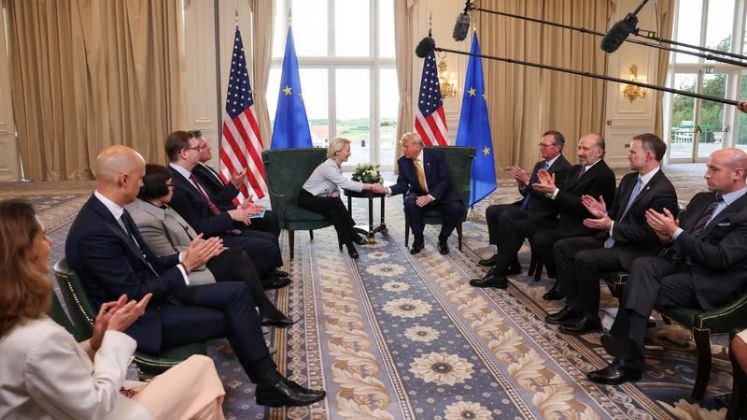
The US and the EU have completed a breakthrough trade deal, averting a potentially bitter economic showdown between two of the globe’s biggest trading partners. The US will apply a 15% tariff to most European imports under the new accord—a concession that avoids a full-scale trade war but does not meet the EU’s previous hopes for tariff-free terms.
The announcement came after a high-stakes summit between US President Donald Trump and European Commission President Ursula von der Leyen at his Scottish golf course. Their one-hour meeting sealed the deal, with Trump describing it as “the biggest deal ever made.” Von der Leyen highlighted that the tariff of 15% would be applied widely across numerous sectors.
German Chancellor Friedrich Merz greeted the accord, calling it one that prevented a trade war that could have significantly hurt Germany’s export-driven economy and its automobile sector. Bernd Lange, chairman of the European Parliament’s trade committee, however, denounced the asymmetry of the pact, fearing that the pledged investments could displace European industry.
Market experts praised the stability the agreement provides, although others were cautious. AllianceBernstein Chief Economist Eric Winograd described the pact as a good sign but asked how long both sides would stick to it.
President Trump, who has been vocal in his criticism of current trade arrangements, keeps up the pressure for what he terms more equitable trade for America. Although he has managed to sign deals with Britain, Japan, Indonesia, and Vietnam, his government has still not achieved its ambitious target of “90 deals in 90 days.” His language on the EU remains confrontational, citing the bloc’s alleged exploitation of the US via trade imbalances.
His main focus is on the US goods deficit with the EU, which totaled US $ 235 billion in 2024. The EU responds by mentioning the US surplus on services, which compensates for the difference. Trump has also bragged about tariffs revenue, saying they collect “hundreds of billions of dollars.”
The deal comes weeks after Trump indicated that he would impose a 30% duty on all imports from the EU from 1st August 2025. The EU, in retaliation, had drawn up retaliatory levies on US $ 109 billion worth of US goods and had even weighed triggering its most offensive trade weapon, the anti-coercion tool, to hit US services.
By averting a trade showdown, the new deal offers a temporary reprieve and a fragile foundation for economic cooperation between the two global powers—one that will require careful management in the months ahead.