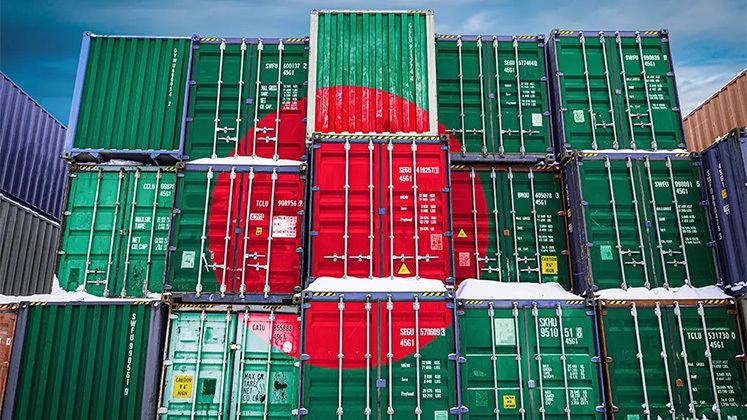
The Export Promotion Bureau (EPB) has published updated data on merchandise export earnings. The figures show that Bangladesh exported US $ 12.99 billion worth of clothing during July–October of the current fiscal year, which is 1.40% more than the same period last year. Bangladesh exported clothing valued at US $ 12.81 billion during the first four months of the preceding fiscal year.
Additionally, overall export earnings for the first four months of the current 2025-26 fiscal year were US $ 16.14 billion, up 2.22% from US $ 15.79 billion during the same time of the previous fiscal year.
Nonetheless, October’s textile exports were valued at US $ 3.02 billion as a single month, which is 8.39% less than October of the previous year. Consequently, shipments of readymade clothing have decreased for the past three months. Exports decreased by 5.5% in August. Additionally, they dropped by almost 5.5% in September.
The fiscal year got off to a good start even though clothing exports fell for three straight months. Clothing exports increased by 24.5% to US $ 3.96 billion in July.
As per exporters, uncertainty on the retaliatory tariffs by US President Donald Trump is reducing export earnings and it is predicted that this negative trend will continue in the coming months.
Bangladesh has been subject to the Trump tariff since 7th August. US President Donald Trump slapped tariffs on Bangladesh and other nations on 31st July, just before the counter-tariff was set to go into effect. Bangladesh’s tariff was consequently lowered from 35% to 20%.
Because the counter-tariff was lower than that of rival nations, Bangladeshi exporters were alleviated of their concerns. However, given the decline in export revenue, exporters are once again concerned.
Former BGMEA President and current Bangladesh Chamber President Anwar-ul Alam Chowdhury Parvez said, “Our main markets are America and Europe. Exports have been hit in both places. Due to Trump’s tariffs, the prices of all products in the American market have increased. That is why the purchasing power of buyers has decreased. Now they are buying less apparel and other products. That has had an impact on our exports.”
“On the other hand, due to the imposition of additional tariffs, our main competitors, China and India are turning away from the American market and exporting more products to the European market than before. In many cases, they are also exporting apparel at lower prices. That is why our exports to the European market are also decreasing.”
The majority of consumers are not placing new orders, hence the readymade clothing industry has experienced negative growth. According to Mohammad Hatem, President of the knitwear industry owners’ group BKMEA, “They are now attempting to pass on a portion of the additional 20% reciprocal duty to Bangladeshi suppliers.”
“Exporters are already under a number of pressures, including the impact of the initial tariff adjustment and increased production costs, so it is not possible for them to bear this additional burden.”
“In addition, Bangladeshi exporters are also facing tough competition in the European Union (EU) and other markets as Chinese and Indian manufacturers are trying to increase exports to these markets to compensate for the loss in the US market. We fear that this slowdown may continue for the next two to three months. However, if international buyers can adapt to the new tariff structure, we hope that our exports will recover again.”
So far this fiscal year, leather and leather products—the nation’s second-largest export industry—are showing signs of improvement. Between July and October, US $ 410 million worth of leather and leather-related products were shipped. Compared to the same period in the prior fiscal year, this export is 11% higher.