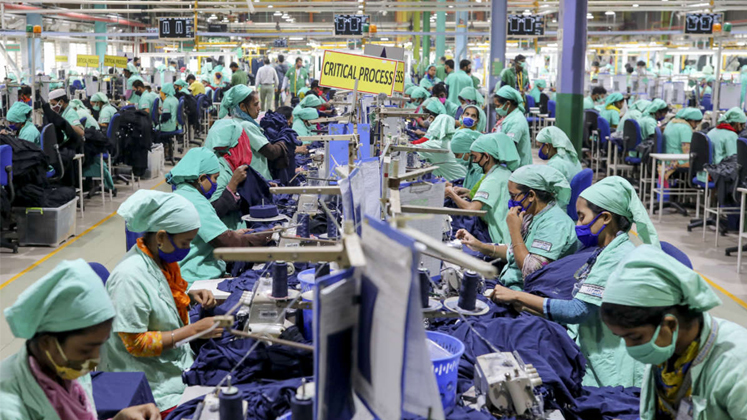
Foreign nationals working in various sectors in Bangladesh, including in the readymade garment industry, has long been a much-debated issue. Even if there is reportedly no specific data on the number of foreign workers in Bangladesh, people in know of things maintain, the number will be in several lakhs.
As per media reports, according to the country’s Home Ministry, the number of foreigners working in Bangladesh is around 86,000 even as according to Transparency International Bangladesh (TIB), the figure is at least 2.5 lakh, of which, only 90,000 are legal workers while Bangladesh’s National Board of Revenue (NBR) in 2020 disclosed that more than 14,000 foreign nationals have submitted income tax returns, meaning that all of them have work permits even if the National Skill Development Authority, an institute under the office of the Prime Minister, has reportedly revealed at a workshop in 2019 that foreign nationals working in Bangladesh remit about US $ 6 billion every year to their countries even as TIB has reportedly underlined that foreigners working in Bangladesh are illegally sending around US $ 3 billion to their countries a year.
Reports have it that foreign nationals in Bangladesh are mainly working in 32 sectors, including garment manufacturing units and buying entities, merchandising companies apart from NGOs, information and communication technology (ICT) sector, education, engineering institutes, consulting firms, multinational companies, private power plants, international contractors, hotel-restaurants, mobile phone companies, oil and gas companies among others and are usually involved in mid-level management and higher positions.
Meanwhile, according to the Dhaka Chamber of Commerce & Industry, around 2.2 million people enter the job market in Bangladesh every year but a large part of them do not get any job even as according to the Bangladesh Institute of Development Studies (BIDS) study, the educated unemployment rate in the country was 33.32 per cent in 2019, with Coronavirus pandemic worsening the situation further since last year.
Given the existing scenario, a lot of questions are being raised as to the presence of expatriates, the number of whom according to some estimates is quite substantial, with many alleging that such nationals are reducing the employment opportunities of the locals even as allegations are also abound that many such foreign nationals take home a huge amount of money back home, which they get as emoluments, at times reportedly by circumventing the tax structure of the country.
However, things are now set to change as moves are afoot to reduce foreigners, hire more locals in jobs even as the Bangladesh Investment Development Authority or BIDA has reportedly come up with a set of recommendations like mandating foreign workers hiring ratio at every tier of job, particularly in mid-level management, in different sectors to offer more job opportunities to the country’s own pool of skilled workforce even as according to the existing guidelines, for every foreign worker hired, a business entity must employ five locals, reports claimed while according to people concerned, there is a lack of coordination between the organisations responsible for overseeing the employment of foreign nationals in Bangladesh and they say there is no specific policy in this regard.
Also Read: The non-traditional market angle to export revival!
It may be mentioned here that in 2016, the NBR reportedly formed a taskforce to gather detailed information on the number of foreign nationals, their income, income tax and their employers; but that initiative has now reportedly been stalled due to a lack of coordination, as per media reports.
As to the existing guidelines that for every foreign worker hired, a business entity must employ five locals, multinational companies are reportedly capitalising on lack of instructions on conforming to the ratio at every level, and mainly recruiting foreign nationals for mid-level management jobs, leaving many local deserving candidates without jobs even though they reportedly now maintain the ratio in hiring is only at low-level jobs, claimed reports while adding that when it comes to employing workers in the manufacturing sector, an ongoing industrial project needs to have 10 local workers for every foreign worker hired even as the permissible cap goes down to 20:1 when the new facility goes into production.
Now to streamline everything, BIDA has initiated a move and in its draft proposal — the draft proposal was supposed to be sent to the Prime Minister’s Office shortly — suggested that the Government amend the existing guidelines for foreign worker recruitment with a view to making it mandatory for all employers that they abide by the hiring ratio at all job level.
Meanwhile, speaking to the media, BIDA Director Ariful Haque said, “We prepared the proposal to increase job opportunities for Bangladeshi workers at the top level of different companies,” even if the authority has already sent letters to ministries and divisions concerned, and business associations, seeking their opinions on the draft proposal.
Besides, the investment authority recommends changing the procedure of permitting the setting up of branches, liaison or representative offices, and project offices of foreign companies even as the procedure for granting work permits to foreign nationals will be amended, according to the proposal.
Further, to stop the practice of showing low amount of salary than the actual figure received by the foreign nationals working in industries and businesses in the country, officials concerned said the amended guideline would set a minimum limit of salary for foreign nationals holding a top position like that of Managing Director, for the the lowest position and for operator post in a company even as neither a foreign national nor his or her employer would be able to show the salary less than the limit set by the guideline.
The guideline titled – permission to set up branch, liaison, representative office and project office of foreign company in Bangladesh and work permit for foreign nationals proposed a new pay structure even as according to the BIDA, the draft guideline had also been sent to various stakeholders including Bangladesh Garment Manufacturers and Exporters Association (BGMEA) and Federation of Bangladesh Chambers of Commerce and Industries (FBCCI), for their opinion.
According to the reports, the guideline classifies the foreign nationals in three categories. Citizens from South Asian countries fall in the first category, citizens from Malaysia, China, Thailand, Hong Kong, South Korea, South Africa and other countries with similar economy in the second category and citizens from United States, United Kingdom, Japan, Australia, Singapore, United Arab Emirates (UAE), Saudi Arabia, Qatar and European Union countries will fall in the third category.
A citizen from South Asian countries holding a position of Managing Director at a factory or business firm in Bangladesh would reportedly be paid a minimum salary of US $ 2,500 a month while a citizen from the second and the third category countries would reportedly receive a minimum salary of US $ 2,800 and US $ 3,000 a month respectively while for the position of Chief Executive Officer (CEO) or Country Manager, citizens from a South Asian country would receive a minimum salary of US $ 2,300, citizens from the second category will reportedly receive US $ 2,400 and citizens from the third category US $ 2,500 a month even as the guideline also proposed a minimum wage limit against each post.
The minimum wage would be US $ 1,400 a month for a citizen, from a South Asian country, holding the position of a worker, technician, supervisor, operator or any similar position while a citizen from the second and the third category countries would receive a minimum salary of US $ 1,500 and US $ 1,600 a month respectively.
Currently, foreign nationals working in Bangladesh are reportedly obliged to disclose their remuneration under a 2011 guideline, but allegations are there that many do not show their actual salary even if the salary against all posts has increased in the last ten years. The old guideline is now being amended so that the foreigners show their actual salary.
Meanwhile, according to BIDA officials, information on foreign nationals’ salary and other allowances will have to be mentioned specifically in the work permit application, even as they added a minimum pay has been proposed in accordance with the state of the economy, per capita income and citizens of various countries to avoid confusion on salary and allowance, and all must follow it.
Now, even if the move made by BIDA is undoubtedly a very good one in terms of bringing in transparency and minimising dependence on foreign nationals, what do the stakeholders think of it?
“Bangladeshi manpower is now sufficiently qualified to cater to the demand of the apparel sector and buying houses. There is no need to recruit foreign nationals in these sectors anymore,” reportedly stated President of the Bangladesh Garment Buying House Association (BGBA) Kazi Iftequer Hossain while speaking to the media, adding, “Foreign nationals only can be recruited in job levels where there are shortages of manpower with technical knowledge.”
As per the BGBA President, there are reportedly over 1,000 foreign nationals currently working in 300 out of 1,800 buying houses under his organisation, underlined media reports.
Speaking to the media, President of the Foreign Investors Chamber of Commerce and Industry Rupali Haque Chowdhury, reportedly said, “Imposing more restrictions on the recruitment of foreign nationals would send the wrong message to foreign investors and increase the burden on compliant companies. If there are any irregularities, actions should be taken according to the law,” while adding, “We lack skilled and qualified manpower in many fields. If foreign experts do not come, the sectors will not develop. We should see what other countries are doing,” even as Executive Director of Policy Research Institute, Ahsan H Mansur, on his part reportedly underlined, “We have to bring in foreigners if we do not have expert manpower. But it will not be wise to impose more restrictions on foreign workers.”
Meanwhile, also interacting with the media, Managing Director of Sparrow Group (one of the largest readymade garment exporters in the country) Shovon Islam reportedly maintained that workers here are still lagging behind in tasks such as merchandising, marketing, price negotiation, different technical works and product design and, that is why foreigners have to be recruited even if local people are gradually becoming more efficient.
Going by the views and opinions as expressed by the experts and industry insiders, one gets a feeling that the BIDA move is a very good one even as a fine balance needs to be maintained still between foreigners and locals to ensure an all-round development while also ensuring skilled local manpower is not deprived of job opportunities.