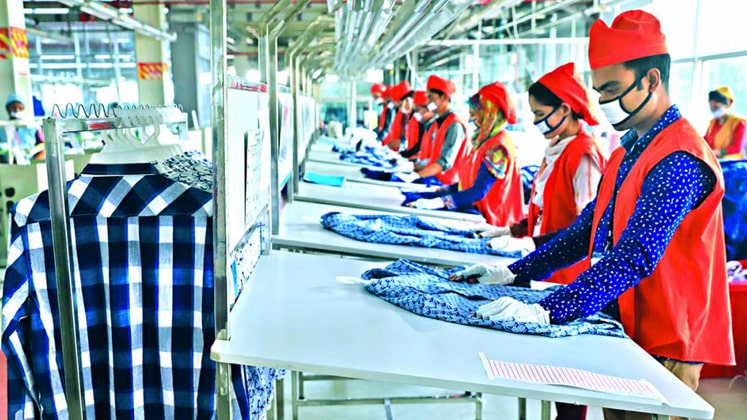
Canada is one of the traditional markets for Bangladesh where the trade balance is heavily tilted towards the latter with products worth CAN $ 726 million going to Canada in 2019, as per the Canada Bangladesh Chamber of Commerce and Industry in Bangladesh (CanCham).
As per CanCham, Bangladesh’s exports to Canada grew 14.53 per cent year-on-year to CAN $ 1.97 billion in 2019, riding on the trade privilege extended by the North American nation. Further, in 2018, Bangladesh’s shipments to Canada were worth CAN $ 1.72 billion, where more than 92 per cent were apparel items. It was CAN $ 1.65 billion in 2017.
“We had expected exports from Bangladesh would grow further this year, but the growth has been affected because of the coronavirus pandemic,” underlined CanCham President Masud Rahman recently.
Rahman’s observations find its reflection in Canada’s overall apparel imports, which declined by 46.63 per cent in April this year as confirmed by the official custom statistics of Canada.The country imported US $ 715.15 million worth of apparels in April ’20 as compared to that of US $ 381.70 million in April last year.
Of all the exporting destinations, China remained the most affected country with over 54 per cent fall in its apparel exports shrunk to below US $ 100 million. The Chinese apparel shipment to Canada valued at just US $ 97.38 million in April this year as against US $ 212.13 million worth of shipment in the same month of 2019.
Bangladesh, the second largest exporting country to Canada, saw a drop of 33.17 per cent to clock just US $ 68.92 million from apparel exports to Canada in April this year, while the export value in the corresponding month of the prior year was US $ 103.12 million. This time even major ASEAN countries such as Cambodia, Vietnam and Indonesia too dwindled in their respective exports to Canada.
Cambodia, which is the largest apparel supplier to Canada from ASEAN region, fell by 23.92 per cent on Y-o-Y basis in April 2020 to ship US $ 59.11 million worth of garments to the North American nation. On the other hand, Vietnam also couldn’t see growth in Canadian apparel market and plunged by 26.32 per cent to ship US $ 54.42 million apparels to Canada.
The export value in April 2019 stood at US $ 73.86 million.
Notwithstanding the downturn, many garment exporters in Bangladesh are very hopeful of Canada as an apparel export destination and feel that Bangladesh has a lot of opportunities to grab in the more than US $ 25 billion worth of the Canadian retail apparel market.
As per the Managing Director of Dragon Sweaters, Mostafa Sobhan Rubel, of his total export volume of US $ 36 million, 15 per cent is shipped to Canada, 45 per cent to the US and the rest to European markets. “Canadian buyers did not cancel any work orders because of the pandemic and they paid me even during the crisis,” said the MD of Dragon Sweaters, whose company mainly exports sweaters to the country.
Mostafa also expressed hope that the Canadian markets will rebound earlier than other North American countries because it has been able to control the pandemic successfully.
“Retailers have started reopening outlets and so exports to Canada will start to grow now,” he claimed, adding that Canada can be a major export destination, as both demand and prices are higher in the country as compared to the other countries.
SM Khaled, Managing Director of Snowtex Group, highlighted, “The share of Canadian work orders in my factory is increasing every year. I am getting a lot of work orders from Canadian buyers this year as well.”
Snowtex Group exports apparel items worth more than US $ 200 million, of which US $ 13 million goes to Canada, mostly comprising outerwear like jackets, workwear and rainwear.
“I hope exports from Bangladesh to Canada will start growing soon as the world has started to reopen. Bilateral trade will definitely grow between the two countries,” claimed the CanCham President, adding the demand for Bangladeshi garment items is very high in Canada because of the competitive prices and the North American country can be a major export destination for local garment items even during the pandemic.
The hopes pinned on Canada as an apparel export destination that can reap rich dividends in coming days do not seem misplaced considering that the Canadian economy has already started showing green shoots with reports of consumer spending and new job postings trending upwards after the coronavirus pandemic forced shutdowns and caused a record plunge in economic activity.
Even the Canadian dollar boosted to a 3-month high against its US counterpart recently,while Canada’s main stock index has rebounded nearly 40 per cent from its March low as investors bet on economic recovery. Canada’s 13 provinces and territories have also been gradually reopening their economies in recent weeks and even housing sales in Toronto, Canada’s biggest city, jumped by 55 per cent in May from April.
As per reports, there have been huge line-ups outside stores like TJX-owned Winners and Inditex-owned Zara, which recently reopened in Canada’s most populous province of Ontario and spending on home and lifestyle products has boomed, as per Karl Littler, Senior VP, Public Affairs, Retail Council of Canada.
Things are also showing marked improvement in the employment front as well with the country’s labour market showing early signs of recovering as lockdowns begin to lift in an economy awash in money from Government support programmes. Canada’s labour market saw a partial rebound from the impact of coronavirus in May, as employment rose by 290,000, the latest Canada job figures show. The number of people working less than half their usual hours also dropped by 292,000, meaning Canada recovered 10.6 per cent of the losses witnessed in March and April, according to the Statistics Canada Labour Force Survey.
A Bloomberg News poll taken at the end of May found that 30 per cent of respondents who had lost their jobs or seen hours decline because of the coronavirus pandemic said they were re-employed or working more. The survey, conducted by Nanos Research, is consistent with other high-frequency data from Indeed Canada and Google that suggest stabilisation in labour conditions and economic activity over the past few weeks.
Any recovery would be a reassuring development for a country that’s experienced a historic employment crash, with more than one quarter of workers either losing their jobs or recording a substantial reduction in hours worked. “Research suggests that the initial shock of job loss and fewer working hours is wearing off as some Canadians’ job prospects start to brighten,” maintained chief data scientist at Nanos Research, Nik Nanos, who is also the founder of Nanos Research, formerly known SES Research.
The Nanos poll, which was taken between 26 and 28 May, found that 25 per cent of respondents had lost jobs or saw hours reduced at one point since the start of the pandemic. Of those, about three in ten have since been rehired or are working more hours. In the survey, 41 per cent said their employment or hours weren’t affected at all by coronavirus. About one third said they were retired or not in the labour force before the crisis hit.
Also, job postings on various sites have reportedly started to increase lately.
Mobility data from Apple and Google smartphones during the latter half of May also reportedly suggest that more people were present in retail stores which coincided with reopenings across Canada.
This, along with brands and retailers opening their stores across all provinces in the North American nation, is expected to give a boost to sales and increased consumer spending on apparels.
In view of the above developments, Bangladesh garment exporters pinning their hopes on Canada to boost the country’s fledgling apparel production and export in the backdrop of global outbreak of COVID-19 seems to be not without reasons.