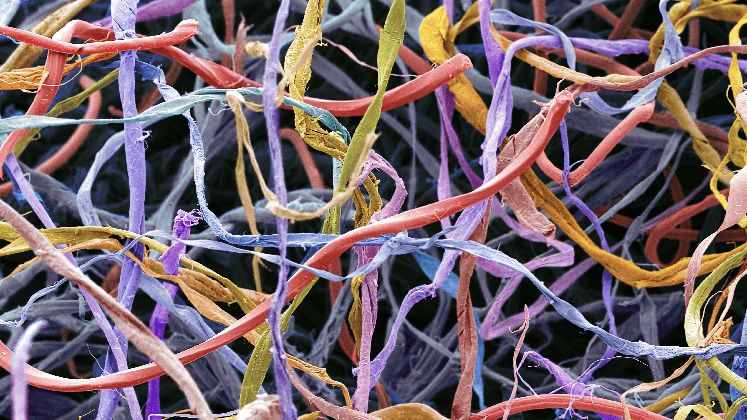
Xeros Technology – a UK-based washing technology group – has partnered with the University of Surrey to jointly fund pioneering research to upcycle the microfibres captured from laundering clothes into a useful and valuable carbon material.
The project has begun in January 2023 with research conducted over a 12-month period.
According to the company, microfibres are defined as tiny ‘threads’, smaller than 5 mm, that break off from textiles through the everyday acts of wearing and laundering garments and textiles.
Estimates suggest every year more than half-a-million tonnes of microfibres are released into the world’s oceans simply from garment washing. Research shows that microfibres from synthetic textiles (known as microplastics) are one of the biggest sources of microplastic pollution in the world’s oceans – they have contaminated the entire planet from the summit of Mount Everest to the depths of the Mariana Trench.
In order to address this significant environmental problem, Xeros Technology developed a washing machine filtration device, XFilter, which captures the microfibres and prevents their release into the world’s oceans.
XFilter is said to be allowing users to place the captured microfibres directly into their bin to be disposed of with other household waste, as we already do with vacuum cleaners and tumble driers that collect similar mixed fibres. Microfibre waste from filtration is a complex material to recycle within the existing recycling infrastructure: not only are the microfibres often mixed materials, but they also contain captured dirt and soil.
Teaming up with the University of Surrey will help Xeros to accelerate research into improved methods to permanently reduce this continued pollution build-up in the future.
Led by Melis Duyar, the team from the University of Surrey and North Carolina State University have developed a new method specifically designed to upcycle textile micro/nano fibres shed during the washing and drying of clothes. The method produces clean hydrogen and solid carbon nanomaterials as a by-product.
Duyar, Senior Lecturer at the School of Chemistry and Chemical Engineering at University of Surrey, commented, “At the University of Surrey, we are developing solutions to upcycle microplastics without releasing the fossil carbon contained within them into the atmosphere in the form of greenhouse gas emissions. Plastics are one of the problems associated with our dependency on fossil fuels, so any solution we develop to address plastics pollution must also fit within our strategy for reaching a net zero emission economy. This partnership with Xeros will allow us to bring our technology closer to commercialisation, by developing methods for upcycling real microfibre waste collected from commercially available filters. We are excited to see our patent pending processes in action as applied to mixed fibre feedstocks, which is a big step towards developing a viable, real-world solution.”
The carbon nanomaterials developed using this upcycling method are claimed to be used in various essential products including batteries, solar cells and medical devices.
Dr Paul Servin, Application Development Director of Xeros, mentioned, “There is nothing better than to convert, what is today considered to be waste and a problem in the world, into a highly valuable product which is what we, together with the excellent researchers at University in Surrey, will accomplish. I’m extremely excited about this project which can hopefully lead the way to future separated collection of microfibres from washing machines, tumble dryers and vacuum cleaners for the purpose of upcycling to a higher valued product.”